If your website needs to appear inside ChatGPT answers, the first technical requirement is not keyword density. It is crawler-facing delivery. ChatGPT and related retrieval systems can only cite what they can fetch, parse, and trust at request time. That makes SEO for ChatGPT a technical rendering problem as much as a content problem. Updated for April 2026, this guide reflects the current behavior of OpenAI's documented bots, including GPTBot, ChatGPT-User, and OAI-SearchBot.
Modern websites often rely on JavaScript hydration, delayed API calls, and client-side rendering patterns that work well for humans but fail for constrained bots. When an answer-engine crawler reaches a route and receives a thin HTML shell instead of complete semantic output, the result is simple: the page is harder to extract, harder to cite, and less likely to appear in generated responses. Pairing deterministic HTML with valid structured data and clear Article markup makes the document easier for ChatGPT retrieval to interpret on the first response.
For teams working on technical SEO, AI visibility, and prerendering, that means the real opportunity is architectural. You need deterministic HTML, stable metadata, structured data for AI visibility, and route-level delivery that gives OAI-SearchBot and similar systems a complete document on the first response. On JavaScript-heavy stacks, this usually overlaps directly with the core problems solved by JavaScript SEO.

This article explains what SEO for ChatGPT actually means, how ChatGPT crawlers interact with modern web applications, why client-side rendering still creates visibility loss, and how prerendering infrastructure can improve crawler-facing reliability without forcing a full frontend rewrite.
What SEO for ChatGPT Actually Means
SEO for ChatGPT is the technical and content practice of making your website easier for ChatGPT-related retrieval systems to fetch, interpret, and cite. Unlike traditional search optimization, the goal is not only to rank a URL in a visible result page. The goal is to make the page usable as source material inside a generated answer.
How generated answers shift the success model
That distinction matters because generated answers behave differently from classic search interfaces. In traditional search, success is often measured through rankings, clicks, and visits. In answer engines, the system may extract a fact, summarize a page, or cite a domain without sending the user to the site at all. The visibility model becomes more about inclusion and trust than about raw click-through volume.
For technical teams, SEO for ChatGPT usually comes down to a few core questions:
- Can the crawler fetch a complete version of the page without waiting for heavy client-side execution?
- Does the initial response expose meaningful headings, structured content, schema, and entity relationships?
- Is the information current enough to be cited?
- Are high-value pages stable enough to be used as trusted source material?
This is why SEO for ChatGPT should be treated as an extension of technical SEO, not as a separate content-only tactic. The same systems that affect crawlability, rendering, schema output, and metadata consistency also shape how answer engines experience your site. In practice, the work usually starts with a scoped technical SEO audit to identify which routes are weak for machine-facing retrieval.
How ChatGPT Crawls and Evaluates Websites
ChatGPT retrieval systems use dedicated user agents such as OAI-SearchBot and ChatGPT-User to request live pages when the answer pipeline needs fresh web context. These bots do not behave exactly like a full browser session. They are optimized for speed, extraction, and lightweight processing.
How OAI-SearchBot handles hydration-dependent routes
That creates an important constraint for modern websites. If the route depends on hydration before exposing the real content, or if the document only becomes meaningful after a chain of client-side requests, the crawler may never see the final state. The bot often evaluates the initial response, extracts whatever semantic information is already available, and moves on quickly.
In practical terms, this means the first response matters far more than many teams assume. The bot does not care that the page eventually looks perfect for a signed-in user with a warm browser cache. It cares whether the critical content exists in a stable, parseable state when the request happens.
That is one reason SEO for ChatGPT has become tightly connected to rendering architecture. The question is no longer just "does the page rank?" It is also "what does the answer engine actually receive?" A simple way to verify that difference is to compare raw bot-facing output with a view as bot vs prerender tool.
Why Client-Side Rendering Still Causes Visibility Loss
Client-side rendering still breaks crawler-facing reliability because it asks the bot to wait for the application to become meaningful after the first response. In many cases, answer-engine crawlers simply do not wait long enough or do not execute the application deeply enough to reconstruct the final page.
This is especially common on:
- single-page applications
- JavaScript-heavy marketing sites
- hybrid routes with inconsistent rendering paths
- large template systems with delayed data fetches
- content platforms where key blocks depend on client-side population
The familiar empty-shell failure pattern
The result is a familiar failure pattern: a human sees a complete experience, but the bot receives an empty shell, incomplete metadata, missing structured data, or partial page content. If the answer engine cannot see the content, it cannot use it. If it cannot use it, the page is less likely to support brand inclusion inside generated results.
That is why technical SEO for ChatGPT often starts with one simple validation step: inspect the crawler-facing HTML, not just the rendered browser view.
Why Prerendering Is Often the Most Practical Fix
Prerendering solves a narrow but important problem. Instead of requiring every crawler to execute the frontend logic on its own, the prerendering layer compiles the route in advance for machine traffic and returns fully serialized HTML.
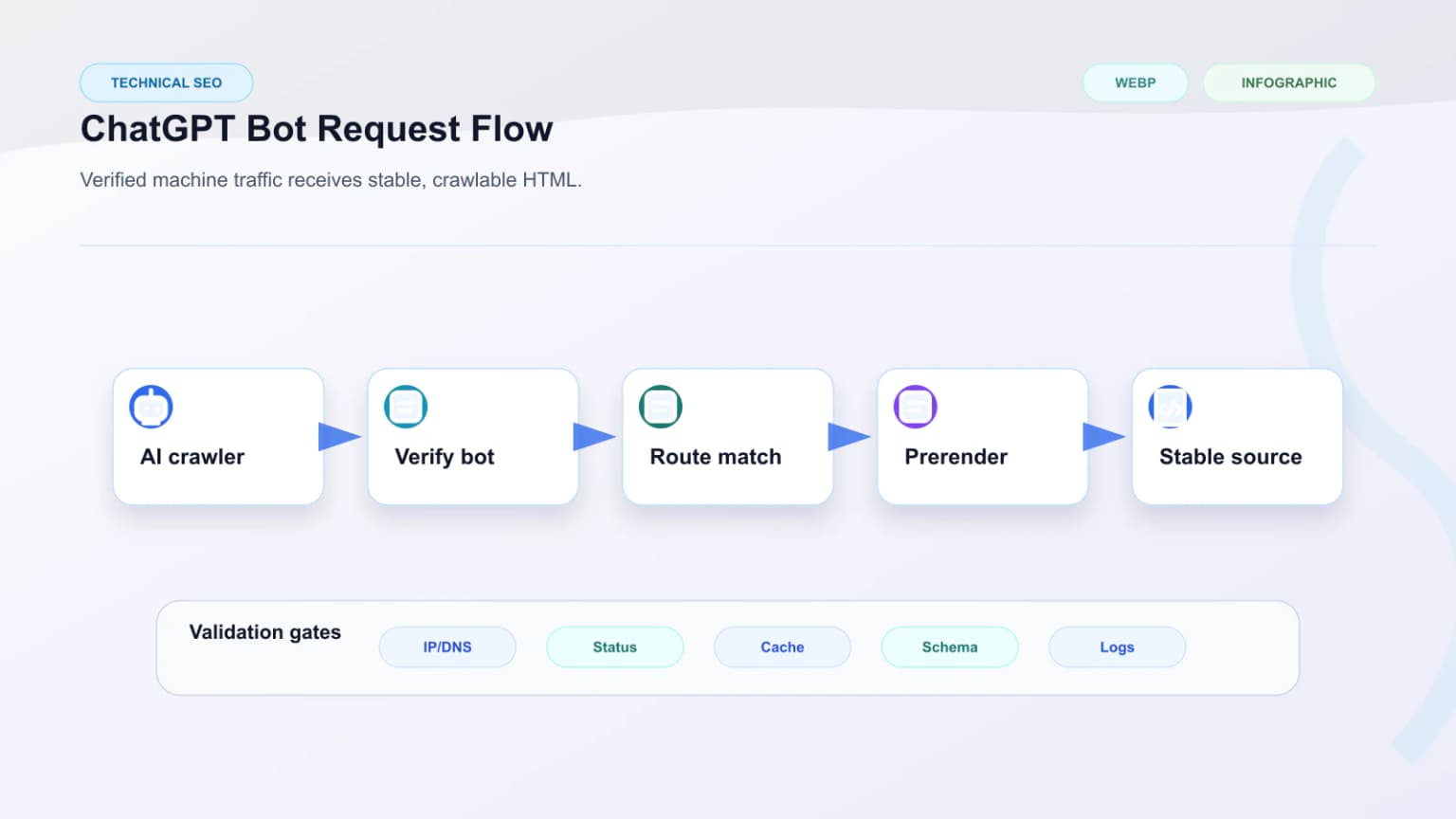
At a high level, the path works like this:
- A verified AI crawler requests the page.
- The proxy detects that the request should use machine-friendly delivery.
- The route is rendered inside an isolated prerendering environment.
- The system returns complete HTML, metadata, and schema to the crawler.
- The human-facing application remains unchanged.
Why teams choose prerendering over a full replatform
This makes prerendering especially attractive for teams that do not want to replatform the entire frontend stack just to improve crawler-facing output. Instead of rewriting everything around a new rendering model, they can stabilize the routes that matter most for search visibility and AI extraction.
For SEO for ChatGPT, prerendering improves:
- first-response completeness
- extractable headings and body content
- schema visibility
- metadata consistency
- machine-readable route stability
It also reduces the risk that high-value pages disappear from generative visibility simply because the crawler encountered a blank shell or incomplete render state. For many teams, this becomes the bridge between weak crawler output and a stable prerendering rollout.
How Ostr.io Fits Into a ChatGPT SEO Workflow
Ostr.io is relevant because it supports proxy-level prerendering for complex JavaScript applications. Instead of asking the origin to serve raw frontend bundles to bots and hoping the answer engine reconstructs the page correctly, it provides a deterministic machine-facing delivery layer.
That matters for teams trying to make ChatGPT-visible routes more reliable without sacrificing product velocity. A prerendering middleware can:
- detect recognized bot traffic
- route that traffic through a rendering cluster
- generate a stable HTML snapshot
- return the result quickly to the crawler
- shield the origin from unnecessary rendering load
Protecting the origin under crawler surges
This is important both for visibility and for infrastructure hygiene. If an answer-engine crawler surge hits a route that requires expensive runtime work, the origin can become unstable. When prerendering absorbs that workload, the system is better able to serve complete documents to machines without degrading the main application.
For technical teams, the key lesson is that ChatGPT SEO is not just about being crawlable. It is about serving a predictable, stable, machine-readable document under real crawler conditions.
ChatGPT SEO Strategy: What Technical Teams Should Prioritize
A useful chat gpt seo strategy should focus on extraction reliability first, then on content quality and semantic structure. That order matters because beautifully written content still underperforms if the crawler never receives it in a usable format.
The strongest priorities are usually:
- deterministic HTML for high-value routes
- stable heading hierarchy
- explicit schema markup
- consistent canonicals and metadata
- machine-readable content blocks such as lists and tables
- route validation under bot-like conditions
Which routes deserve the cleanest delivery path
That does not mean every page needs the same treatment. Teams should identify the URLs most likely to shape brand visibility in answer engines: service pages, product pages, category pages, comparison pages, FAQs, and authoritative editorial content. Those routes usually deserve the cleanest machine-facing delivery path.
How to structure content for retrieval, not just narrative
It is also useful to shift the way content is structured. Answer engines often work better with dense factual formatting than with vague narrative-heavy marketing copy. Clear sections, direct definitions, well-formed tables, scoped lists, and explicit entity relationships make the page easier to interpret.
Structuring Content for Algorithmic Comprehension
Structured data remains highly relevant for SEO for ChatGPT because it gives retrieval systems a clearer model of what the page is about. JSON-LD does not guarantee inclusion, but it strengthens the machine-readable layer that answer engines depend on.
The most useful schema patterns often include:
WebPageArticleorBlogPostingFAQPageBreadcrumbListOrganizationService
These entities help clarify the page purpose, connect related objects, and make the content easier to interpret as source material. Combined with prerendered HTML, they create a stronger extraction environment than a client-side page with loose semantics and missing entity definitions.
The same principle applies to content layout. Machines benefit from explicit information boundaries. That means headings that match the actual topic, tables that compare concepts clearly, and FAQ blocks that express common questions in exact language.
Traditional SEO Software vs ChatGPT-Facing Visibility Tools
Classic SEO platforms still matter, but they do not fully explain answer-engine visibility. Technical teams increasingly need a second layer of monitoring that focuses on ChatGPT, generative citation, and AI extraction behavior.
| Capability | Traditional SEO software | ChatGPT-facing visibility workflow |
|---|---|---|
| Primary success signal | Rankings, clicks, impressions | Inclusion, citation, semantic relevance |
| Rendering assumption | Search engines may eventually render the page | The initial machine-facing response must be useful immediately |
| Core data source | SERPs and indexed URLs | LLM prompts, answer output, and crawl diagnostics |
| Technical risk | Indexation and canonical issues | Thin HTML, unstable rendering, missing schema, stale cached output |
This comparison is why many teams now combine classic technical SEO tooling with AI visibility monitoring and prerendering diagnostics. One layer tells you how the page performs in search. The other tells you whether the page is actually usable inside generated answers.
Limitations of ChatGPT SEO Optimization
Teams should also understand the limits of optimizing for ChatGPT. Not every answer will cite sources the same way. Different prompt phrasing can produce different outputs. Some responses rely more on retrieved web content than others. Visibility is directional, not perfectly deterministic.
There are also real operational risks:
- stale prerendered snapshots after important content changes
- weak cache invalidation across distributed delivery layers
- dynamic pages that depend on geolocation or authenticated state
- personalized routes that should never be prerendered for bots
- monitoring gaps between server logs and answer-engine observations
Why ChatGPT SEO is infrastructure, not a copy change
These issues do not make ChatGPT SEO impossible. They simply mean the optimization needs to be handled as infrastructure, not as a one-time copy change. The technical delivery layer has to stay synchronized with the live business data if the page is going to remain trustworthy enough to cite.
Integrating Visibility Monitoring With Server Delivery
One of the best practices for enterprise teams is connecting ChatGPT visibility monitoring with server logs, rendering diagnostics, and route-level validation. This is what turns AI SEO from a vague reporting exercise into an actionable engineering workflow.
When the monitoring layer is connected to delivery data, teams can investigate:
- whether OAI-SearchBot received a full 200 response
- whether the route returned complete schema
- whether prerendering timed out or served stale content
- whether a deploy changed the machine-facing HTML
- whether a drop in citation frequency maps to a technical regression
This closed loop is valuable because answer-engine visibility often feels abstract until it is tied to the real request path. Once the team can see that a drop in citations followed a rendering failure, cache problem, or proxy misconfiguration, the work becomes operationally clear.
What the Best SEO Software for ChatGPT Compliance Looks Like
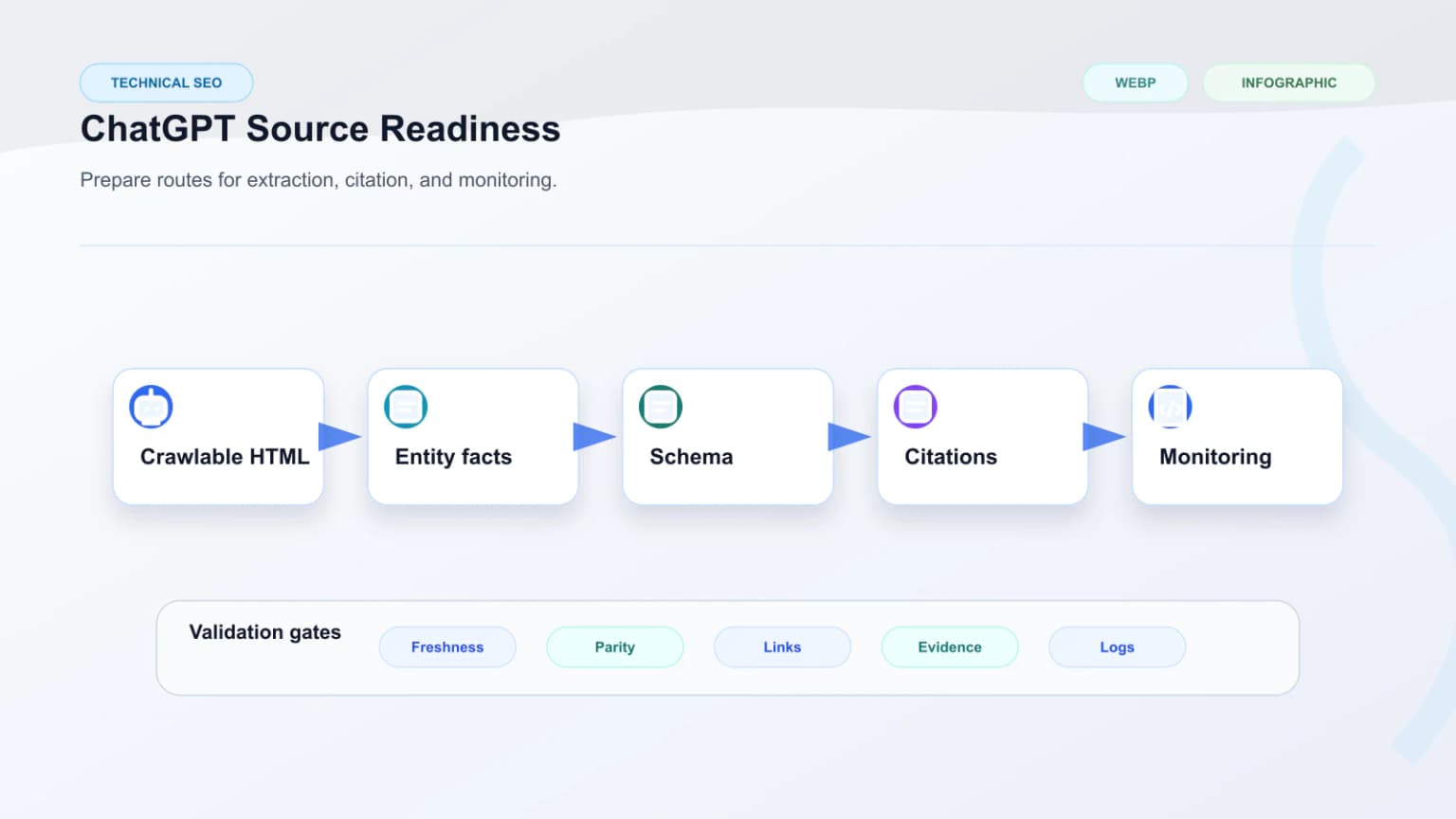
The best SEO software for ChatGPT compliance is usually not one tool. It is a stack:
- prerendering or deterministic rendering infrastructure
- technical SEO validation
- schema and metadata checks
- server log analysis
- AI visibility monitoring or prompt-based testing
In that stack, prerendering is often the foundational layer because it fixes the first-response problem. Without a reliable machine-facing response, all the downstream analytics simply tell you that inclusion is weak. They do not solve the root cause.
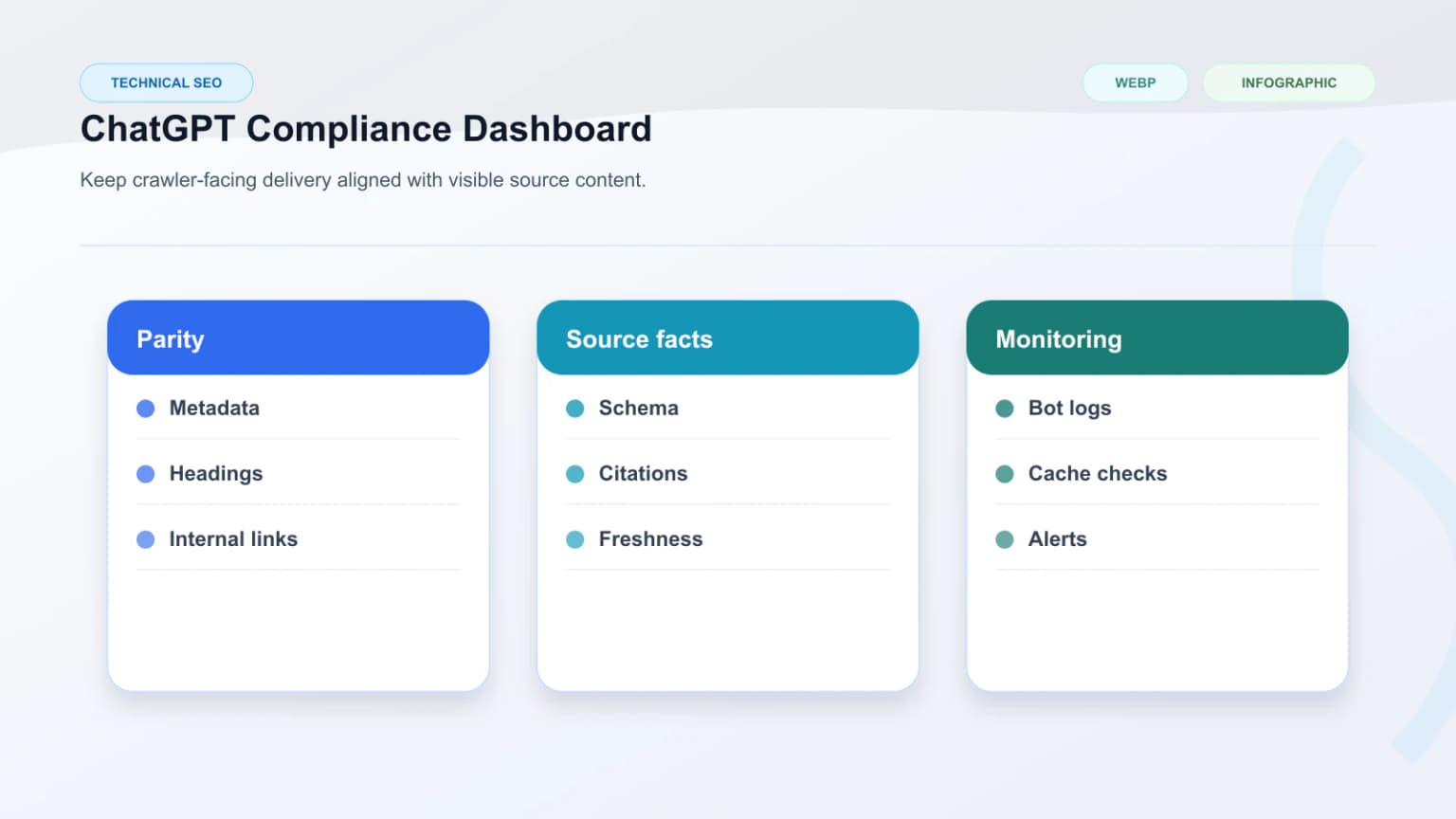
For modern teams, the strategic conclusion is straightforward: if the website depends on JavaScript-heavy delivery, ChatGPT visibility is partly a rendering systems problem. Solve the delivery path, then measure the result.
Conclusion
SEO for ChatGPT is ultimately about making the page usable as source material for answer engines. That means the content has to be accessible, structured, and trustworthy when the crawler arrives. Client-side rendering patterns often weaken that outcome because they delay the point at which the page becomes meaningful to a machine.
Prerendering offers a practical fix by serving deterministic HTML to bot traffic while preserving the human-facing application. Combined with strong schema, stable metadata, and route-level monitoring, it creates the technical conditions that support better inclusion inside ChatGPT and similar systems.
If your team wants stronger visibility in answer engines, start by looking at the machine-facing output. The routes that win are usually the ones that are easiest to fetch, easiest to parse, and easiest to trust. If you want to go deeper into the middleware side, the breakdown of prerendering middleware is a good companion reference.
Content Cocoon
ChatGPT SEO Editorial Cluster
This article should connect ChatGPT-specific retrieval topics back to the parent AI visibility and prerendering services, while also citing a few external references about bots, rendering, and crawler validation.
Internal Pathways
AI Search Visibility Service
The parent service for answer-engine and structured extraction readiness.
Prerendering
A related service when ChatGPT visibility depends on deterministic HTML delivery.
JavaScript SEO
Relevant when ChatGPT retrieval issues are caused by thin initial HTML or hydration-heavy routes.
External Technical References
How AI Agents Crawl Websites
A strong external reference for how retrieval bots behave under real crawling constraints.
HTTP Status Codes for Bots
Useful when debugging whether bots are receiving stable, trustworthy responses.
Prerender Checker
Helpful for validating machine-facing HTML output for ChatGPT-related routes.
Frequently Asked Questions
What is SEO for ChatGPT?+
SEO for ChatGPT is the practice of making your website easier for ChatGPT-related retrieval systems to fetch, parse, and cite through stable HTML, clear structure, and machine-readable output.
Why does ChatGPT struggle with JavaScript-heavy pages?+
Because important content often appears only after hydration or delayed API calls, while answer-engine crawlers usually work under tighter timing and execution constraints than a full browser session.
How does prerendering help ChatGPT visibility?+
Prerendering delivers deterministic HTML to crawlers so they can read headings, body content, metadata, and schema without depending on complex client-side execution.
Can you use ChatGPT for SEO while also optimizing for ChatGPT?+
Yes. Teams can use ChatGPT as a content and workflow assistant, but technical optimization for ChatGPT still depends on crawler-facing architecture, not only on prompt usage.