Teams often talk about AI visibility as if it were mainly a prompt, content, or brand-mention problem. In practice, many AI retrieval failures start much lower in the stack. If answer engines cannot extract a stable understanding of the page, they have less confidence in what the route represents, which facts belong to it, and how that page should be cited. Updated for April 2026, this article reflects current best practices for JSON-LD structured data as both a search-feature signal and a source-extraction layer for AI.
That is why structured data still matters. On modern websites, schema.org vocabulary is not a magic ranking switch, but it is a powerful machine-readable layer that helps answer engines understand entities, relationships, intent, and page purpose. When it is paired with deterministic HTML and a stable delivery path, it becomes much easier for systems like ChatGPT, Perplexity, Copilot, and adjacent retrieval engines to interpret the content correctly. Common building blocks include Article, Organization, and FAQPage types, used consistently across the site graph.
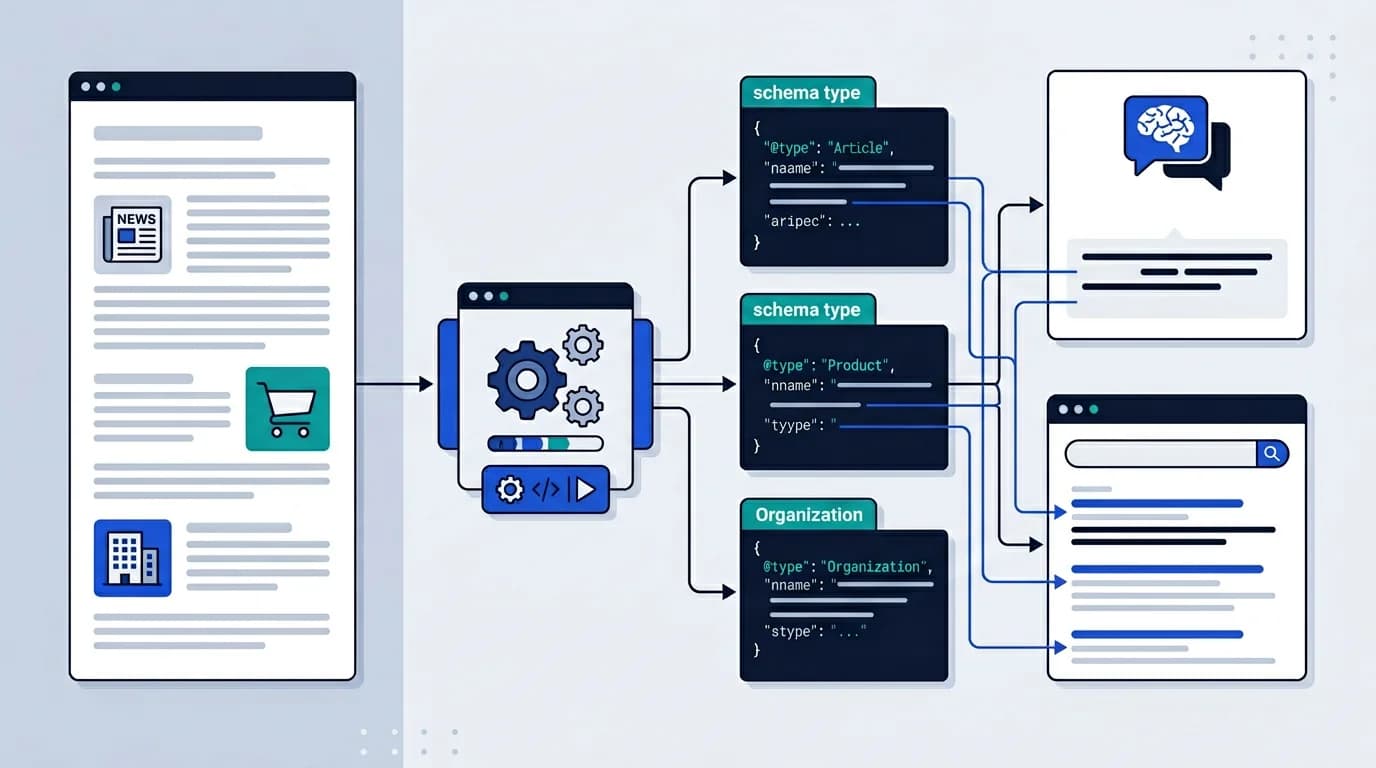
This article focuses on the implementation side of the problem. If you already understand the reporting layer from the guide on AI visibility tools, this is the next step: how to make the page more extractable in the first place.
Why structured data matters for AI visibility
AI systems do not rely on schema alone, but they benefit from clear machine-readable hints. On a complex site, prose can be ambiguous. A page may mention a brand, product, service, category, and question on the same route. Without a clean entity layer, the crawler has to infer too much from surrounding text and partial page structure.
Structured data reduces that ambiguity. It helps define:
- what the main entity of the page is
- how secondary entities relate to the main one
- whether the route is an article, service, product, FAQ, or organization page
- which attributes belong to the entity and which are just nearby copy
- how the page fits into the broader information graph of the site
Why entity clarity matters on JavaScript sites
That matters even more on JavaScript-heavy websites. If the HTML arrives thin and the page depends on hydration, the retrieval system may already be working with a reduced document. In that environment, clean JSON-LD is not the whole solution, but it often becomes one of the strongest explicit signals available in the first response. This is why structured data work usually overlaps with JavaScript SEO, prerendering, and broader AI search visibility audits.
JSON-LD is useful because it separates semantics from presentation
For implementation teams, JSON-LD is usually the best schema format because it is easier to generate, validate, and version than deeply nested microdata. It lets the application expose a clear entity graph without forcing the visible UI markup to carry all of the semantic structure inline.
Keeping semantics stable while UI evolves
That separation is valuable for AI visibility because frontend presentation and machine-readable meaning often evolve at different speeds. A design system may change card components, move copy blocks, or refactor layout wrappers. If the entity graph is modeled deliberately, the semantic layer can stay stable even while the visible interface changes.
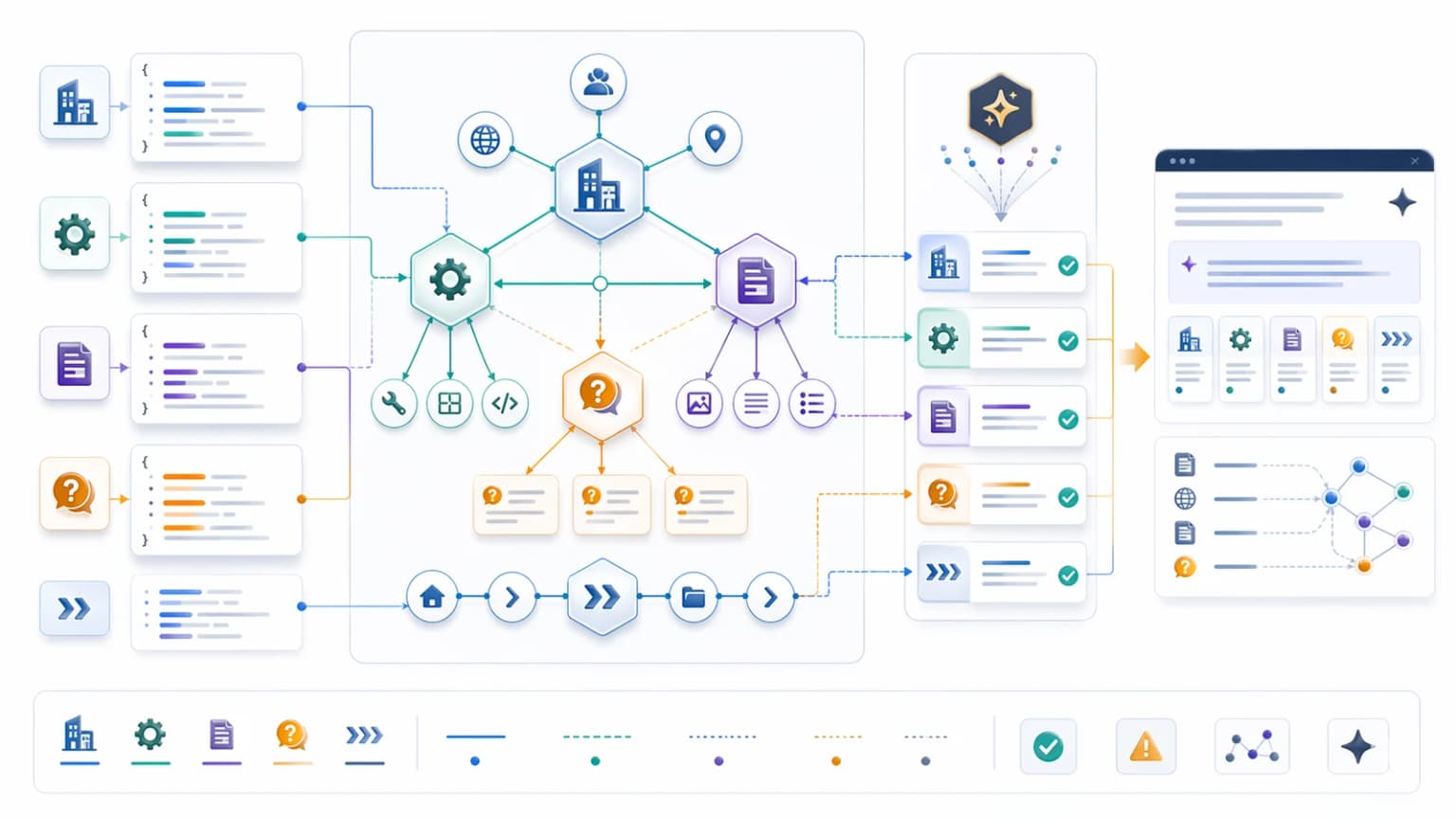
The strongest JSON-LD implementations usually share a few characteristics:
- one clear primary entity per page
- consistent use of
@type,name,description,url, and related identifiers - explicit relationships between article, organization, service, product, FAQ, and breadcrumb entities
- minimal duplication across multiple disconnected schema blocks
- output that is present before hydration or available in prerendered HTML
Common signs of a missing entity model
When teams skip this modeling work, the result is often messy but familiar: multiple competing entities, incomplete graphs, repeated names with weak relationships, and route templates that technically have schema but do not expose a trustworthy machine-readable structure.
Which schema types matter most for answer-engine extraction
The right schema depends on the page template, but most B2B, SaaS, publishing, and marketplace websites benefit from a predictable core stack.
In practice, the most useful schema types usually include:
Organizationfor the site or brand entityWebPagefor the route-level documentArticleorBlogPostingfor editorial contentServicefor commercial solution pagesFAQPagefor routes with real question-and-answer blocksBreadcrumbListfor hierarchy and topic relationshipsProductwhere commercial product details are the core entity
Why schema should reflect page purpose, not maximize types
The implementation rule is simple: the schema should reflect the true purpose of the page, not every possible markup opportunity. Over-marking a route often makes the entity layer noisier, not clearer.
For example, an editorial article about technical implementation might reasonably expose:
BlogPostingas the main content entityOrganizationas the publisherImageObjectfor the hero assetBreadcrumbListfor hierarchyFAQPageonly if the page really contains a usable FAQ section
By contrast, a service landing page may be better modeled around Service, supported by Organization, WebPage, and BreadcrumbList, while skipping Article entirely. This is one of the biggest schema mistakes teams make: using types that look impressive instead of types that describe the route accurately. The full vocabulary catalogue is available on the schema.org type hierarchy and the underlying serialization rules live in the W3C JSON-LD 1.1 specification.
Schema type to AI engine support matrix
Different answer engines weigh schema types differently. The matrix below reflects observed behavior in April 2026 from production monitoring across multiple sites, treat it as directional rather than authoritative, since engine behavior shifts often.
| Schema type | ChatGPT | Perplexity | Claude | Google AI Overviews |
|---|---|---|---|---|
Article | ✓ | ✓ | ✓ | ✓ |
Product | ✓ | ✓ | partial | ✓ |
FAQPage | partial | ✓ | partial | ✓ |
HowTo | partial | ✓ | partial | ✓ |
Organization | ✓ | ✓ | ✓ | ✓ |
The pattern is consistent: Article and Organization are the safest universal carriers, while FAQPage and HowTo work best on engines with explicit answer-extraction surfaces.
AI visibility depends on entity clarity, not just markup presence
A page can technically contain JSON-LD and still be poor for AI extraction. The problem is often not missing markup. It is weak entity design.
Why entity design matters as much as syntax
Answer engines need to understand what is central and what is supporting. If the main page entity is vague, duplicated, or split across multiple components, the system has less confidence in how to interpret the route. That is why entity design matters as much as syntax.
Common weak patterns include:
- one route outputting both
ArticleandServiceas if each were primary - schema blocks generated by unrelated components without a shared model
- inconsistent naming between title, heading, and entity
name - missing
urlor unstable canonical alignment - FAQ schema injected for collapsed UI that bots cannot see in the actual page body
This is where the work connects back to adjacent technical topics. If your canonical logic is unstable, the entity URL may drift across states. If your SSR and hydration outputs diverge, the schema graph can change after first render. Those risks are covered in canonical issues on JavaScript websites and SSR cloaking risks and semantic parity, and they directly affect schema trust as well.
The first response still decides whether schema is usable
Many teams generate valid schema, but they surface it too late. If the JSON-LD appears only after client-side execution, the page is asking the crawler to do extra work before the entity layer becomes visible.
Why crawler execution limits matter for schema timing
That is risky for AI visibility because answer-engine crawlers often operate under stricter execution limits than a normal user browser. If the route initially returns a shell and injects schema only after hydration, the markup may be syntactically correct but operationally weak.
This is why structured data quality cannot be reviewed in isolation. Teams should validate:
- whether schema is present in the raw HTML
- whether prerendered HTML contains the same entity graph
- whether client hydration changes the graph
- whether canonicals, URLs, and metadata align with the schema state
- whether important routes return machine-readable output consistently

When schema projects become rendering projects
If the first response is incomplete, the page may still underperform for AI retrieval even with otherwise reasonable schema design. That is one reason many answer-engine optimization projects end up becoming rendering projects. The schema exists, but the delivery path is not stable enough.
Prerendering helps structured data become consistently extractable
Prerendering does not improve AI visibility by sprinkling magic metadata over the page. It improves visibility because it changes what machines actually receive. If a verified crawler is routed to a prerendered snapshot, the entity graph, headings, links, and route-level metadata can all be delivered together in the first response.
That matters when the original app depends on:
- client-side data fetching
- delayed route hydration
- metadata assembled in browser logic
- schema blocks emitted by late-mounting components
- framework behavior that differs across rendering paths
In these situations, prerendering creates a cleaner machine-facing contract. The bot receives one stable document instead of reconstructing the page from scattered runtime behavior. This is the same reason prerendering supports SEO for ChatGPT, SEO for Grok, and SEO for Perplexity. The AI system needs extractable structure before it can reason over the content.
A practical schema stack for AI-ready templates
The most effective implementation patterns are usually template-driven. Instead of hand-authoring different schema blocks on every page, teams define a repeatable stack for each major route type.
| Template type | Primary schema | Supporting schema | Common failure mode |
|---|---|---|---|
| Blog article | BlogPosting | Organization, BreadcrumbList, FAQPage | FAQ or author data injected too late |
| Service page | Service | Organization, WebPage, BreadcrumbList | Generic WebPage only, with no service entity |
| Product page | Product | Offer, Organization, BreadcrumbList | Variant state causes unstable values |
| Category page | CollectionPage or WebPage | BreadcrumbList, ItemList where appropriate | Thin page with no meaningful entity scope |
| FAQ-heavy landing page | WebPage or Service | FAQPage, Organization, BreadcrumbList | FAQ schema marked up without visible answers |
The goal is not maximal schema volume. The goal is a controlled and believable entity model that stays aligned with the route intent and survives every rendering path.
How to validate structured data for AI visibility
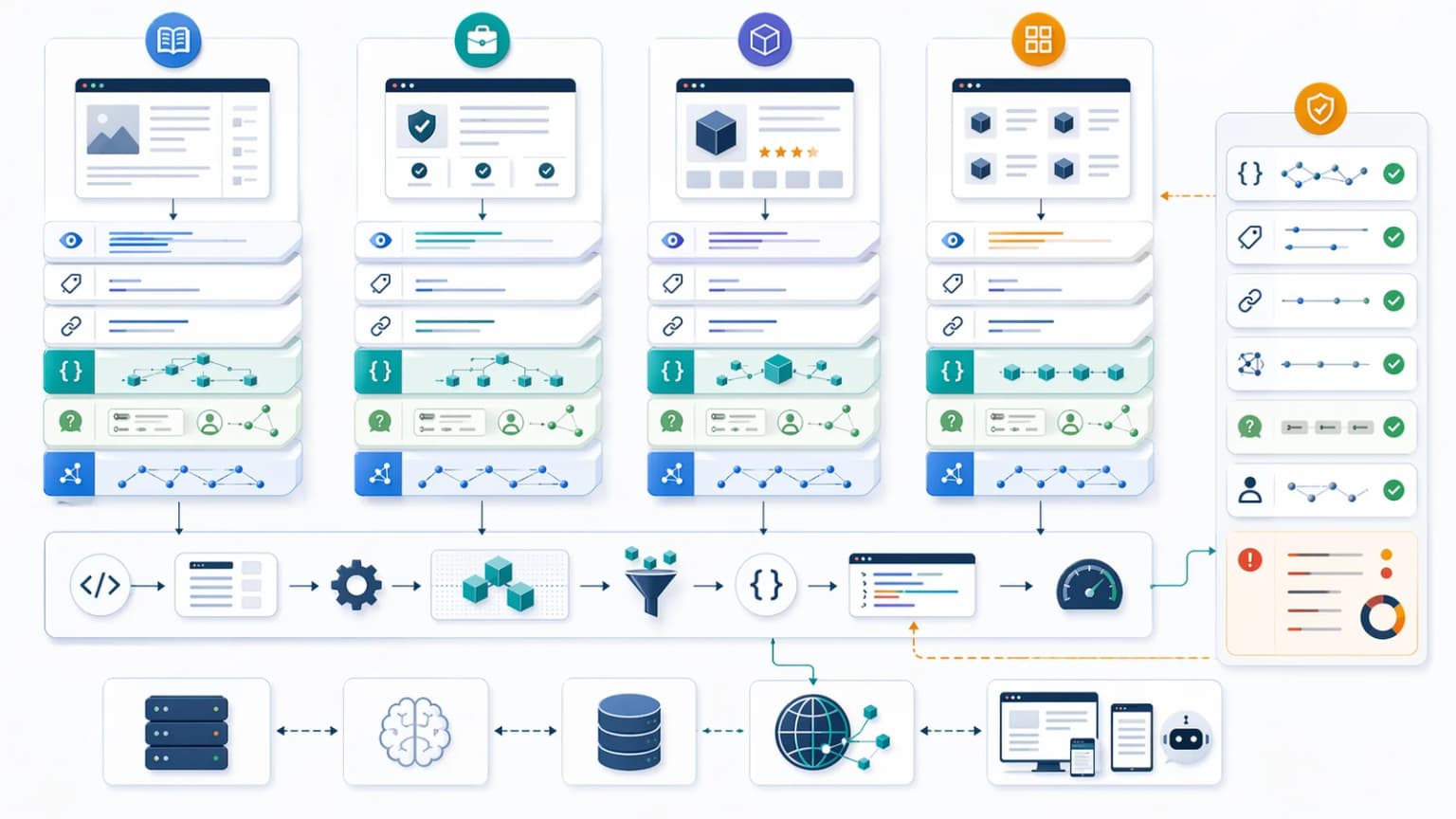
Validation should happen at the route level, not just in a code review diff. A template may look fine in source code and still fail because of hydration timing, conditional rendering, stale prerender snapshots, or route-specific data gaps.
The safest review workflow is usually:
- Inspect the raw HTML response for the live route.
- Compare that output with the prerendered version using a view as bot vs prerender tool.
- Validate the entity graph with a JSON-LD validator.
- Confirm that the canonical URL and schema
urlvalues match. - Check whether deployment, caching, or hydration changes the graph after initial render.
A reproducible CLI check is useful for CI pipelines and incident response. The example below fetches a route through Google's Rich Results Test URL surface so the response is identical to the manual test:
curl -s "https://search.google.com/test/rich-results?url=https%3A%2F%2Fexample.com%2Farticle" \
  -H "User-Agent: Mozilla/5.0 (compatible; SchemaCI/1.0)"
For cross-validation, the same route can also be hit against the Schema Markup Validator endpoint to check whether the JSON-LD parses against the broader schema.org vocabulary, not only Google's eligible rich result types.
Supporting issues schema alone cannot fix
This is also the stage where teams discover supporting issues that schema alone cannot solve:
- crawled routes with weak content value
- duplicate entities across near-identical URLs
- missing internal links to support topic relationships
- stale snapshots after content edits
- pages that are crawled but still not trusted or indexed
When those issues appear, schema work should be folded into the broader technical diagnosis rather than treated as a standalone patch.
Best practices for teams implementing schema at scale
For large sites, schema quality is mostly a systems problem. The team needs one source of truth for entity fields, consistent template ownership, and a release workflow that checks both correctness and visibility.
The best operating practices usually look like this:
- model entities at the design stage of the template, not as a final SEO add-on
- tie schema URLs to canonical logic so preferred URLs stay aligned
- keep route-level schema generation close to server or prerender output
- version schema rules by template type
- test raw HTML, prerendered HTML, and hydrated DOM for parity
- monitor critical routes after releases, not only at launch
This is also where editorial and engineering workflows should meet. Clear content structure, factual completeness, and useful topic clusters support the entity graph. But the frontend and platform teams still need to ensure that the graph is visible, stable, and production-safe.
What structured data cannot do on its own
Structured data helps interpretation, but it does not replace core search quality. It cannot compensate for weak content, thin pages, poor canonical control, or broken rendering. It also does not guarantee that an answer engine will cite the page.
What it does do is improve clarity. It makes the route easier to parse, compare, and trust. On technical sites where rendering is already complicated, that clarity is valuable because it reduces ambiguity at exactly the point where machines decide what the page is about.
Conclusion
Structured data for AI visibility is really about extraction readiness. The markup is most useful when it reflects a clear entity model, aligns with canonical and metadata systems, and appears in the first machine-readable response. That is why the strongest implementations are not isolated schema projects. They are part of a larger system that includes rendering discipline, prerendering, parity checks, and route-level validation.
If a team wants better inclusion across answer engines, the practical question is not just whether schema exists. It is whether the right entity graph is visible, stable, and trustworthy when machines fetch the route.
Content Cocoon
Structured Data for AI Visibility Cluster
This article should connect JSON-LD and entity modeling back to answer-engine extraction, prerendering reliability, and the technical service pages that help teams operationalize AI visibility.
Internal Pathways
AI Search Visibility Service
The parent service for teams improving answer-engine extraction, schema quality, and machine-readable visibility.
AI Visibility Tool Integration
A companion article focused on monitoring inclusion and connecting technical delivery with AI visibility reporting.
SEO for ChatGPT
Useful when structured data decisions need to support real answer-engine retrieval workflows.
Prerendering
Relevant when schema is present logically but not consistently visible in the first machine-facing response.
External Technical References
JSON-LD Validator
Helpful for validating entity graphs and confirming that machine-readable markup is accessible before deployment.
View as Bot vs Prerender
Useful when comparing raw crawler-facing HTML with the intended prerendered output that contains schema.
How AI Agents Crawl Websites
A strong external reference for understanding why first-response machine readability matters for AI systems.
Frequently Asked Questions
Does structured data directly guarantee AI visibility?+
No. Structured data does not guarantee citation or inclusion, but it improves machine-readable clarity and gives answer engines a cleaner entity layer to interpret.
Is JSON-LD better than microdata for AI visibility work?+
Usually yes, because JSON-LD is easier to model, validate, and keep stable across frontend changes, especially on modern JavaScript-heavy websites.
Should schema be present in the first HTML response?+
Yes. For strong extraction readiness, important schema should be visible in raw HTML or prerendered HTML rather than appearing only after hydration.
Which schema types matter most for most websites?+
Commonly useful types include Organization, WebPage, BlogPosting or Article, Service, FAQPage, Product, and BreadcrumbList, depending on the route purpose.