Optimizing SEO for Grok requires configuring asynchronous web applications to deliver fully serialized HTML payloads directly to AI retrieval systems. If the route responds with a thin JavaScript shell instead of complete semantic output, Grok has less trustworthy source material to extract, summarize, and cite. Updated for April 2026, this guide reflects current public guidance from xAI's developer documentation on how Grok-related systems interact with web content.
That makes SEO for Grok an architectural problem as much as a content problem. The site has to expose deterministic HTML, stable metadata, valid structured data, and machine-readable page structure on the first response. On JavaScript-heavy websites, this usually overlaps with the same rendering and crawlability issues that already affect AI visibility, JavaScript SEO, prerendering, and the broader practice of structured data for AI visibility. Clear Article and Organization markup give Grok stronger entity anchors when deciding whether the route is reliable enough to cite.

This article explains what SEO for Grok actually means, how Grok-facing retrieval interacts with modern websites, why client-side rendering still creates visibility loss, how prerendering infrastructure improves machine-facing delivery, and what technical teams should monitor if they want Grok to treat their content as reliable source material.
What SEO for Grok Actually Means
SEO for Grok is the technical practice of making a website easier for Grok and adjacent AI retrieval systems to fetch, parse, and trust. The objective is not limited to ranking a page in a classic search result. The objective is to make the page usable as source material inside generated answers and AI-assisted discovery flows.
That shifts the optimization model. In traditional search, success is often framed through rankings, impressions, and click-through behavior. In AI interfaces, the system may extract the core fact, summarize the page, and mention the brand without producing a conventional visit. Visibility becomes more about inclusion, source trust, and semantic clarity than about pure traffic capture.
Core questions for technical teams
For technical teams, the core questions become:
- can the first response expose meaningful content without waiting for hydration?
- are headings, metadata, canonicals, and schema present in the initial HTML?
- is the route stable enough to act as source material for an AI answer?
- is the content structured clearly enough for fast extraction?
This is why SEO for Grok should be treated as a branch of technical SEO rather than a lightweight prompt-era content tactic. The same systems that affect crawlability, rendering, schema generation, and metadata consistency also shape whether the page can participate in AI retrieval at all. For most teams, that work sits close to a formal technical SEO audit and a route-level AI search visibility review rather than a copy-only workflow.
How Grok Discovers and Reads Web Content
Grok-facing retrieval depends on web-accessible source material that can be fetched, interpreted, and incorporated into generated responses. The exact retrieval path is less important than the practical constraint: if the route does not expose machine-readable content quickly, the page becomes a weak candidate for AI-assisted citation and summarization.
This is where many JavaScript-heavy websites fail. Teams often validate the page through a fully rendered human browser session and assume the same quality exists for machines. In reality, the AI retrieval layer is interested in the initial response and the extractable structure it contains. If the page only becomes meaningful after a delayed chain of client-side operations, the source quality drops immediately.
Why the first response matters most
The technical lesson is that the first response matters more than the eventual interface. Grok does not need the full interactive application experience. It needs a route that can expose the topic, headings, definitions, entities, and supporting facts in a parseable format without depending on fragile browser execution. A useful way to sanity-check that gap is to compare crawler-facing output with a view as bot vs prerender tool. For background on the engine itself, xAI's company site and the X platform manipulation policy outline both the model context and the rules that shape acceptable bot behavior.
Grok bot signatures and observed behavior
Most teams want to differentiate Grok-related fetches from generic curl/Python clients before they decide whether to serve the prerendered snapshot or the interactive shell. The signatures below summarize the public surface area as of April 2026. Treat IP ranges as directional, xAI publishes infrastructure changes occasionally, so verify against your live access logs rather than hard-coding ranges in production middleware.
| User-Agent string | IP / CIDR | Behavior | Mitigation pattern |
|---|---|---|---|
Mozilla/5.0 (compatible; Grokbot/0.1; +https://x.ai/bot) | xAI-published ranges, often Cloudflare-fronted | Initial HTML fetch, follows canonical, respects robots.txt | Route to prerender, log fetch, cache snapshot 5–15 min |
Grokbot-Image/0.1 (when present) | Same xAI ranges | Asset fetch for images referenced in cited pages | Allow CDN access, no prerender required |
Generic Mozilla/5.0 claiming Grok provenance | Random datacenter IPs | Possible spoof; no reverse-DNS confirmation | Verify by reverse DNS, downgrade to default response |
| Authenticated Grok browse via API | xAI tenancy ranges | Server-side fetch on behalf of an end-user prompt | Treat as machine traffic, prerender, do not personalize |
For cross-engine reference, OpenAI's bots documentation describes a similar discrimination model that many teams reuse for Grok-style rules, same User-Agent, reverse-DNS, and CIDR validation pattern, just a different identity registry.
A quick command-line probe to confirm the route serves a complete document under a Grok-shaped User-Agent:
curl -A "Mozilla/5.0 (compatible; Grokbot/0.1; +https://x.ai/bot)" -L https://example.com/article
If the response is a JavaScript shell with empty body content, the prerendering layer is either not matching that User-Agent or the snapshot is missing for the route. Pair this with curl -I to inspect the canonical, content-type, and any x-prerender debug headers the middleware exposes.
Why Client-Side Rendering Still Causes Visibility Loss
Client-side rendering still creates visibility loss because it delays the moment when the page becomes machine-readable. A browser can wait for scripts, hydration, and API calls. AI retrieval systems often operate under stricter time and processing assumptions, which makes the initial HTML disproportionately important.
Common client-side rendering failure patterns
Common failure patterns include:
- single-page applications that ship a minimal shell first
- routes where the main body content arrives only after client-side fetches
- pages with metadata that changes too late in the render cycle
- schema that is injected inconsistently or after hydration
- template systems where important blocks are populated asynchronously
The result is a split experience: users see a complete page, while the machine sees an empty or partial document. If Grok cannot extract a clean semantic picture from the page, the route becomes less useful as source material.
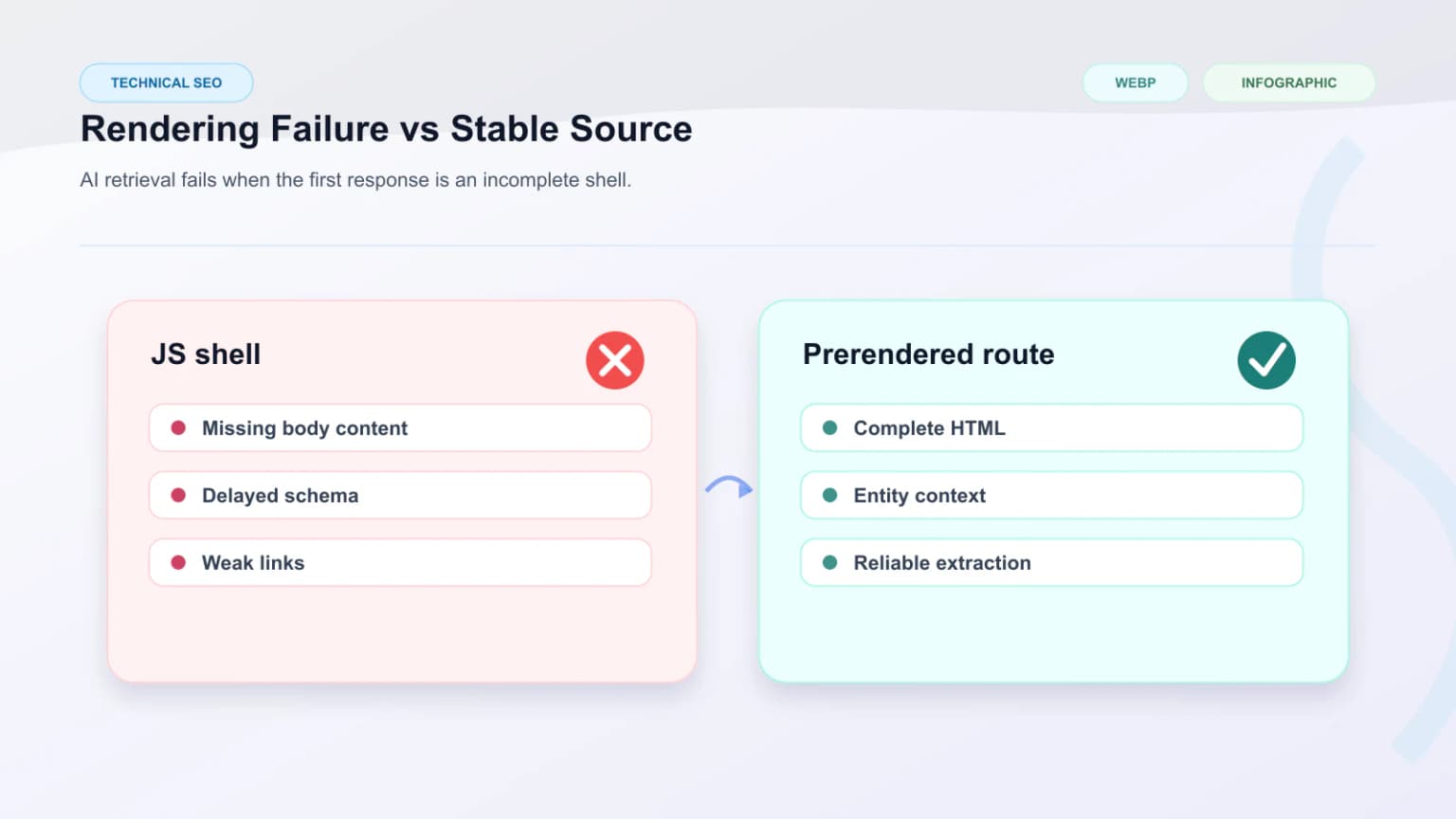
This is why SEO for Grok usually starts with a blunt validation step: inspect the machine-facing HTML, not just the rendered user interface.
Why Prerendering Is Often the Most Practical Fix
Prerendering fixes the gap between a JavaScript application and the deterministic HTML that AI systems need. Instead of depending on Grok to execute the frontend stack correctly, the prerendering layer compiles the route for machine traffic and serves a static HTML snapshot that already contains the important content.
At a high level, the path looks like this:
- An AI retrieval request reaches the route.
- The proxy identifies the request as machine-facing traffic.
- The route is rendered inside a prerendering environment.
- The system returns complete HTML, metadata, and schema.
- Human users still receive the normal interactive app.
This creates a cleaner delivery model for teams that do not want to replatform the entire frontend stack immediately. Instead of rewriting everything around SSR, they can stabilize the routes that matter most for Grok visibility and AI extraction.
What prerendering improves for Grok
Prerendering improves:
- first-response completeness
- heading and body extraction quality
- schema visibility
- metadata consistency
- route-level machine-facing stability
That is why prerendering often becomes the most practical path when AI retrieval is blocked by rendering architecture rather than by weak content quality. If the team is still deciding between rendering models, the broader breakdown of prerendering for technical SEO is a strong companion read.
How Prerendering Middleware Supports Grok-Facing SEO
Prerendering middleware matters because it creates a proxy-level machine-delivery path without forcing the origin to serve fragile frontend bundles directly to AI crawlers. Instead of hoping the retrieval layer reconstructs the route correctly, the site can return a clean HTML snapshot that is designed for extraction.
In operational terms, the middleware can:
- identify likely AI or bot traffic
- route machine-facing requests into a rendering layer
- execute the route outside the origin request path
- return deterministic HTML to the retrieval system
- reduce rendering load on the origin
This is useful for visibility and for infrastructure resilience. If a burst of AI-driven requests hits a high-value route, the origin does not need to dynamically rebuild the same interface repeatedly under crawler load. The prerendering layer absorbs that work and gives the retrieval system a stable document instead. For teams comparing platforms, the guide on what websites benefit from a prerendering service helps map that decision to real site architectures.
SEO for Grok Strategy: What Technical Teams Should Prioritize
An effective SEO for Grok strategy should prioritize extraction reliability before refinement of marketing copy. Great prose still underperforms if the retrieval layer never receives it in a usable format.
The strongest priorities are usually:
- deterministic HTML on high-value routes
- stable canonical and metadata output
- explicit schema markup
- machine-readable body structure
- route validation under bot-like conditions
- cache logic that keeps snapshots synchronized with live data
Which URLs to optimize first
Teams should focus first on the URLs most likely to influence AI visibility: service pages, category pages, product pages, explainers, FAQ hubs, and editorial assets that contain proprietary facts or differentiating expertise. These routes deserve the cleanest machine-facing delivery path.
It is also useful to tighten the structure of the content itself. Grok-facing retrieval benefits from pages that define the topic directly, separate information into strong headings, and express key points in lists, tables, and scoped factual sections instead of loose narrative-only blocks.
Structuring Content for Algorithmic Comprehension
Structured data remains important because it gives AI systems a clearer model of the page entities and relationships. JSON-LD does not force citation, but it improves the machine-readable layer that extraction workflows depend on.
The most useful schema patterns often include:
ArticleorBlogPostingFAQPageBreadcrumbListOrganizationWebPage- related service or product entities when relevant
This layer becomes much stronger when paired with deterministic HTML. A prerendered page with valid schema, clean headings, and extractable factual blocks is much easier for AI systems to interpret than a JavaScript shell with vague semantics. Teams usually validate that layer with a JSON-LD validator before rolling out template changes broadly.
Content layout patterns Grok prefers
The same principle applies to content layout. Pages become easier to process when they include:
- direct definitions near the top
- headings that reflect real user questions
- lists for implementation steps
- tables for concept comparison
- scoped FAQ answers that reduce ambiguity
Traditional SEO Software vs Grok-Facing Visibility Tools
Traditional SEO platforms still matter, but they do not fully explain Grok-facing visibility. Classic rank trackers show how URLs perform in search interfaces. They do not necessarily show whether the same routes are usable as source material inside AI answers.
| Capability | Traditional SEO software | Grok-facing visibility workflow | Architectural implication |
|---|---|---|---|
| Primary signal | Rankings, impressions, clicks | Inclusion, citation, semantic relevance | Requires zero-click measurement logic |
| Core data source | SERPs and indexed URLs | Prompt testing, answer output, crawl diagnostics | Needs AI-facing monitoring |
| Rendering assumption | Engines may eventually render the page | Initial HTML must already be useful | Strongly favors prerendering |
| Technical failure mode | Indexation and canonical issues | Thin HTML, stale snapshots, missing schema | Requires delivery-layer QA |
This is why many technical teams now pair classic technical SEO tooling with AI visibility diagnostics and prerendering validation. One layer helps explain search performance. The other helps explain whether the page can actually participate in AI retrieval. The same pattern shows up in adjacent answer-engine workflows like SEO for ChatGPT and SEO for Perplexity AI.
Limitations of SEO for Grok Optimization
Optimizing for Grok also has limits. Not every answer will cite web sources the same way. Different prompts can trigger different retrieval behavior. Some outputs will rely more on the model's existing synthesis patterns than on live fetched pages. Visibility is directional, not perfectly deterministic.
Operational risks to plan for
There are also real operational risks:
- stale prerendered snapshots after content changes
- weak cache invalidation across distributed delivery layers
- dynamic pages that depend on geolocation or authenticated state
- personalized routes that should never be cached for AI crawlers
- gaps between server telemetry and AI visibility observations
These limits do not make the work less valuable. They simply mean Grok-facing SEO has to be treated as infrastructure and validation, not as a one-time publishing task.
Integrating AI Visibility Monitoring With Server Delivery
One of the best practices for enterprise teams is to connect AI visibility monitoring with server logs, rendering diagnostics, and route-level QA. This makes Grok-facing SEO operational rather than theoretical.
Once that loop exists, teams can investigate:
- whether the machine-facing route returned a clean
200 - whether the initial payload contained complete schema
- whether prerendering timed out or captured an incomplete interface
- whether a deploy changed the machine-facing HTML
- whether a drop in visibility maps to a technical regression
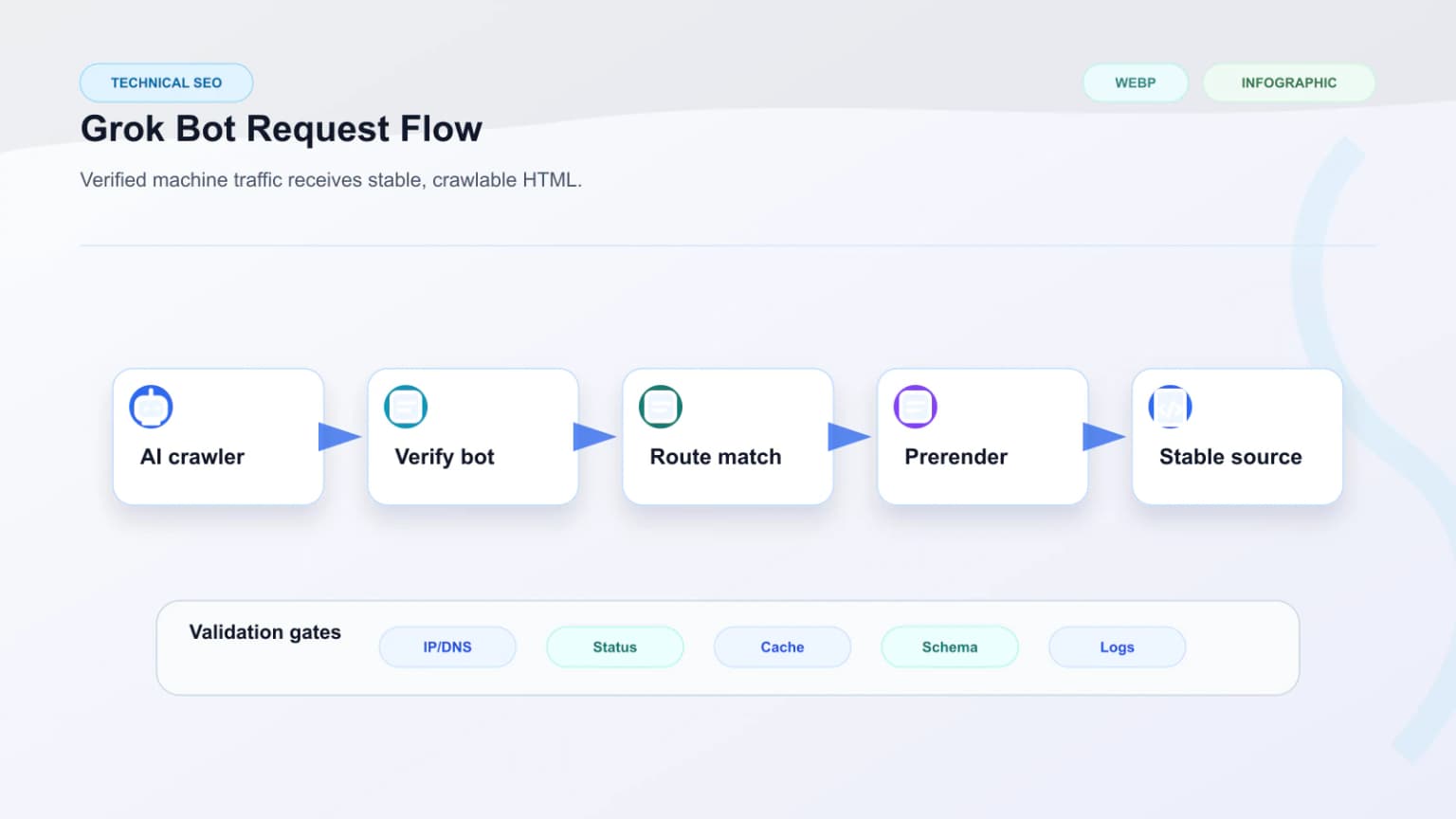
This closed loop is valuable because AI visibility feels abstract until it is connected to the actual delivery path. Once the team can correlate output quality with route behavior, the work becomes much easier to debug.
What the Best SEO Software for Grok Compliance Looks Like
The best SEO software for Grok compliance is rarely a single tool. It is a stack:
- prerendering or deterministic rendering infrastructure
- technical SEO validation
- schema and metadata QA
- server log analysis
- prompt-based AI visibility monitoring
In that stack, prerendering usually acts as the foundational layer because it solves the first-response problem. Without stable machine-facing HTML, the rest of the tooling mainly reports weak visibility rather than resolving the cause.
A practical Grok visibility stack
For teams trying to improve Grok-facing visibility, the practical stack usually includes:
- origin application for human users
- proxy-level prerendering for machine traffic
- structured data generation inside page templates
- route validation against bot-facing HTML
- observability that maps AI-answer behavior back to delivery quality
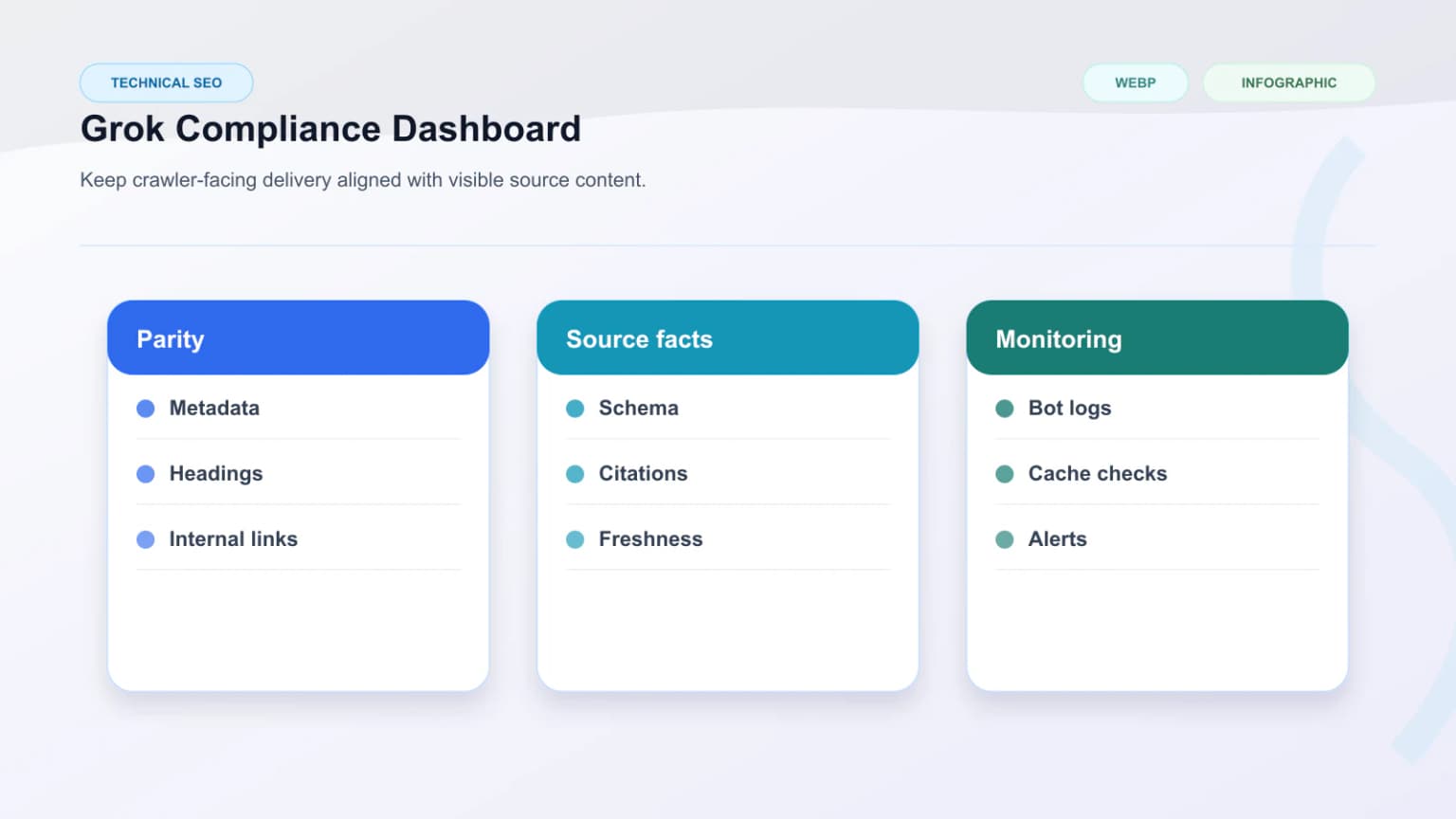
That is the posture that makes SEO for Grok more sustainable. It replaces hopeful assumptions with deterministic delivery and a monitoring loop that can catch regressions before they turn into visibility loss.
Conclusion
SEO for Grok is fundamentally a machine-facing delivery problem. If the route cannot expose a complete, parseable, current version of the page quickly, the AI system has weaker source material to use. That makes deterministic HTML, structured semantics, and route-level rendering quality central to the outcome.
Prerendering is often the most practical fix because it stabilizes crawler-facing output without forcing an immediate full-platform rewrite. Combined with schema, metadata discipline, and delivery monitoring, it creates the technical conditions that support stronger inclusion across Grok and adjacent AI systems. If you want the middleware view, the external guide to prerendering middleware is a useful technical reference.
For engineering teams, the next step is not guessing whether the page should be cited. It is validating what the machine actually receives. The routes that win are usually the ones that are easiest to fetch, easiest to parse, and easiest to trust.
Content Cocoon
Grok SEO Editorial Cluster
This article should connect Grok-facing retrieval topics back to the parent AI visibility and prerendering services, while keeping the implementation focus on deterministic HTML, rendering stability, and machine-readable output.
Internal Pathways
AI Search Visibility Service
The parent service for answer-engine and structured extraction readiness.
Prerendering
A related service when Grok visibility depends on deterministic HTML delivery.
JavaScript SEO
Relevant when Grok retrieval issues are caused by thin initial HTML or hydration-heavy routes.
SEO for ChatGPT
A companion article for teams comparing answer-engine retrieval patterns across AI systems.
External Technical References
How AI Agents Crawl Websites
A strong external reference for how retrieval bots behave under real crawling constraints.
HTTP Status Codes for Bots
Useful when debugging whether AI crawlers are receiving stable, trustworthy responses.
Prerender Checker
Helpful for validating machine-facing HTML output for Grok-related routes.
Frequently Asked Questions
What is SEO for Grok?+
SEO for Grok is the practice of making your website easier for Grok-facing retrieval systems to fetch, parse, and trust through stable HTML, clear structure, and machine-readable output.
Why does Grok struggle with JavaScript-heavy pages?+
Because important content often appears only after hydration or delayed API calls, while AI retrieval systems usually work under tighter timing and execution constraints than a full browser session.
How does prerendering help Grok visibility?+
Prerendering delivers deterministic HTML to machine traffic so Grok-facing retrieval can read headings, body content, metadata, and schema without depending on complex client-side execution.
What should technical teams monitor after launch?+
They should monitor bot-facing HTML quality, schema presence, prerender freshness, metadata consistency, and whether visibility changes correlate with technical regressions.