Executing an effective strategy for SEO for Perplexity AI depends on how efficiently automated retrieval systems can extract semantic data from dynamic web applications. If a route responds with a thin JavaScript shell instead of a complete document, the answer engine has less trustworthy source material to synthesize and cite. Updated for April 2026, this guide reflects the current behavior of PerplexityBot and the retrieval expectations documented in the Perplexity API reference.
That makes SEO for Perplexity an architecture problem as much as a content problem. The site has to expose deterministic HTML, stable metadata, valid schema, and a machine-readable body structure in the first response. On JavaScript-heavy websites, this usually overlaps with the same rendering and crawlability issues that already affect AI visibility, JavaScript SEO, prerendering, and the broader practice of structured data for AI visibility.
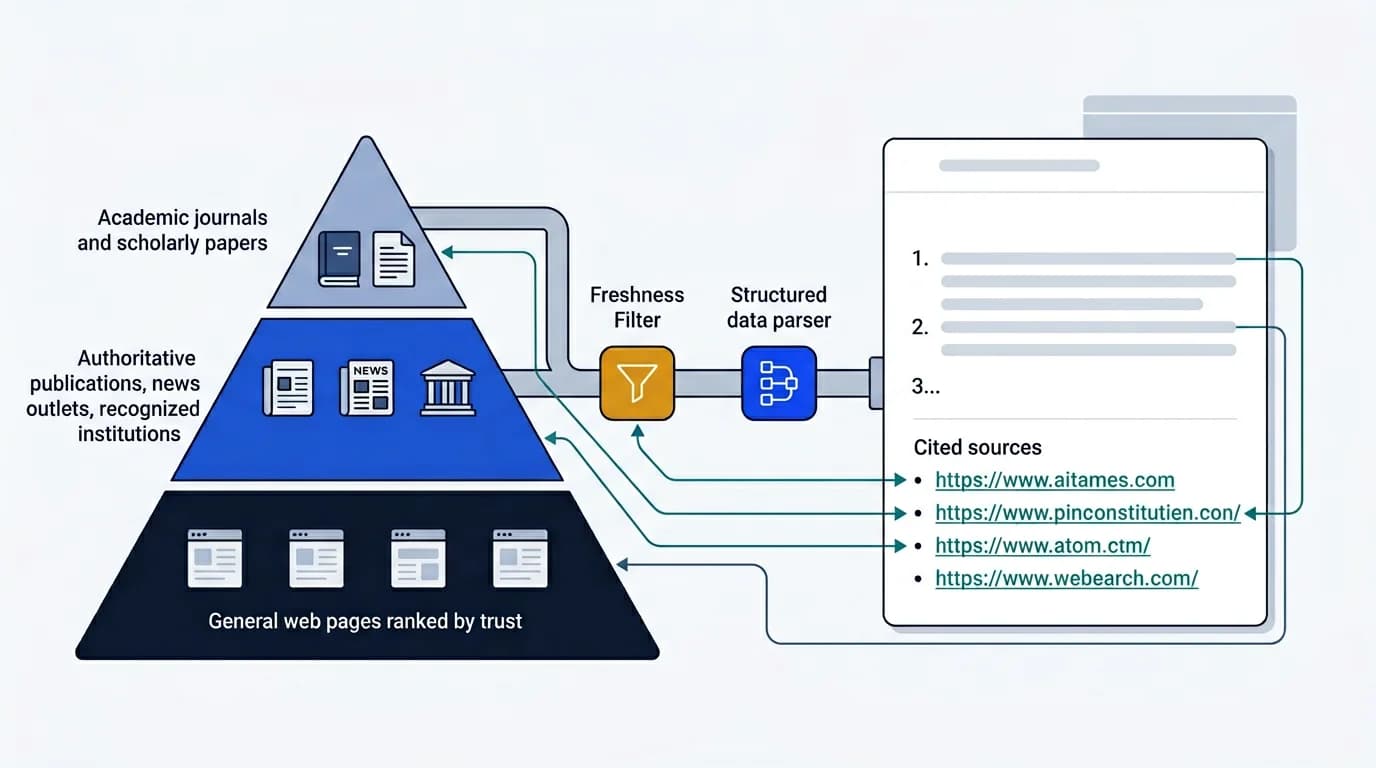
This article explains what Perplexity AI is from a technical retrieval perspective, why server-side serialization matters, how Perplexity differs from ChatGPT architecturally, how prerendering middleware improves extraction quality, and what rendering strategies make the most sense for machine-readable delivery.
What Is Perplexity AI and How Does It Extract Network Data?
Perplexity operates as a conversational answer engine that uses live web retrieval to gather, synthesize, and cite current source material. That retrieval model makes the initial response quality of the target page unusually important. If the page does not expose stable semantic content at fetch time, the route becomes a weak source candidate.
How Perplexity differs from classic search retrieval
This is one of the biggest technical differences between Perplexity-facing SEO and a classic search workflow. The answer engine is not simply ranking the URL and returning it as a blue link. It is trying to ingest the page as a source, reduce it into useful facts, and weave those facts into a generated response. That means the route needs to be machine-readable before any client-side execution path can complete.
In practical terms, Perplexity-facing retrieval performs best when:
- the initial HTML already contains the key factual content
- headings reflect the actual query intent clearly
- metadata and canonicals are stable
- schema helps define entities and relationships
- the route does not depend on delayed hydration to become meaningful
Why Perplexity SEO sits under technical SEO
This is why SEO for Perplexity belongs under technical SEO rather than under lightweight copy optimization. The same systems that affect machine-readable HTML for search bots also affect how well Perplexity can use the page as source material. In practice, this usually overlaps with a scoped technical SEO audit and a wider AI search visibility program.
Why AI Websites Require Server-Side Serialization
AI answer engines operate under strict timing and compute assumptions. They are optimized for fast extraction, not for reconstructing a modern frontend stack inside a full browser session. If the route depends on hydration, delayed API calls, or client-only content assembly, the answer engine may never receive a complete page state.
Why JavaScript-heavy sites lose answer-engine visibility
This is the structural weakness of many JavaScript-heavy websites. A human user sees a complete page after the frontend finishes loading. The retrieval layer often sees only the initial shell. When that happens, the page loses semantic clarity exactly where it matters most: at the first network response.
That makes server-side serialization valuable because it ensures the route exposes meaningful content in the initial payload. Instead of forcing the answer engine to wait for the application to become useful, the site delivers the finished semantic document immediately. For many teams, that practical delivery layer is implemented through prerendering rather than a full application rewrite.
Where serialization matters most
This is especially important on:
- single-page applications
- hybrid routes with delayed content population
- marketing sites built on client-side data fetches
- product pages with dynamic comparison blocks
- large content systems where critical sections are injected late
When the machine-facing response is complete, the retrieval system has a stronger basis for extraction, citation, and inclusion.
Analyzing Perplexity vs ChatGPT Architectural Differences
Perplexity and ChatGPT share answer-engine patterns, but their practical retrieval emphasis is not identical. Perplexity more directly emphasizes live web retrieval and source citation as part of the user experience, which makes route freshness and machine-facing delivery especially important.
From an infrastructure perspective, that means the site has to be prepared for a workflow where:
- live route fetches are central to answer quality
- source clarity matters as much as topic relevance
- unstable rendering degrades citation potential immediately
- machine-facing latency affects usability more directly
That does not mean the optimization stack is completely different from ChatGPT. It means the consequences of poor machine-facing delivery are easier to expose in a Perplexity-style answer environment because retrieval and citation are more visibly tied to the live web layer.
Why broad AI visibility requires both engines
The practical takeaway is that perplexity vs chatgpt is not just a product comparison. It is a reminder that different answer engines put different pressure on the technical delivery path. Teams that want broad AI visibility need routes that are readable across both models, not only in one environment. That is why it helps to compare this article with the more retrieval-specific breakdown in SEO for ChatGPT.
Deploying Prerendering Middleware for Algorithmic Bots
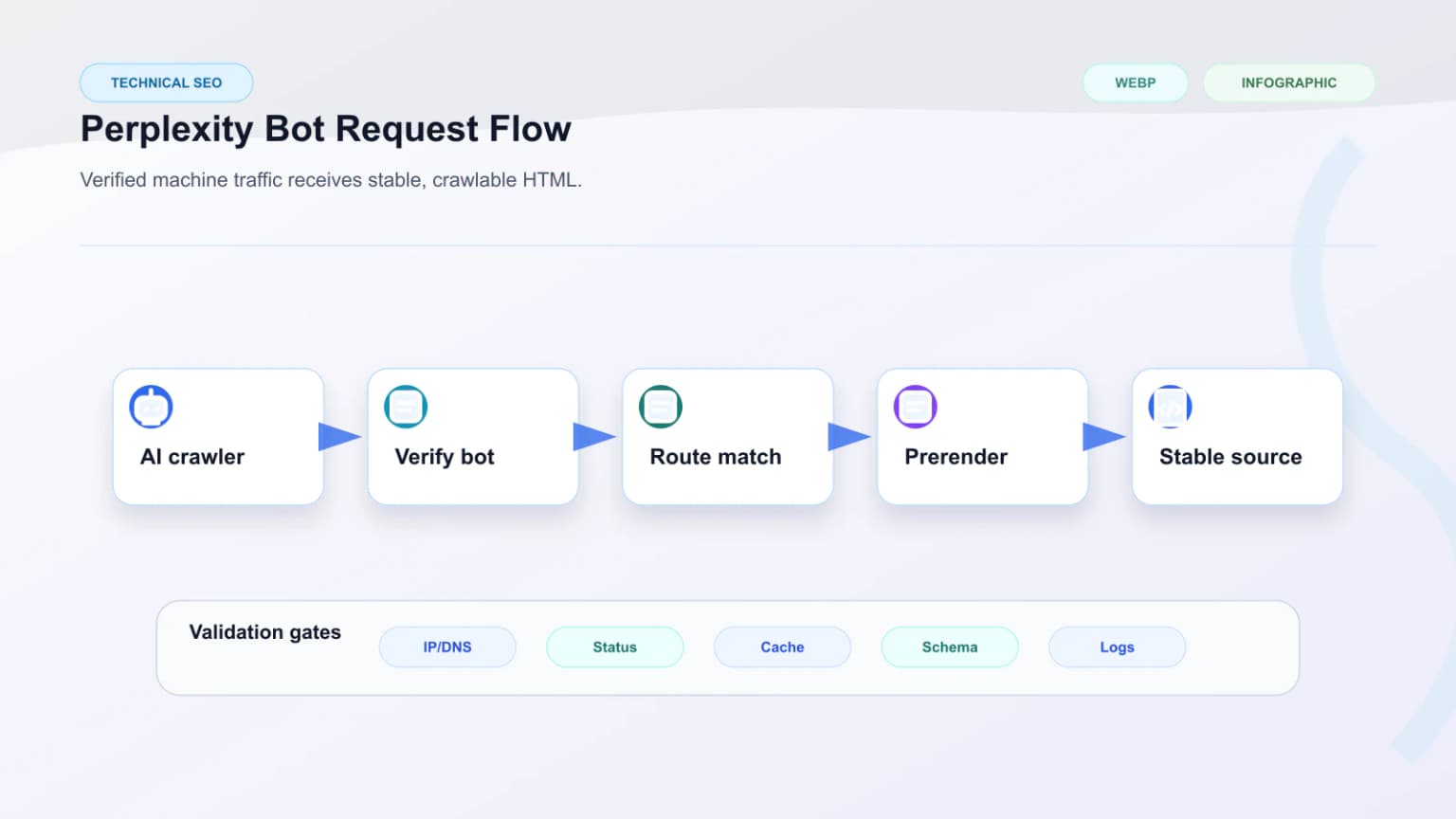
Prerendering middleware solves the gap between a JavaScript-heavy application and the deterministic HTML that answer engines need. Instead of hoping the retrieval layer can reconstruct the route through client execution, the prerendering layer compiles the route for machine traffic and returns a static HTML snapshot that already contains the useful content.
At a high level, the path works like this:
- The AI retrieval request reaches the route.
- The proxy detects machine-facing traffic.
- The request is routed into a prerendering environment.
- The route is rendered into stable HTML.
- Metadata, schema, headings, and body content are returned in the first response.
Why prerendering avoids a full replatform
This is why prerendering is often the most practical path for SEO for Perplexity. It allows teams to stabilize machine-facing delivery without forcing a full replatform of the entire frontend stack. Human users continue to get the interactive app. Machines get a deterministic document. If you need a framework-level baseline, the external explainer on what prerendering is is a good companion resource.
For technical teams, this improves:
- first-response completeness
- extraction quality
- schema visibility
- metadata consistency
- machine-facing route stability
How the Perplexity API Interacts With Prerendered Content
The Perplexity API and similar programmatic AI workflows are much easier to support when the page already exposes lean, structured, machine-readable content. Prerendered HTML helps because it gives these retrieval paths populated content blocks instead of empty component shells.
This is where schema and page structure become more important. If the route includes explicit JSON-LD, clear entity definitions, and scoped headings, the retrieval layer has a stronger model of the page. It becomes easier to separate the main topic, related entities, and factual assertions without asking the AI system to infer too much from ambiguous prose.
The practical rule is straightforward: if the page needs to support programmatic AI retrieval, it should expose complete semantic content in a deterministic response. That means schema, metadata, and body content should all be available before the machine needs to interpret the page. This same rule also shows up in SEO for Microsoft Copilot, where machine-readable source quality is just as dependent on first-response completeness.
Structuring Data for Perplexity Deep Research Protocols
Deep-research workflows rely on machine-readable structure because they often compare multiple sources and synthesize the result. Dense, well-bounded factual formatting helps these systems process the route more efficiently than vague narrative copy with weak semantic boundaries.
This is why pages become easier to use when they include:
- direct definitions near the top
- headings that mirror real user questions
- bullet lists for implementation logic
- tables for concept comparison
- explicit schema that defines the page entities
Structured content does not guarantee citation, but it does improve the extraction layer. It gives the AI system a more stable and less ambiguous document to work from. On modern websites, that often matters as much as the underlying topic relevance itself. Teams usually validate that entity layer with a JSON-LD validator and compare raw outputs with a prerender checker.
Limitations and Nuances of AI Search Optimization
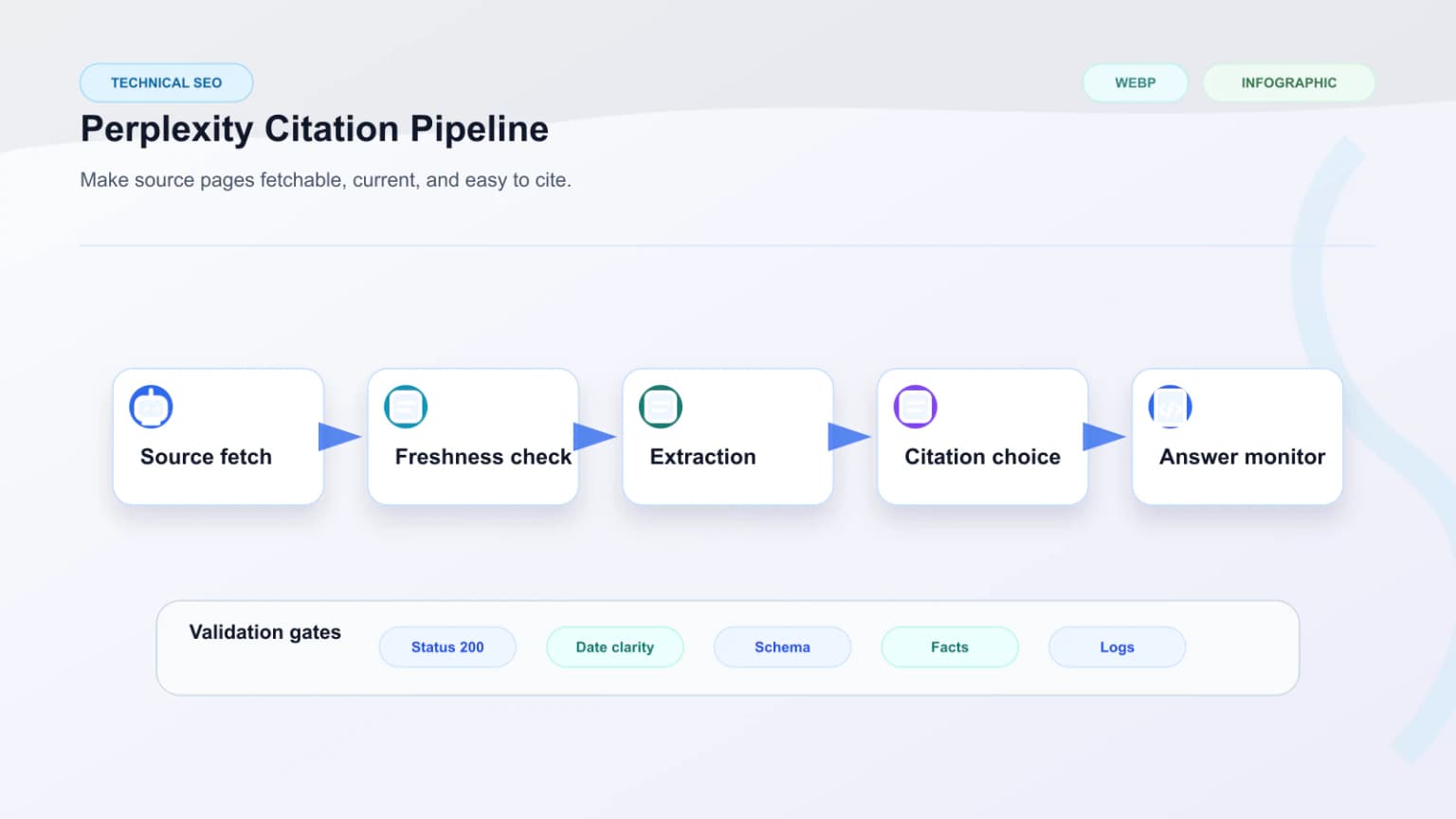
Optimizing for Perplexity and similar answer engines also introduces real tradeoffs. A route can become more visible as source material while sending fewer direct visits. Cache freshness becomes critical because stale prerendered snapshots can spread outdated facts. Personalized routes become dangerous if they are accidentally exposed to machine-facing delivery.
The major technical risks include:
- stale snapshots after content changes
- weak cache invalidation across distributed delivery layers
- dynamic pages that depend on geolocation or authentication
- personalized routes that must never be prerendered for bots
- monitoring gaps between server delivery and AI-answer output
These limitations do not make the strategy weaker. They simply mean AI search optimization has to be treated as infrastructure and validation, not as a one-time publishing task.
Comparing Rendering Strategies for Machine Readability
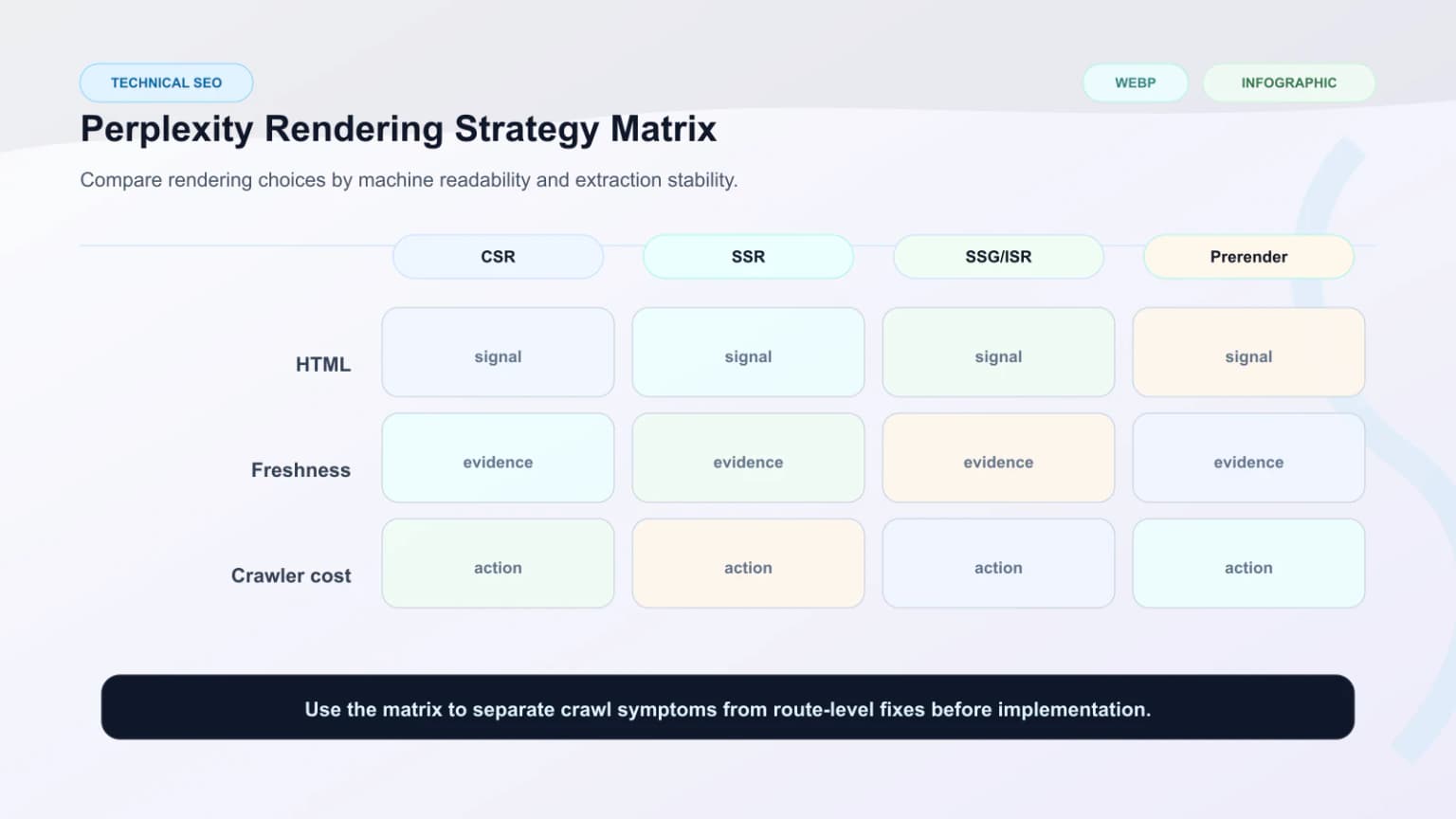
Rendering strategy is ultimately a tradeoff between machine-facing completeness, operational cost, and implementation complexity. Different teams solve the problem in different ways, but the important question is always the same: what does the machine receive in the first response?
| Rendering strategy | Algorithmic extraction efficiency | Origin server compute load | Implementation complexity |
|---|---|---|---|
| Pure client-side rendering | Low, high risk of thin HTML | Low | Low |
| Native server-side rendering | High | High | High |
| Static site generation | High | Low at runtime | Medium to high |
| Proxy prerendering | High | Low to moderate on origin | Low to medium |
For many JavaScript-heavy teams, proxy prerendering is the fastest practical path because it isolates the machine-facing problem without forcing an immediate rewrite of the delivery model. If your team is still evaluating route fit, the separate guide on what websites benefit from a prerendering service goes deeper on architecture selection.
Conclusion
SEO for Perplexity AI is fundamentally a machine-facing delivery problem. If the route cannot expose a complete, parseable, current version of the page quickly, the answer engine has weaker source material to retrieve, compare, and cite. That makes deterministic HTML, structured semantics, and route-level rendering quality central to the outcome.
Prerendering is often the most practical fix because it stabilizes machine-facing output without forcing an immediate full-platform rewrite. Combined with schema, metadata discipline, and route-level monitoring, it creates the technical conditions that support stronger inclusion across Perplexity and adjacent AI retrieval systems.
For engineering teams, the next step is not guessing whether the page should be visible. It is validating what the machine actually receives. The routes that win are usually the ones that are easiest to fetch, easiest to parse, and easiest to trust.
Content Cocoon
Perplexity SEO Editorial Cluster
This article should connect Perplexity-facing retrieval topics back to the parent AI visibility and prerendering services, while keeping the implementation focus on deterministic HTML, answer-engine extraction, and machine-readable output.
Internal Pathways
AI Search Visibility Service
The parent service for answer-engine and structured extraction readiness.
Prerendering
A related service when Perplexity visibility depends on deterministic HTML delivery.
JavaScript SEO
Relevant when Perplexity retrieval issues are caused by thin initial HTML or hydration-heavy routes.
SEO for ChatGPT
A companion article for teams comparing answer-engine retrieval patterns across AI systems.
External Technical References
How AI Agents Crawl Websites
A strong external reference for how retrieval bots behave under real crawling constraints.
Prerendering Middleware Explained
Useful when mapping proxy routing and rendering behavior to AI answer engines.
Prerender Checker
Helpful for validating machine-facing HTML output for Perplexity-facing routes.
Frequently Asked Questions
What is Perplexity AI from an SEO perspective?+
Perplexity AI is an answer engine that relies heavily on live web retrieval and source citation, which makes machine-readable HTML and stable route delivery especially important.
Why does Perplexity struggle with JavaScript-heavy pages?+
Because important content often appears only after hydration or delayed API calls, while the retrieval layer works best when the first response already contains the useful semantic content.
How does prerendering help Perplexity visibility?+
Prerendering gives machine-facing requests deterministic HTML so the answer engine can read headings, body content, metadata, and schema without depending on fragile client-side execution.
What should technical teams validate after deployment?+
They should validate bot-facing HTML quality, schema presence, metadata consistency, snapshot freshness, and whether visibility changes correlate with route-level technical regressions.