Listing architecture still causes major technical SEO problems because teams often design it for user interaction first and crawler understanding second. Infinite scroll can feel smooth in the browser, but if it removes crawlable URLs, weakens internal linking, or hides inventory behind JavaScript events, bots may never discover enough of the listing to evaluate it properly.
Pagination has the opposite problem. It is easy to generate endless page states, but not every state deserves indexation. If every page number becomes a search target without clear purpose, the site can create duplication, thin-value URLs, and crawl waste instead of stronger discovery.
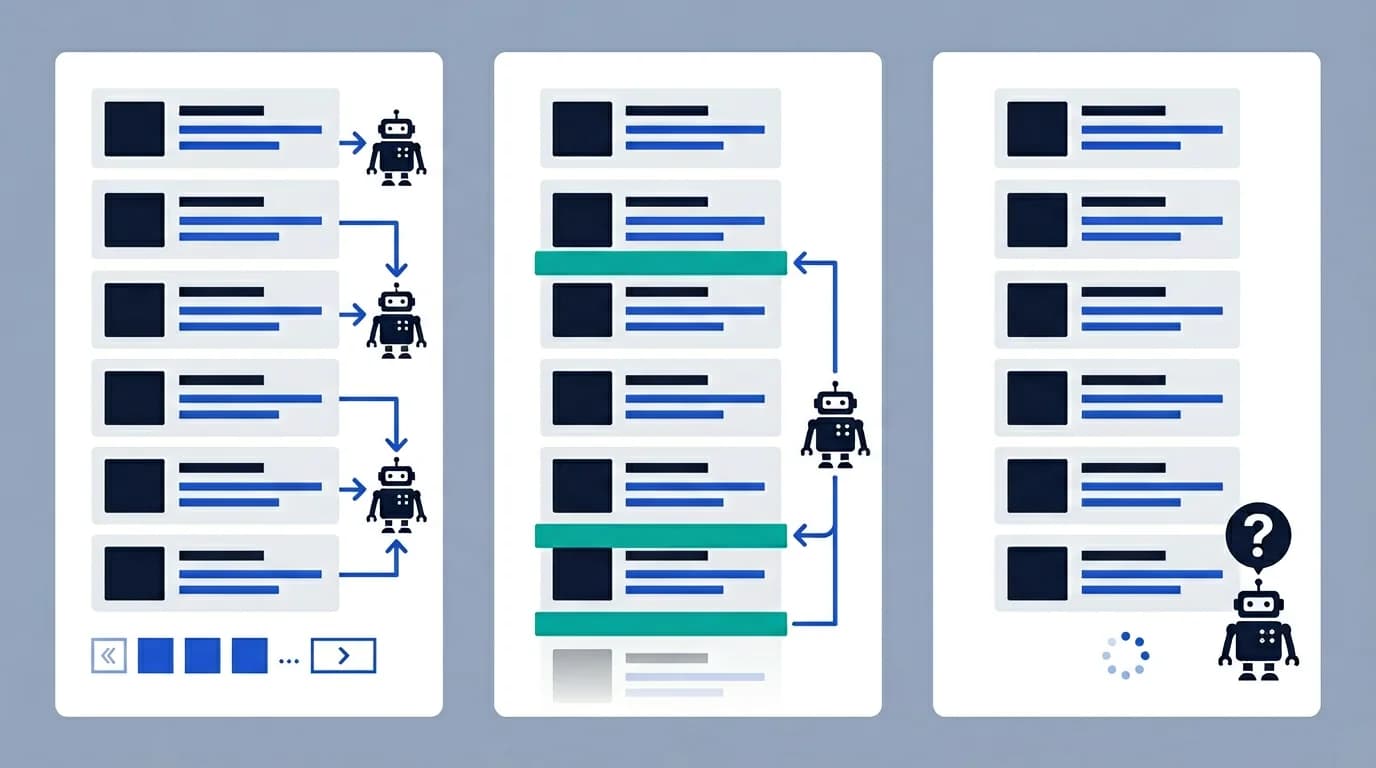
The right goal is not to choose one interaction pattern blindly. It is to create a listing architecture that stays useful for users while preserving machine-readable discovery, stable URL logic, and clear indexation rules for crawlers. As of April 2026, the recommendations in this guide still align with the listing patterns crawlers handle most reliably across large catalogs and editorial archives.
Why pagination still matters for crawlability
Pagination gives crawlers something they can request directly: stable URLs that expose additional inventory in an ordered structure. That makes it easier for bots to discover deeper items without depending on browser events, scroll behavior, or client-side interaction.
On modern sites, pagination still matters because it provides, as Google emphasizes in its pagination and incremental page loading guidance:
- crawlable URLs for deeper listing states
- predictable internal linking between list segments
- a structure for distributing discovery across large inventories
- a stable fallback when infinite scroll exists for users
Where paginated discovery matters most
This is especially important on large category, marketplace, directory, and editorial archive pages where the inventory exceeds what one route should reasonably expose at once.
Infinite scroll is not automatically bad, but it needs crawlable support
Infinite scroll is a UX pattern, not a crawler strategy. It can work well for users, but only if the site preserves a bot-friendly path to the same content, which is the same conclusion reached in web.dev's infinite scroll guidance.
The safest rule is simple:
- users can have infinite scroll
- bots still need crawlable paginated URLs
That usually means keeping a real paginated route structure under the surface even if the browser enhances the experience with scrolling or "load more" interaction. Without that fallback, the site risks turning discovery into a JavaScript-only behavior that crawlers may not execute or prioritize reliably.
Which paginated pages should be indexable
Not every paginated state should be treated as an indexable landing page. The answer depends on whether the deeper page represents meaningful search value or simply exposes more of the same inventory.
In practice:
- page 1 is often the strongest canonical search target for a listing
- deeper pages may still need to be crawlable for discovery
- some deeper pages can be indexable if they serve real standalone intent
- many paginated states are better treated as crawl paths than ranking targets
Make indexation a deliberate policy choice
This is where teams need policy, not guesswork. If paginated routes are indexable, that choice should be intentional. If they are not, the site should still preserve crawlable navigation rather than hiding deeper content entirely. Codifying that policy belongs inside a broader technical SEO audit checklist.
Avoid using pagination to create duplicate search targets
One of the most common mistakes is allowing paginated states to compete with the main listing page for the same intent. If page 2, page 3, and page 4 expose mostly similar category semantics without a strong reason to rank independently, they can dilute the signal of the primary route.
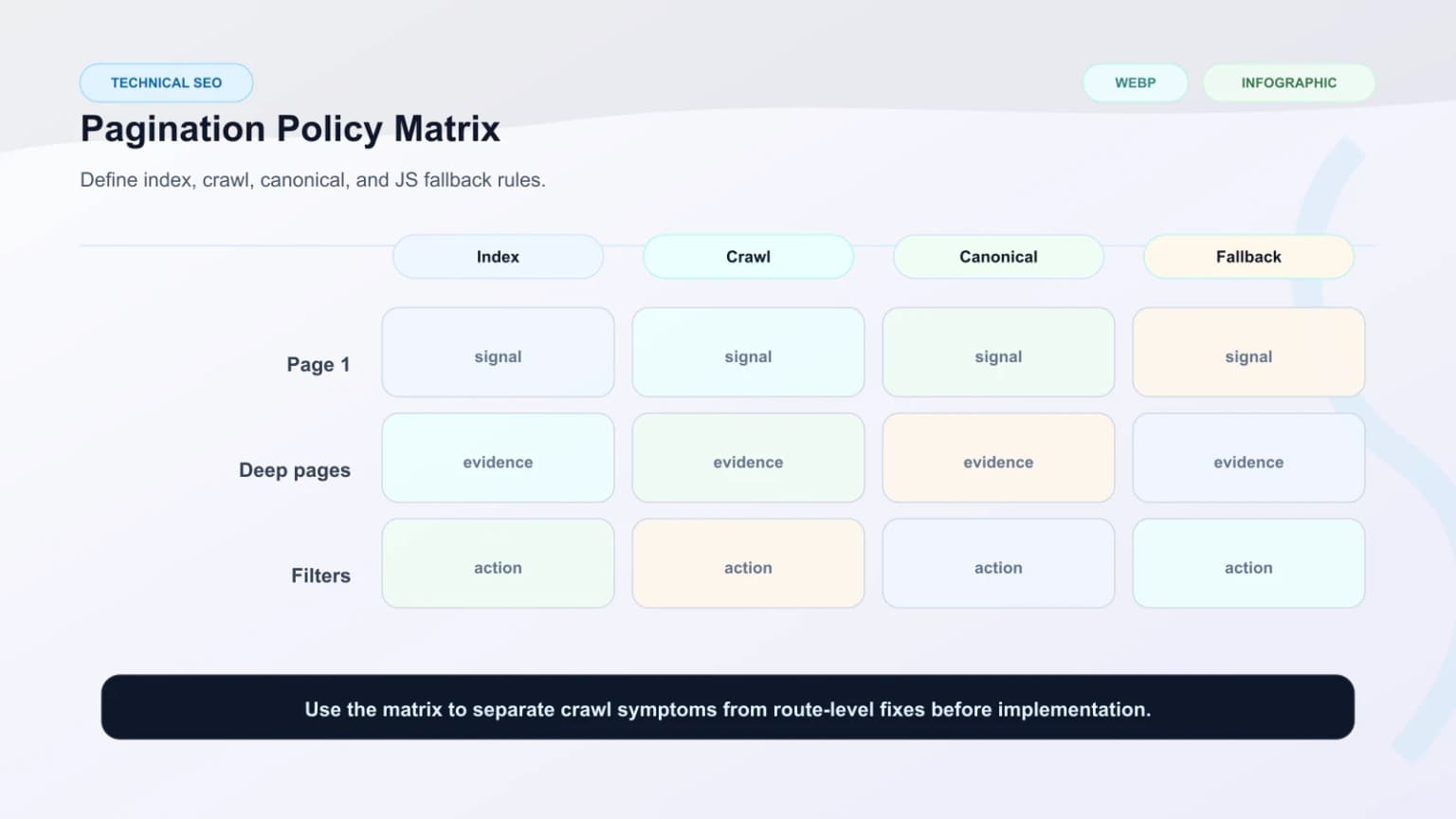
This is why pagination policy needs to align with:
- canonical logic
- robots directives
- sitemap inclusion
- internal linking behavior
Pick one canonical rule per listing type
The site should know whether paginated pages are:
- canonicalized to themselves and indexable
- canonicalized to the main page
- crawlable but
noindex - excluded from sitemap exposure
The exact choice depends on the listing type, but the important part is consistency.
Load-more patterns are safer when they update the URL model
"Load more" interfaces can be acceptable if they preserve URL-based states underneath. When they do not, bots may only see the initial chunk of items and miss the deeper inventory entirely.
A stronger pattern usually means:
- a real paginated route structure exists
- "load more" fetches the next page or segment predictably
- the URL can reflect the deeper state where appropriate
- the non-JavaScript or bot-facing version still exposes crawlable navigation
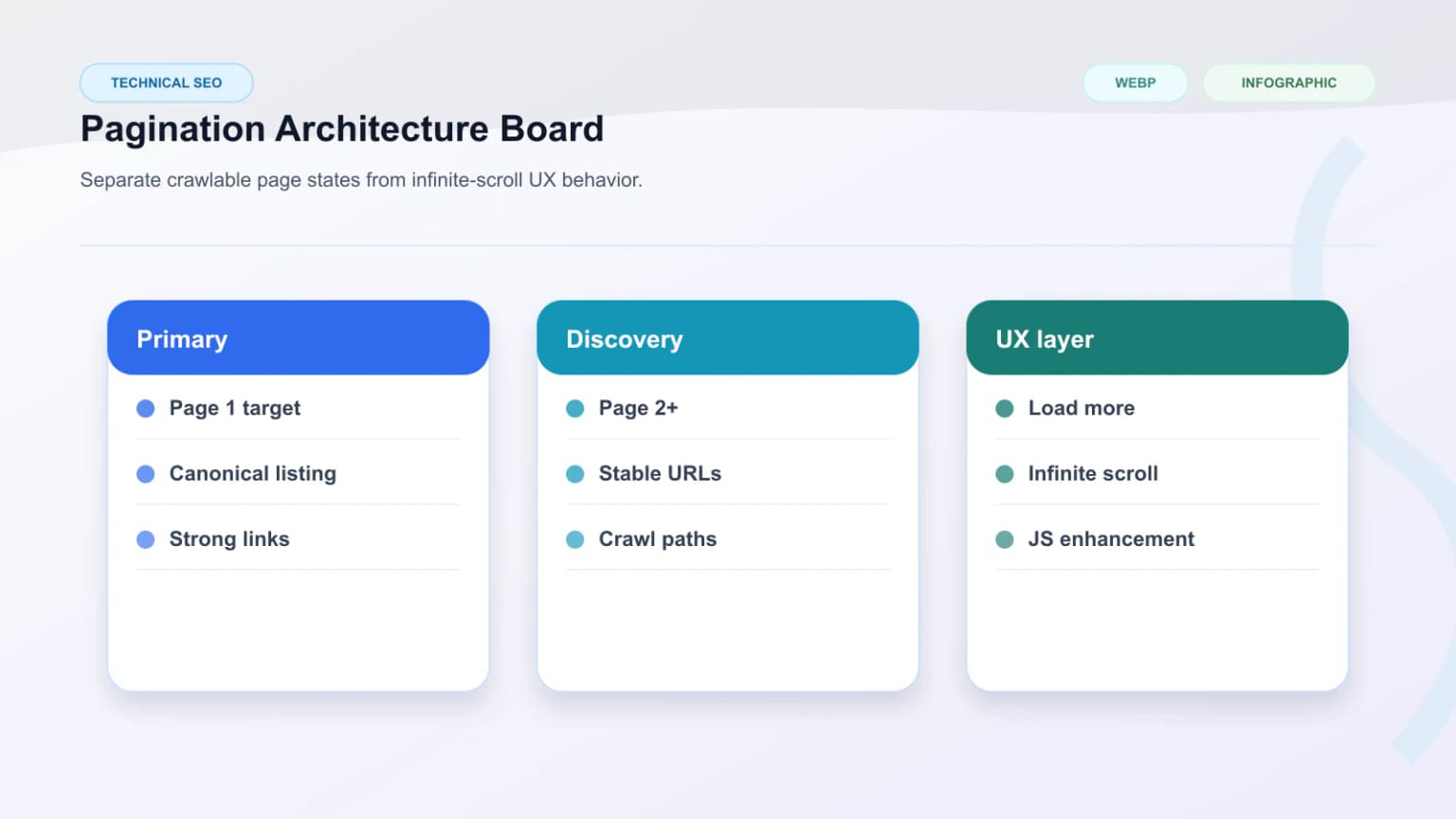
Separate the interaction layer from the discovery layer
This keeps the interaction layer separate from the discovery layer. Users get a smoother experience, while crawlers still get a stable route structure.
How infinite scroll breaks discovery on JavaScript-heavy sites
Infinite scroll becomes risky when:
- deeper items appear only after client-side scroll events
- the URL never changes as more content loads
- the route has no crawlable next-state links
- the listing is not exposed through paginated HTML or bot-facing output
- the page becomes excessively heavy while deeper inventory remains hidden
This is particularly dangerous on JavaScript-heavy sites because the same route often already depends on hydration for the first response. If the initial HTML is thin and the deeper content is also scroll-gated, bots may receive almost none of the real inventory. In those cases, prerendering or stronger server output can help, but the route still needs a sensible URL model.
Internal linking should support pagination, not fight it
Pagination is part of internal linking architecture. If the site hides page navigation, removes crawlable anchors, or relies entirely on client-state controls, it weakens route discovery even when URLs technically exist.
Good pagination linking usually means:
- visible or crawlable links to adjacent pages
- a clear relationship between the main listing and deeper states
- category hubs that surface important child inventory
- no dependence on user gestures for bot discovery
Why weak pagination links waste crawl budget
This is one reason pagination overlaps with crawl budget optimization. If crawlers cannot move through listing structures efficiently, deeper products, posts, or profiles may remain under-discovered.
Sitemaps and paginated pages should follow the same policy
If the site has a clear pagination strategy, the sitemap should reflect it. Do not include paginated URLs just because they exist.
Typical sitemap patterns are:
- include only the main listing page if deeper states are not intended to rank
- include selected paginated routes only when they carry real indexable value
- exclude crawl-only or
noindexpaginated states from the sitemap
This is where the sitemap guide and pagination guide connect directly. The sitemap should reinforce the listing policy, not contradict it.
A practical decision model for paginated routes
The strongest teams usually decide pagination behavior by route family rather than by ad hoc URL inspection.
| Route type | Best default | Why it usually works |
|---|---|---|
| Core category page | Indexable page 1 | Strongest intent and cleanest landing target |
| Deep category pages | Crawlable, policy-driven | Useful for discovery, not always for ranking |
| Editorial archive pages | Often self-canonical | Can hold real navigational value when archives matter |
| Internal search results | Usually not indexable | Low control, high duplication risk |
| JS-only infinite lists | Add paginated fallback | Bots need URL states, not only interaction states |
The goal is not to make every deeper page rank. The goal is to make sure important inventory remains discoverable without flooding the index with weak route variants.
How to validate pagination and infinite scroll for SEO
The best validation workflow usually includes:
- Inspect the raw HTML of the main listing page.
- Confirm whether deeper listing states have real URLs.
- Check whether bots can follow pagination without JavaScript interaction.
- Validate canonicals, robots tags, and sitemap policy for deeper pages.
- Compare the user-facing infinite scroll behavior with the bot-facing route structure.
Useful support includes a crawler checker and a view as bot vs prerender tool when the listing relies on JavaScript.
Common mistakes to avoid
The most common mistakes are:
- replacing pagination entirely with JavaScript infinite scroll
- indexing every paginated state without a policy
- canonicalizing paginated pages inconsistently
- hiding deeper inventory behind uncrawlable "load more" logic
- exposing paginated URLs in sitemaps even when they are not intended to rank
- treating pagination as UX only instead of crawl architecture
These problems usually do not come from one broken tag. They come from missing route policy.
Conclusion
Pagination and infinite scroll should be designed together, not treated as competing ideologies. Users can have a smooth interface while crawlers still receive stable listing URLs, clear discovery paths, and consistent indexation signals.
The practical rule is simple: make deeper content reachable through URLs, decide which page states deserve indexation, and keep that policy aligned across canonicals, robots directives, internal links, and sitemap exposure.
Content Cocoon
Pagination and Infinite Scroll Cluster
This article should connect pagination and infinite scroll decisions back to crawlable architecture, indexation control, internal linking, and the broader technical SEO systems that shape listing-page visibility.
Internal Pathways
Crawl Budget Optimization
A companion article for understanding how low-value paginated or endlessly generated URLs waste crawler attention.
XML Sitemap Guide for Technical SEO
Useful when deciding which paginated routes deserve sitemap exposure and which should stay out of the inventory.
Technical SEO Audit Checklist and Implementation Guide
Relevant when pagination and infinite scroll need to be audited as part of a broader crawlability and rendering review.
Prerendering
Helpful when listing templates rely on JavaScript and bots need a cleaner, crawlable machine-facing version.
External Technical References
Crawler Checker
Useful for validating whether paginated or load-more listing routes are reachable and understandable to bots.
View as Bot vs Prerender
Helpful when comparing JavaScript-powered listing pages against the machine-facing output bots actually receive.
SEO Audit Tool
A supporting reference when pagination issues overlap with metadata, rendering, and indexation problems.
Frequently Asked Questions
Is infinite scroll bad for SEO?+
Not automatically, but it becomes risky when deeper content is accessible only through scroll events or client-side interaction. Bots still need crawlable paginated URLs or another stable discovery path.
Should all paginated pages be indexable?+
No. Many deeper paginated states are better used as crawl paths rather than ranking targets. The right policy depends on whether those pages serve real standalone search intent.
Can load more work for SEO?+
Yes, if it sits on top of a real paginated URL structure and does not hide deeper inventory from bots behind JavaScript-only behavior.
Should paginated pages appear in the sitemap?+
Only when that matches the site’s indexation policy. Crawl-only or noindex paginated routes usually should not be included in the sitemap inventory.