Duplicate content on large websites is rarely a single-page problem. It is usually a route-family problem. Once the site starts generating many pages from similar templates like ecommerce category pages, overlapping filters, parameter states, location variants, or weakly differentiated programmatic routes, duplication stops being a local issue and becomes an architectural one.
This is why large sites often struggle with duplication even when no one page looks obviously broken. The problem appears when search systems evaluate clusters of URLs and conclude that the inventory contains too many pages with nearly the same purpose, the same facts, or the same answer. At that point, crawlers become more selective, canonicals become more important, and indexation confidence begins to fall. Updated for April 2026, this guide reflects current Google guidance on canonical URLs, how to consolidate duplicate URLs, and how duplication interacts with crawl budget on large sites.
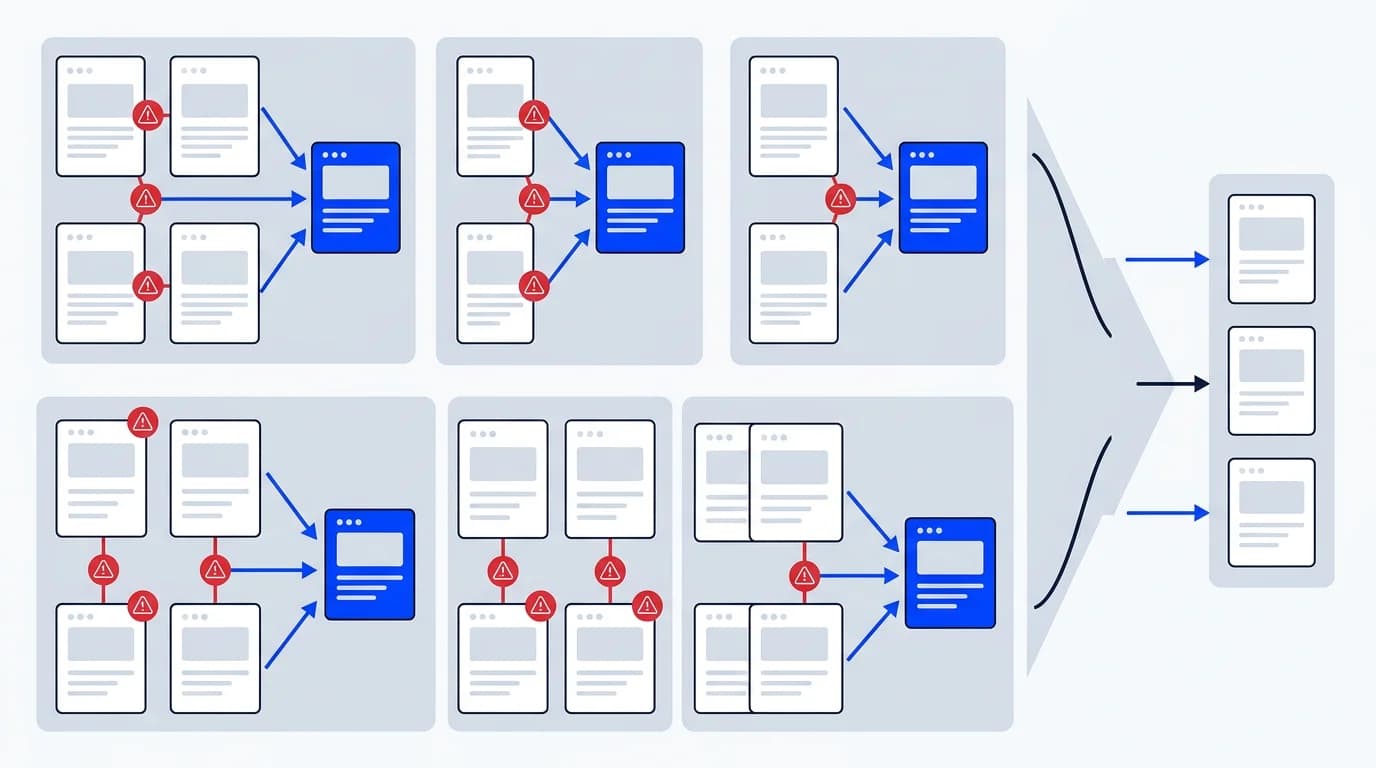
This guide explains how duplicate content spreads across large websites, why near-duplicates are often more dangerous than exact copies, and how technical teams should consolidate route inventory before duplication overwhelms crawl and indexation systems.
Duplicate content at scale usually starts with route families
Large websites rarely create duplication by manually copying one page over and over. More often, duplication emerges because the same template logic is used to publish many URLs with only minor differences.
Common sources include:
- faceted category states
- location or city pages
- parameterized product or listing variants
- comparison templates with weak differentiation
- internal search pages accidentally exposed
- programmatic SEO routes with very thin unique value
Why duplication is created upstream, not in copy
This is why duplication often sits close to programmatic SEO quality control, faceted navigation SEO, and the broader technical SEO audit checklist. The duplicate problem is frequently created upstream in the route model, not downstream in editorial copy.
Near-duplicate pages are often the real problem
Exact duplicates are relatively easy to understand. Near-duplicate pages are harder because they look unique enough to publish but not unique enough to deserve independent search treatment.
That usually means pages where:
- only a few nouns change
- item sets overlap heavily
- headings and metadata stay mostly the same
- the main answer is functionally identical across many URLs
- the route exists because the system can generate it, not because it solves a distinct intent
Near-duplicates are dangerous because they can quietly expand without obvious alarms. The site keeps publishing "new" pages while search systems keep seeing repetition.
Canonical tags help, but they do not solve weak inventory strategy
Many teams treat duplicate content as a canonical-tag problem. Canonicals matter, but they are not enough if the site is still generating too many weakly differentiated URLs.
Canonical tags work best when the site already knows:
- which route should be the preferred version
- which URLs should collapse into that version
- which states should never become search-facing entities
- how internal links should reinforce the preferred route
When canonicals become a patch instead of a fix
If those decisions are unclear, canonicals become a patch on top of a noisy inventory. This is why duplication often overlaps directly with canonical issues on JavaScript websites, especially when route states are generated dynamically.
Crawl budget suffers when duplicate clusters expand
Duplicate content is not only an indexation issue. It is also a crawl-efficiency issue. When crawlers encounter large sets of similar pages, they spend time evaluating URLs that may never deserve independent visibility.
That usually creates:
- slower discovery of stronger routes
- more fetch attention on low-value variants
- weaker confidence in large template families
- more pages stuck in discovered or crawled but not indexed states
How duplicate growth reshapes crawl evaluation
This is why duplication is tightly linked to crawl budget optimization, why pages are discovered but not crawled, and why pages are crawled but not indexed. Duplicate growth changes how the whole inventory is evaluated.
Internal linking can amplify or reduce duplication
Internal links tell crawlers which URLs are important. If the site links aggressively to many overlapping pages with almost the same intent, it amplifies duplication instead of controlling it.
The healthiest linking patterns usually:
- emphasize the strongest parent route
- promote only selected high-value variants
- avoid giving equal prominence to every generated state
- reduce crawl paths into low-value duplicates
Internal-link discipline matters because it turns route policy into crawler behavior. A clean canonical cannot fully compensate for an internal-link model that keeps pushing bots toward duplicate clusters.
Sitemaps should not publish duplication at scale
One of the most common operational mistakes is allowing near-duplicate URLs to enter the XML sitemap. That tells crawlers the site considers those routes important and index-worthy even when they mostly repeat stronger primary pages.
On large sites, sitemap policy should usually:
- include only canonical URLs
- exclude weakly differentiated route states
- remove parameterized duplicates entirely
- segment route families so duplication leaks are easier to find
Why sitemap admission signals page importance
This is why duplication review belongs next to the XML sitemap guide for technical SEO. Sitemap admission is one of the strongest signals of whether the site believes a page deserves independent visibility.
Rendering and route-state drift can create hidden duplicates
On JavaScript-heavy websites, duplicate problems are not always visible in the final browser UI. The machine-facing version of the route may expose duplicates even when the user-facing experience seems cleaner.
Common hidden-duplicate patterns include:
- parameter states visible in raw HTML but normalized in the browser
- different canonicals across SSR, prerender, and hydrated states
- metadata assembled too late
- route rewrites that leave multiple URL shapes crawlable
When duplication becomes a rendering problem
That is why duplication sometimes becomes a rendering problem as much as an information-architecture problem. This is where Next.js rendering decisions for SEO and AI visibility and prerendering enter the diagnosis.
Consolidation policy should be defined before cleanup starts
Large sites often know they have duplication but still struggle to fix it because they have not defined a consolidation model. Cleanup works much faster when teams classify every route family into one of a few states:
- keep as an indexable primary route
- consolidate into another canonical route
- keep crawlable but non-indexable
- remove from crawl paths and sitemaps
- prune entirely
Without these buckets, teams keep debating individual pages instead of reducing the duplicate system that created them.
A practical framework for judging duplicate risk
The fastest way to judge duplicate risk is not to ask whether two pages share some copy. The better question is whether search systems would interpret them as meaningfully different entities.
Useful review dimensions include:
- distinct search intent
- unique factual coverage
- unique item or entity set
- stable canonical target
- unique internal-link role
- unique answer value in the first response
If most of those dimensions overlap, the route probably belongs in a duplicate cluster even if the page is not an exact copy.
Duplicate cleanup should happen by family, not page by page
The highest-leverage cleanup work happens when the team groups URLs by family and fixes the system that produces them.
That often means:
- identifying the route families with the biggest duplicate footprint
- selecting the canonical or primary state for each family
- changing internal links to reinforce the preferred routes
- removing duplicate states from sitemaps
- applying noindex, canonical consolidation, or pruning where appropriate
- validating the machine-facing output on representative samples
This is much more effective than manually adjusting a handful of pages while the template continues generating new duplicates behind the scenes.
Common duplicate-content traps on large sites
The most common traps are:
- treating every generated URL as a potential landing page
- relying on canonicals without reducing inventory noise
- leaking duplicate states into sitemaps
- allowing filters and parameters to create search-facing routes without policy
- reviewing only visible UI instead of crawler-facing output
- fixing duplicates page by page instead of by route family
These mistakes usually come from weak governance rather than from one broken tag.
Conclusion
Duplicate content at scale is a systems problem. It grows when route families publish too many overlapping pages, when canonical policy is unclear, and when crawlers keep being invited into low-value URL states.
The strongest fix is not just "add more canonical tags." It is to reduce duplicate inventory, define route-family consolidation rules, and make sure internal links, sitemaps, and machine-facing output all reinforce the same preferred pages.
If your site is carrying too many near-duplicate routes, a technical SEO audit is often the fastest way to group duplication by family and turn cleanup into a workable implementation plan.
Content Cocoon
Duplicate Content at Scale Cluster
This article should connect duplicate-content diagnosis back to canonical policy, route-family governance, crawl efficiency, and the broader technical SEO systems that determine whether large inventories are interpreted as distinct pages or as noisy repetition.
Internal Pathways
Canonical Issues on JavaScript Websites
A companion article for understanding how unstable preferred-URL logic often turns route families into duplicate clusters.
Programmatic SEO Quality Control
Useful when duplicate growth comes from large-scale template families that were launched without strong thresholds.
Faceted Navigation SEO for Large Websites
Relevant when filters, sorts, and parameter combinations are multiplying near-duplicate listing states.
Technical SEO Audit
The parent service for teams diagnosing duplication, crawl waste, canonical drift, and indexation loss together.
External Technical References
SEO Audit Tool
Helpful for reviewing route-level duplication issues alongside status codes, metadata, and rendering quality.
Extract Sitemap Tool
Useful for checking whether non-canonical or near-duplicate URLs are still leaking into sitemap inventories.
View as Bot vs Prerender
Helpful when duplication symptoms overlap with route-state drift or machine-facing rendering inconsistencies.
Frequently Asked Questions
What does duplicate content at scale usually mean?+
It usually means route families are publishing many exact or near-duplicate URLs through templates, filters, parameters, or weakly differentiated programmatic pages rather than through one-off manual copying.
Are near-duplicate pages worse than exact duplicates?+
They are often harder to control because they look unique enough to keep publishing but still overlap heavily in purpose, facts, and search value.
Can canonical tags solve duplicate content on their own?+
Not usually. Canonicals help most when the route inventory is already governed and the site knows which states should be primary, consolidated, noindexed, or removed.
What is the best cleanup approach for large websites?+
Group URLs by route family, choose the preferred state, update internal links and sitemaps, then consolidate or prune weak variants instead of fixing pages one by one.