Faceted navigation can help users narrow large inventories quickly, but it also creates some of the most expensive technical SEO problems on large websites. Once filters, sorts, sizes, brands, locations, prices, and availability states start generating many crawlable URL combinations, the site can flood crawlers with routes that are technically valid but strategically weak.
That is why faceted navigation should be treated as a route-policy problem, not only as a UI convenience. The central question is not whether filters are useful. The real question is which filtered states deserve crawl attention, which should be consolidated, and which should stay out of the search-facing architecture entirely.
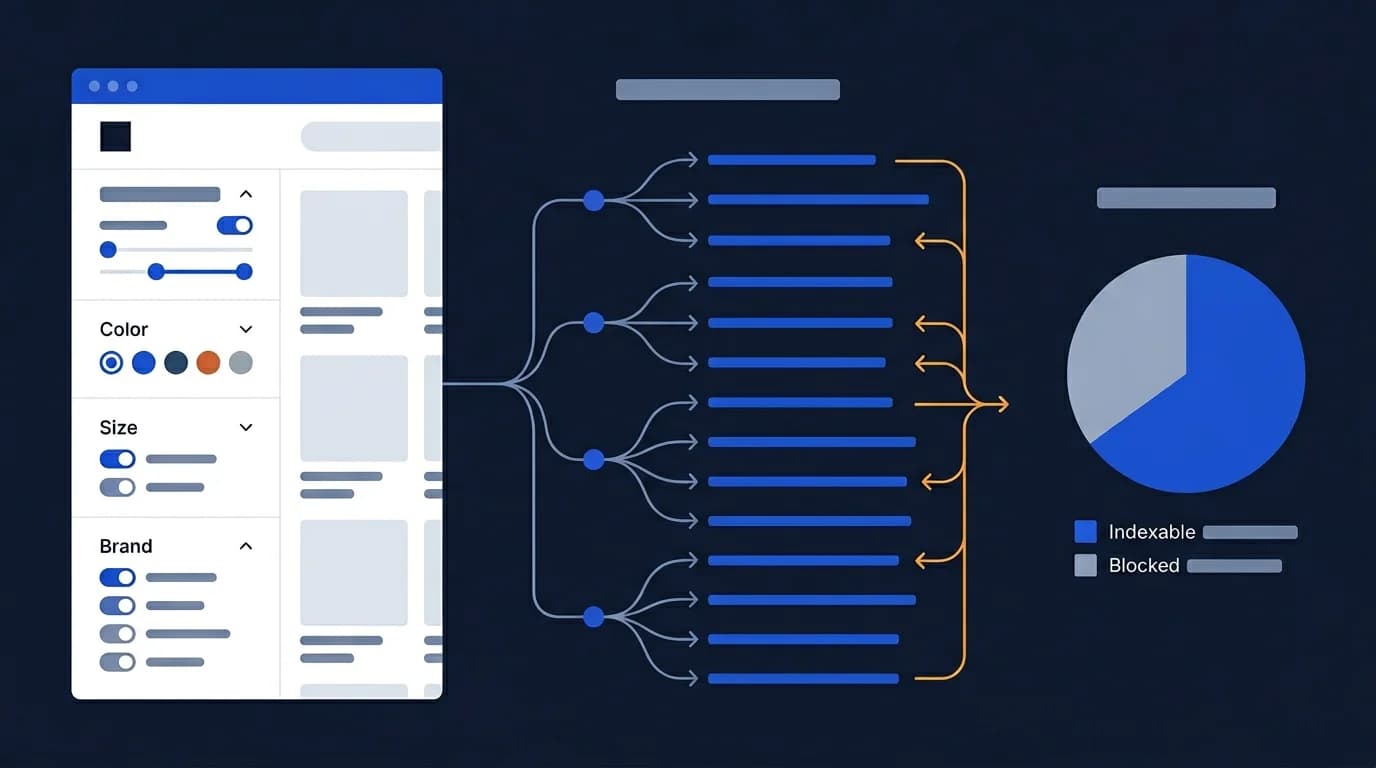
This guide explains how faceted navigation affects crawlability, canonical control, and indexation, and how technical teams should design filter systems that help users without overwhelming crawlers. Updated for April 2026, the patterns below reflect how filter sprawl is currently surfacing in crawl logs on large catalog and marketplace sites.
Why faceted navigation becomes dangerous at scale
Faceted navigation usually starts as a user-helpful filter layer. It becomes dangerous when the application exposes every filter combination as a crawlable URL without a clear policy for which states matter, a pattern Google has called out for years in its faceted navigation best and worst practices.
That usually leads to:
- parameterized URL sprawl
- duplicate or near-duplicate page states
- weak canonical signals
- crawl waste across low-value combinations
- delayed discovery of stronger primary routes
Why filter sprawl strains search systems
The issue is not that filtered URLs exist. The issue is that the site may be creating more crawlable states than search systems can justify spending time on.
Not every facet combination deserves search visibility
Some filtered pages can be valuable search targets. Many others are just temporary navigation states that help users browse but should not become standalone search destinations.
The strongest facet strategy usually separates, mirroring the pattern in Google's ecommerce search best practices:
- index-worthy facet combinations
- crawlable but non-indexable states
- states that should be consolidated or blocked from discovery
This is where teams often get into trouble. If every combination is treated as a potential landing page, the site creates a huge search-facing inventory with very uneven value.
Canonical policy is the core control layer
Faceted navigation often rises or falls on canonical discipline. Once filter states multiply, the canonical layer becomes the main way to define which URL should represent the route meaning.
Good facet SEO usually depends on:
- a clear preferred URL for the main category
- intentional self-canonicalization only for truly valuable facet pages
- collapse of low-value parameter combinations
- alignment between canonical logic and internal linking
- stable first-response metadata on filtered routes
How filter states scale into sitewide duplication
This is why faceted navigation overlaps so strongly with canonical issues on JavaScript websites and the broader technical SEO audit checklist. Filter states are where weak canonical systems tend to scale into sitewide duplication problems.
Parameter sprawl is really a crawl-budget problem
When a site generates too many faceted URL combinations, the crawler has to spend time evaluating routes that often contribute little unique value. That can delay or weaken attention on the pages that matter most.
Typical crawl-budget drains include:
- sort parameters
- session or tracking parameters
- overlapping filter combinations
- low-demand product or category slices
- filter states with almost identical item sets
Why crawlers also decide where not to spend time
This is where faceted navigation becomes directly tied to crawl budget optimization. The crawler is not only reading pages. It is deciding where not to spend more time.
Internal linking should reinforce the right facet states
Internal links help crawlers interpret which routes are important. If the site exposes every filter combination equally through crawlable links, it weakens prioritization.
A stronger setup usually means:
- main category pages receive the strongest architectural emphasis
- selected facet landing pages are linked intentionally
- low-value combinations are not promoted through strong crawl paths
- filter interactions do not create uncontrolled link graphs
This does not mean filters should be unusable. It means the crawlable architecture should reflect business and search value, not just the full mathematical set of filter possibilities.
Sitemaps should not amplify faceted URL noise
Sitemap policy should follow facet policy. If a facet state is not meant to rank, it probably should not appear in the sitemap inventory.
Typical safe rules include:
- include only the main category route by default
- include selected high-value facet pages when they have real standalone demand
- exclude crawl-only or low-value filtered states
- remove parameterized duplicates from sitemap generation entirely
Why facet policy and sitemap policy must align
This is one reason faceted navigation should be reviewed together with XML sitemap strategy, not as a separate frontend concern.
JavaScript-heavy filter systems add another layer of risk
Faceted navigation becomes more fragile when filter states are assembled mostly in the browser. If the crawler sees a thin shell, delayed filter state, or unstable metadata after hydration, the route can become both duplicative and hard to interpret.
Common JavaScript-related risks include:
- filter URLs generated only after interaction
- client-side canonical updates
- inconsistent metadata between base and filtered states
- bot-facing HTML that hides useful listing context
- large filter widgets that generate crawlable states without stable meaning
When rendering improves but policy still matters
This is where Next.js rendering decisions and prerendering can matter. Better machine-facing output helps, but the filter policy still has to be intentional.
A practical way to classify filter states
The strongest teams do not review filter URLs one by one forever. They classify them by route family and search value.
| Filter state type | Best default | Why |
|---|---|---|
| Main category page | Indexable | Strongest broad-intent landing target |
| High-demand curated facet | Potentially indexable | Can satisfy real standalone search intent |
| Multi-filter narrow combination | Usually consolidate or noindex | Often too thin or duplicative |
| Sort-only state | Usually not indexable | Changes order, not meaning |
| Tracking or session parameter state | Exclude entirely | No search value at all |
The point is not to suppress every filter. The point is to decide which states deserve to exist as real search entities.
Pagination and facets should be designed together
Category templates often combine faceted states and paginated states. If the team designs them separately, the site can produce a huge number of route combinations that are hard to control.
The safest pattern usually means:
- define the preferred facet state first
- decide whether deeper pagination is crawl-only or indexable
- keep canonicals, robots, and sitemap rules aligned across both layers
- avoid letting filter + page combinations generate uncontrolled inventories
This is why the pagination article and the faceted-navigation article should sit together in the architecture.
How to validate faceted navigation SEO
The strongest validation workflow usually includes:
- Sample important filter combinations by template.
- Check canonicals on the raw HTML response.
- Review whether the route is internally linked intentionally or just accidentally discoverable.
- Confirm whether sitemap logic matches the facet policy.
- Compare user-facing filter behavior with the crawler-facing route structure.
Useful support includes a crawler checker, an extract sitemap tool, and a view as bot vs prerender tool when rendering quality is part of the problem.
Common mistakes to avoid
The most common faceted-navigation mistakes are:
- self-canonicalizing every filter combination
- exposing sort states as indexable pages
- leaking facet URLs into sitemaps without policy
- letting tracking parameters survive into search-facing routes
- generating crawlable combinations that have no standalone demand
- relying on client-side filter behavior without stable machine-facing output
These problems usually do not come from one broken page. They come from missing route governance at the template level.
Conclusion
Faceted navigation helps users, but it can hurt SEO when the site turns every filter state into a crawlable search candidate. The strongest setups use clear route policy, intentional canonical logic, controlled sitemap exposure, and machine-readable output that keeps important categories strong while preventing low-value combinations from taking over the crawl graph.
For large websites, faceted navigation SEO is really about discipline. Decide which filter states deserve search visibility, make those routes stable, and keep the rest from diluting the site's crawl and indexation systems.
Content Cocoon
Faceted Navigation Editorial Cluster
This article should connect faceted navigation decisions back to crawl efficiency, canonical control, sitemap hygiene, and the broader technical SEO systems that determine whether filter-driven URLs help or harm visibility.
Internal Pathways
Canonical Issues on JavaScript Websites
A companion article for understanding how parameterized filters and route states create duplicate preferred-URL problems.
Crawl Budget Optimization
Useful when faceted URL sprawl is consuming crawler attention that should go to stronger primary routes.
Pagination and Infinite Scroll for SEO
Relevant when category architecture includes both filter states and paginated listing logic.
Technical SEO Audit
The parent service page for teams that need route-policy, canonical, and crawlability issues audited together.
External Technical References
Extract Sitemap Tool
Helpful for checking whether facet-driven URLs are leaking into sitemap inventories unnecessarily.
Crawler Checker
Useful for validating whether filter URLs are crawlable and what response bots receive on those states.
View as Bot vs Prerender
Helpful when faceted listing templates rely on JavaScript and teams need to compare bot-facing output.
Frequently Asked Questions
Is faceted navigation bad for SEO?+
Not automatically, but it becomes risky when the site exposes too many low-value filter combinations as crawlable or indexable URLs without clear canonical and crawl policy.
Should every filter combination be indexable?+
No. Most filter combinations should not become search targets. Only selected high-value facet states with real standalone demand usually deserve indexation.
Why are sort parameters usually weak for SEO?+
Because they change order rather than meaning. In most cases they create duplicate states without contributing useful unique search intent.
Should facet URLs be included in the sitemap?+
Only when that matches an intentional indexation policy. Low-value or crawl-only filter states usually should not appear in the sitemap inventory.