A technical SEO audit is only useful if it helps a team decide what to fix, why it matters, and how the implementation should be validated afterward. Too many audits stop at screenshots, crawler exports, or generic advice. Engineering teams need something more operational: a checklist that starts with discovery, moves through route-level validation, and ends with implementation-ready tasks.
That is especially important on modern websites where SEO problems are rarely isolated. A weak sitemap may overlap with broken canonical logic. A clean canonical may still fail because rendering is incomplete. Structured data may be valid in source code but missing from the first response. The audit needs to connect these systems instead of reviewing each one in isolation.
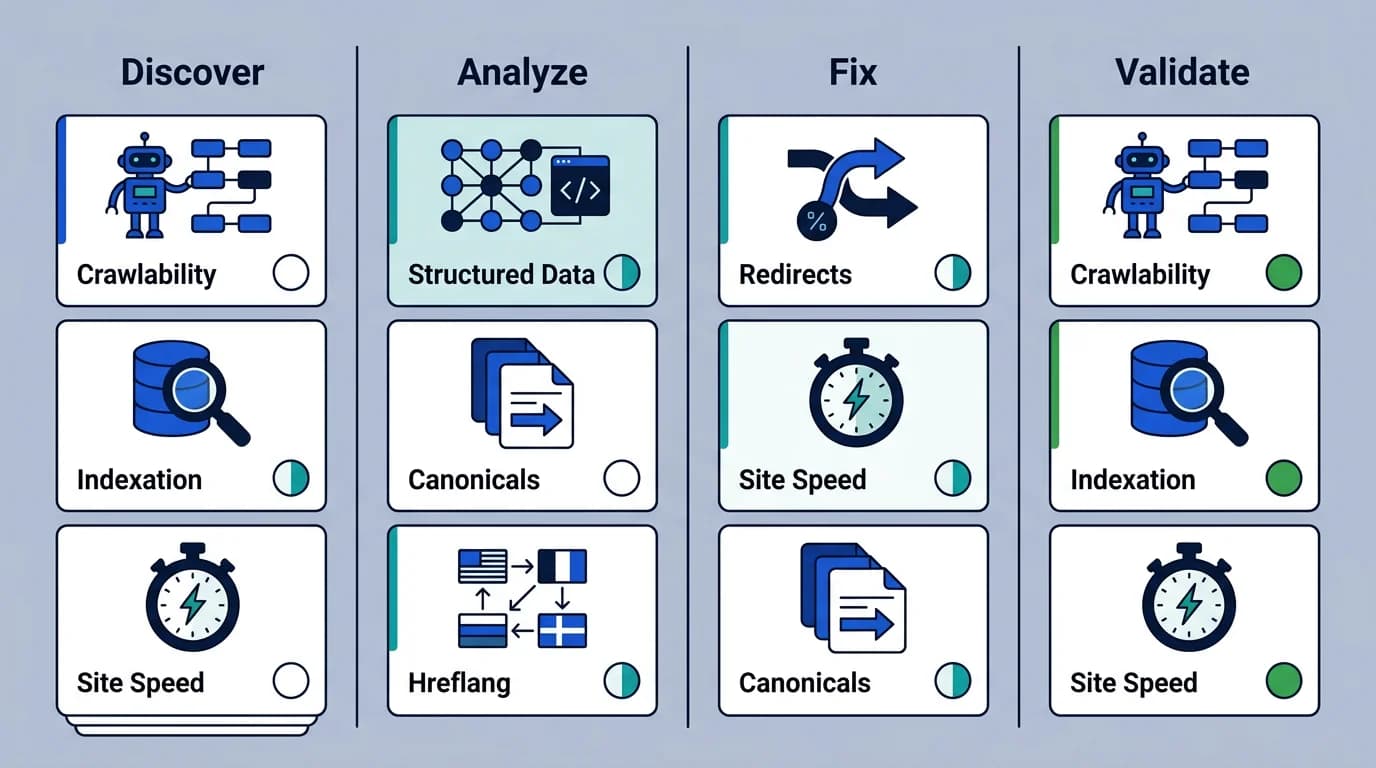
This guide explains what a strong technical SEO audit checklist should include, how to validate the most important systems, and how to turn findings into implementation-ready work for engineering and product teams. As of April 2026, this checklist reflects the audit shape we use against the latest Google crawling and indexation behavior.
What a technical SEO audit should actually produce
The goal of a technical SEO audit is not just to find issues. The goal is to explain which systems are failing, how those failures affect crawlability or visibility, and what should be done first.
A strong audit should produce, building on the foundations covered in Google's SEO starter guide:
- a prioritized list of issues by impact and implementation effort
- route or template grouping instead of random URL-level notes
- clear evidence of what bots actually receive
- direct links between symptoms and root causes
- validation steps for the fixes after rollout
Why audits should be decision tools, not reports
That is why the best audits sit between diagnostics and implementation. They are not only reports. They are decision tools. For teams working on modern frontend stacks, they often overlap directly with JavaScript SEO, technical SEO audit, and prerendering work.
Start with crawl control and discovery systems
The first part of the checklist should confirm whether crawlers can discover the right pages and avoid wasting time on the wrong ones, the core concern of Google's crawling and indexing documentation. This usually starts with robots.txt, XML sitemaps, and basic domain policy.
At minimum, the audit should check:
- whether
robots.txtexists and is reachable - whether the rules are valid and do not block important templates accidentally
- whether
robots.txtlinks to a live sitemap - whether the root sitemap exposes a valid
urlsetorsitemapindex - whether sitemap entries reflect real indexable URLs
- whether domain, protocol, and trailing-slash policies are consistent
Why discovery checks remain the foundation
These checks seem basic, but they still matter because every later layer depends on them. If crawlers are pointed to stale, blocked, or duplicate URLs, the site creates noise before rendering or metadata quality even enters the picture.
Validate redirects, preferred URLs, and 404 handling
Once discovery is stable, the next checklist layer is URL control. The site should tell crawlers which URL version is preferred and do so consistently across redirects, canonicals, internal links, and metadata.
The audit should confirm:
httptohttpsredirect behavior- preferred host behavior such as
wwwvs non-www - path normalization including trailing slash policy
- whether 404 routes return the correct status
- whether broken URLs collapse toward a stable not-found policy where appropriate
How weak URL control causes duplicate signals
When this layer is weak, duplicate signals spread quickly. Crawlers may split attention across near-identical paths, and canonical signals become less trustworthy. That is why URL control usually connects directly to canonical issues on JavaScript websites, not just redirect housekeeping.
Review per-page metadata as a system, not as isolated tags
Many audits check whether a page has a title, description, or canonical. That is not enough. The real question is whether the metadata system reinforces one stable interpretation of the route.
For each important page type, the checklist should review:
titleand meta description quality<link rel="canonical">with full preferred URLog:urlalignment with the canonical URL- page-type-specific Open Graph tags
- robots directives including special handling for pagination or thin templates
- whether metadata appears in the first response or only after hydration
Why metadata problems travel together
This system view matters because metadata problems often travel together. A route with unstable canonical logic may also expose the wrong og:url, the wrong schema url, and duplicate states across parameterized URLs. In production, that becomes an indexation problem, not just a tag problem.
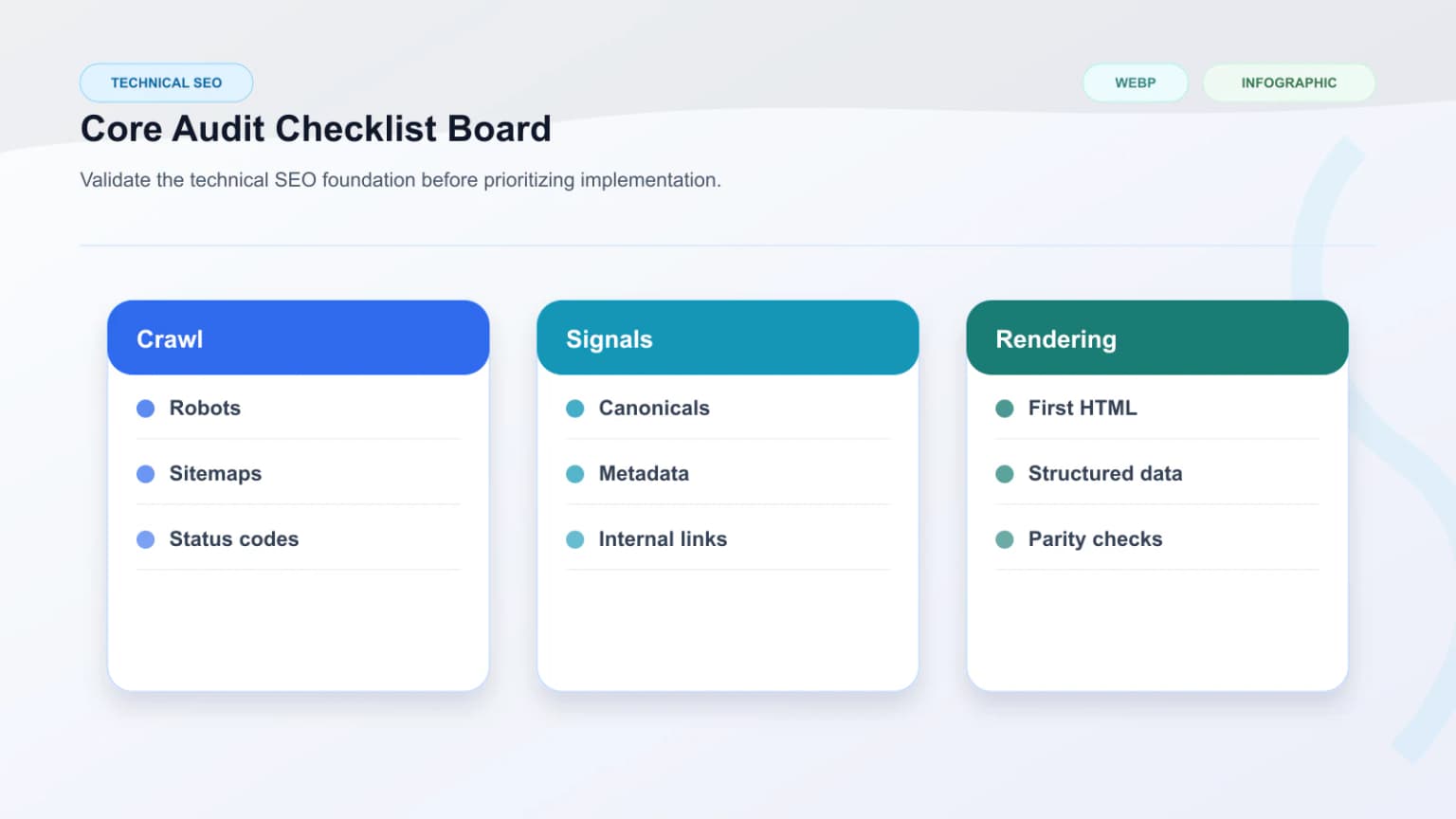
Structured data belongs in the audit checklist too
Structured data is not a decorative extra. It should be part of the audit because it helps define entities, page purpose, and machine-readable relationships, especially for answer-engine extraction.
The audit checklist should include:
- whether JSON-LD exists on the templates where it should
- whether the chosen schema type matches the page purpose
- whether schema URLs align with canonical URLs
- whether FAQ schema reflects visible page content
- whether schema is present in raw or prerendered HTML
- whether entity relationships remain stable across rendering paths
Why schema validity is not enough on its own
This is one area where a checklist becomes far more useful than a loose review. It forces the team to check not only validity but visibility. That matters for both classical search and AI visibility, especially when the page depends on client rendering. For the schema-specific layer, the companion guide on structured data for AI visibility goes deeper.
Rendering and first-response HTML should be in every modern audit
On JavaScript-heavy sites, a technical SEO audit that ignores rendering is incomplete. A page can look fine to a human and still be weak for bots if the first response is too thin or semantically incomplete.
The rendering section of the checklist should review:
- whether important headings and copy exist in raw HTML
- whether canonicals and metadata are present before hydration
- whether structured data is visible in the first response
- whether internal links are crawlable without client interaction
- whether route meaning changes between server, prerender, and hydrated states
When the rendering path is the real issue
This is often the point where teams discover that the issue is not just "SEO settings." It is the rendering path itself. On modern stacks, this overlaps directly with Next.js rendering decisions for SEO and AI visibility, why pages are crawled but not indexed, and route-level prerendering decisions.
After prerendering, the checklist should get more specific
If the site uses prerendering, the audit should not stop at "prerendering is installed." It should validate whether the machine-facing HTML is actually stronger and whether the delivery layer stays aligned with the live application.
That checklist usually includes:
- whether prerendering is applied to the intended public routes
- whether the snapshot contains complete content, metadata, and schema
- whether cache freshness matches content update needs
- whether bot-facing and user-facing meanings remain aligned
- whether components like cookie banners or accordions are handled intelligently for bots
- whether infinite scroll is replaced by crawlable pagination where needed
Feature checklist vs visibility checklist
This is the difference between a feature checklist and a visibility checklist. The real question is not whether prerendering exists. The real question is whether it improves machine-facing output without introducing parity risk.
A practical checklist by audit layer
The most useful audit structure groups checks by systems that can be owned and fixed.
| Audit layer | Core checks | Why it matters |
|---|---|---|
| Discovery | robots.txt, sitemaps, URL inventory | Determines what crawlers can find and prioritize |
| URL control | redirects, canonicals, 404 policy | Reinforces one preferred route per page |
| Metadata | title, description, OG, robots | Helps crawlers and social parsers interpret route purpose |
| Structured data | JSON-LD type, visibility, URL alignment | Improves machine-readable entity clarity |
| Rendering | first-response HTML, hydration, parity | Determines whether bots see the real page meaning |
| Internal linking | crawlable links, hierarchy, pagination | Supports discovery, context, and route importance |
| Performance and stability | response quality, errors, stale snapshots | Affects crawl reliability and machine trust |
This layered view also makes handoff cleaner because issues can be grouped by platform, frontend, content, or SEO ownership.
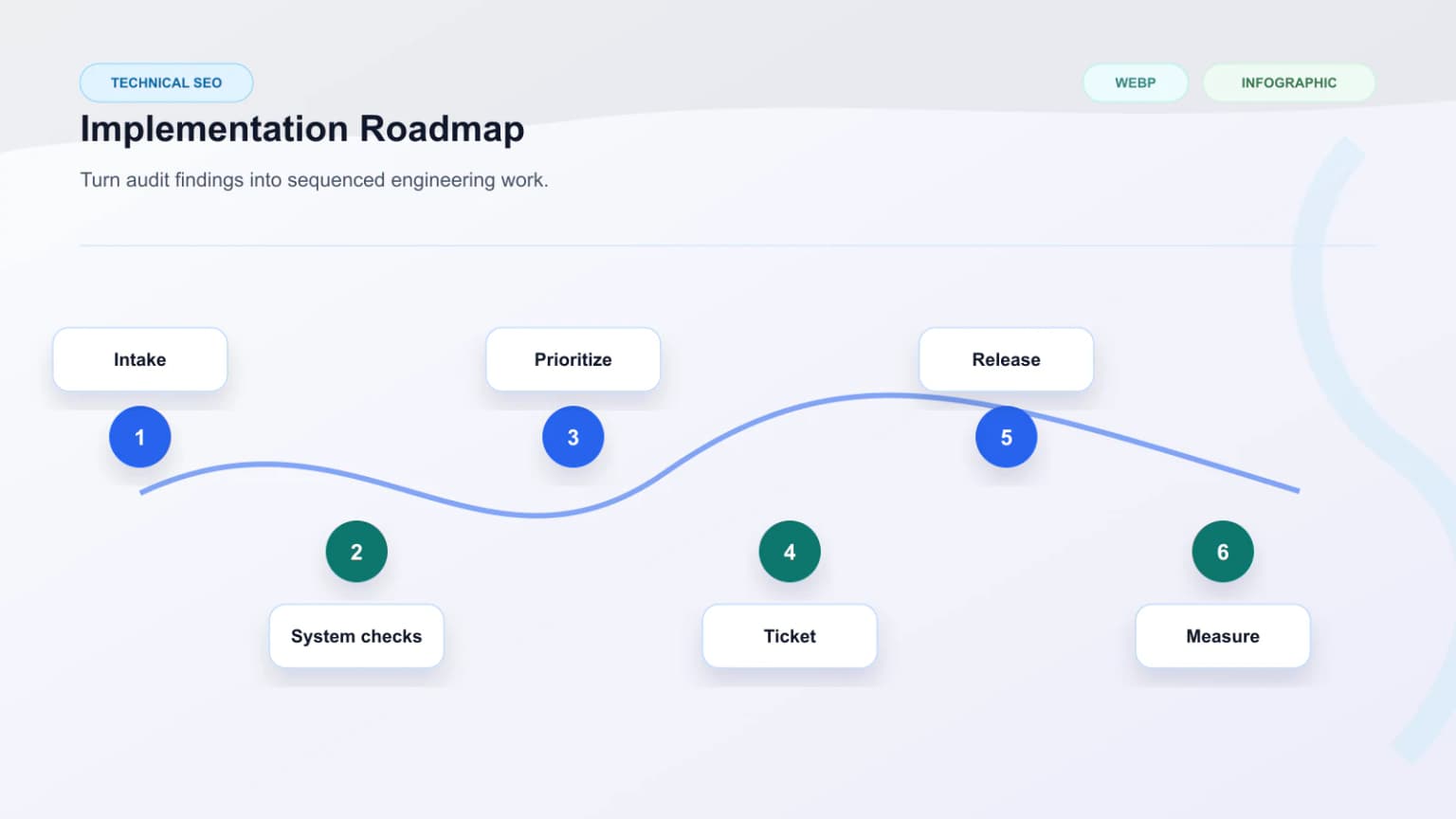
Turn audit findings into implementation-ready tasks
This is where many audits fail. They identify problems but do not tell the engineering team exactly what to build or validate next.
A useful implementation-ready task should include:
- the affected route group or template
- the observed behavior
- the expected technical behavior
- the likely root cause
- the proposed fix
- how to validate success after release
What an actionable task looks like in practice
For example, "canonical is wrong on some pages" is weak. "Category templates append filter parameters to canonicals after hydration, creating duplicate preferred URLs on faceted routes; move canonical generation to the server/prerender path and validate against raw HTML and sitemap targets" is actionable.
This format turns the audit into a real engineering input rather than a commentary document.
Suggested validation workflow after fixes ship
A technical SEO fix is not complete when the code merges. It is complete when the live route behaves correctly for bots.
After release, teams should validate:
- raw HTML on the affected route
- canonical and metadata alignment
- JSON-LD visibility and URL consistency
- sitemap exposure for indexable pages
- prerendered output if a machine-facing delivery layer is involved
Useful supporting checks include an SEO audit tool, an extract sitemap tool, and a prerender checker when route output depends on rendering stabilization.
Common mistakes in technical SEO audits
Even experienced teams fall into the same audit traps.
The most common ones are:
- reviewing tags without reviewing the rendering path
- focusing on random URLs instead of template families
- mixing severity with curiosity instead of business impact
- treating valid schema as sufficient even when it is invisible to bots
- stopping at diagnosis without writing implementation-ready tasks
- failing to validate fixes on the live route afterward
These mistakes make the audit feel thorough while still leaving the team unclear on what to do next.
Conclusion
A strong technical SEO audit checklist does more than verify tags and files. It connects crawl control, URL policy, metadata, structured data, rendering, and validation into one implementation workflow. That is what turns SEO auditing from a passive report into a practical engineering roadmap.
The best teams use the checklist to simplify decisions. They group issues by system, prioritize the templates that matter, and translate every meaningful finding into a fix that can be implemented and verified on the live site.
Content Cocoon
Technical SEO Audit Checklist Cluster
This article should connect audit checklist work back to rendering, indexation, schema, and the core service pages that help engineering teams move from diagnosis into implementation.
Internal Pathways
Technical SEO Audit
The parent service page for teams that need crawlability, rendering, metadata, and indexation problems turned into a scoped roadmap.
Canonical Issues on JavaScript Websites
A companion article for preferred URL drift, duplicate route signals, and canonical validation work.
Structured Data for AI Visibility
Useful when the audit checklist extends into schema, entity modeling, and machine-readable extraction quality.
Next.js Rendering Decisions for SEO and AI Visibility
Relevant when the audit findings depend on the rendering mode chosen for key public templates.
External Technical References
SEO Audit Tool
Helpful for running a structured audit pass across crawlability, metadata, rendering, and machine-facing output.
Extract Sitemap Tool
Useful when checking whether important URLs are actually exposed through XML sitemaps.
Prerender Checker
Helpful when validating whether crawler-facing HTML is complete after prerendering or rendering fixes.
Frequently Asked Questions
What should a technical SEO audit checklist include?+
It should include crawl control, sitemap validation, redirect policy, canonicals, metadata, structured data, rendering quality, internal linking, and post-release validation steps.
Why should rendering be part of a technical SEO audit?+
Because on modern JavaScript-heavy sites, bots may receive incomplete HTML even when the page looks fine in the browser. That directly affects crawlability, indexation, and AI visibility.
What makes an audit implementation-ready?+
Implementation-ready audits group findings by template or system, explain the expected behavior, identify root causes, propose fixes, and define how the team should validate success after rollout.
Should structured data be part of the checklist?+
Yes. Structured data should be reviewed for type accuracy, URL alignment, visibility in the first response, and consistency across rendering paths.