Redirecting bot traffic is not just a security decision. On JavaScript-heavy websites, it is often an infrastructure decision that determines whether crawlers receive usable HTML without exhausting the origin. The best implementations do not simply "send bots somewhere else." They classify traffic carefully, route only the right requests, and preserve semantic parity while moving expensive rendering work away from the main application path.
As of April 2026, this guide reflects current Google guidance on verifying Googlebot and the AI-crawler routing patterns we now see for OpenAI, Anthropic, and Perplexity user agents.
That is why bot redirection belongs between bot detection, prerendering, technical SEO, and the broader prerendering vs SSR vs SSG decision guide. Detection tells the system which requests are safe to trust. Redirection tells the proxy what to do next. If either layer is weak, the site can waste rendering capacity, misroute humans, or drift into compliance problems.
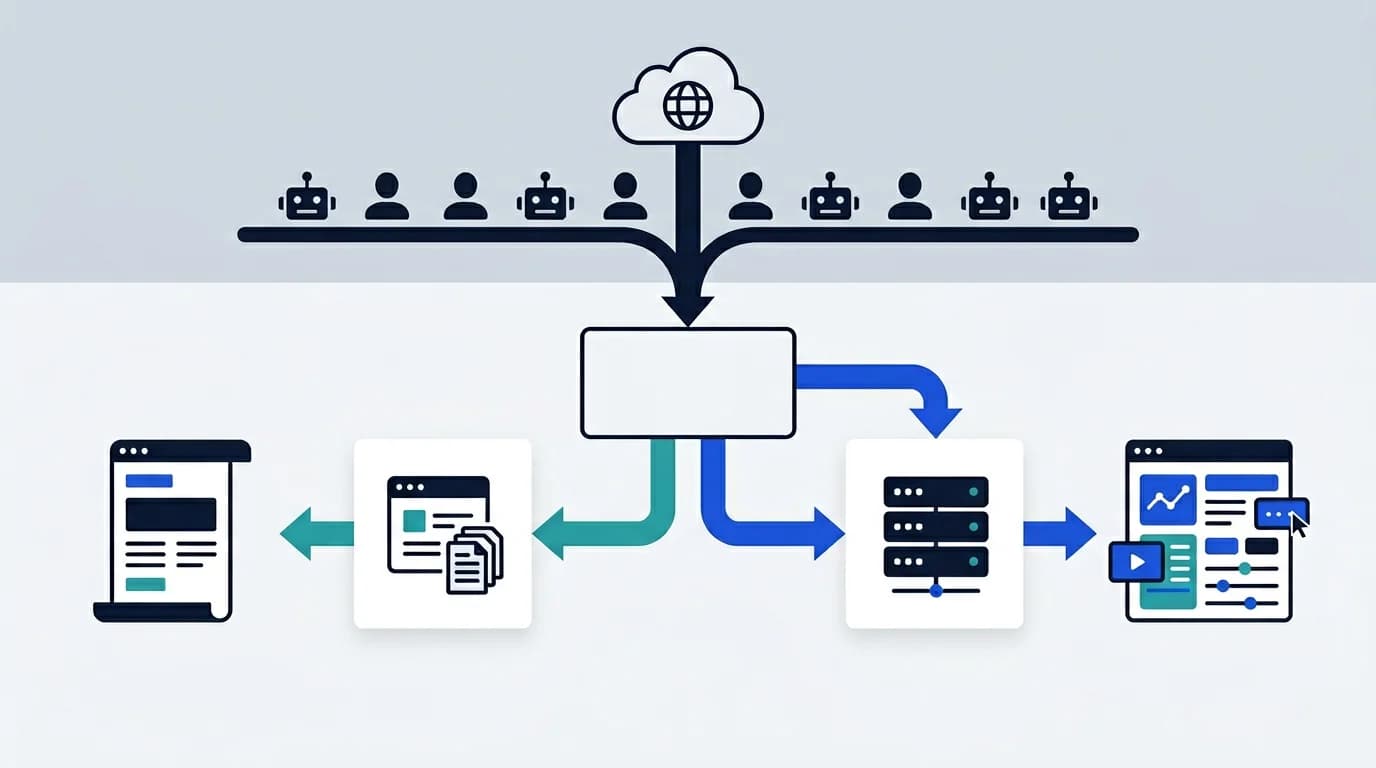
This article explains how bot traffic redirection works, which requests should be routed to prerendering, what fallback rules matter, and how to keep the setup compliant and operationally stable.
What Redirecting Bot Traffic Really Means
Redirecting bot traffic does not have to mean issuing a browser-visible 301 or 302. In most production setups, it means internal routing at the reverse proxy or edge layer. The request still targets the same public URL, but the infrastructure decides which backend path should fulfill it, in line with the equivalence model from Google's dynamic rendering documentation.
For verified crawler traffic, that usually means:
- accept the original public URL
- classify the request as a trusted machine client
- route it to a prerendering service or rendering middleware
- return serialized HTML for the same page
Why internal routing beats a visible redirect
This is why bot routing is usually an internal delivery decision rather than a user-facing redirect pattern.
Why Teams Redirect Verified Bots Instead of Serving Everything From Origin
Serving all bot traffic directly from origin can become expensive fast on JavaScript-heavy sites. Every crawler request may trigger route rendering, data fetching, and downstream application work that adds little value when the same page could be returned as deterministic HTML.
Teams usually introduce redirect logic because it helps:
- protect origin capacity during crawl spikes
- deliver machine-readable HTML faster
- reduce repeated rendering work on expensive routes
- keep human performance separate from crawler delivery needs
This is closely related to crawl budget optimization, because weak or slow machine-facing delivery wastes crawler attention and origin resources at the same time.
Redirect Logic Starts After Detection, Not Before
A common mistake is treating redirect rules as a simple User-Agent switch. That is too fragile. Bot redirection should start only after traffic has been classified with enough confidence.
A stronger decision model usually combines:
User-Agentevaluation- reverse DNS or IP verification for known crawlers
- reputation and request-pattern checks
- route eligibility rules
- explicit exclusions for private or personalized paths
Classification comes before routing
That is the key difference between classification and routing. The system first decides whether the request is a trusted bot. Only then should it decide whether that bot belongs in the prerender path.
The signals used for classification differ across crawler types, and the table below summarizes how teams typically verify the major bots seen in production logs:
| Bot | User-Agent pattern | IP / CIDR signal | Behavioral pattern | Verification method |
|---|---|---|---|---|
| Googlebot | Googlebot/2.1 | Google-published ranges | Steady crawl, respects robots.txt | Reverse DNS to googlebot.com then forward DNS |
| Bingbot | bingbot/2.0 | Microsoft-published ranges | Lower-frequency, predictable bursts | Reverse DNS to search.msn.com |
| GPTBot | GPTBot/1.x | OpenAI-published CIDR list | Deep crawl on documentation and articles | IP CIDR allowlist plus User-Agent |
| ClaudeBot | ClaudeBot/1.0 | Anthropic-published CIDR list | Selective retrieval on cited content | IP CIDR allowlist plus User-Agent |
| PerplexityBot | PerplexityBot/1.0 | Perplexity-published CIDR list | Spiky, query-driven retrieval | IP CIDR allowlist plus User-Agent |
| Malicious scraper | Spoofed (often Googlebot) | Datacenter / residential proxy ranges | High velocity, no robots.txt fetch | Reverse DNS fails, fingerprint anomalies |
Which Requests Should Be Routed to Prerendering
Not every automated request deserves the prerendering layer. The strongest candidates are verified search and AI crawlers hitting public routes whose initial HTML is too weak to express the real page meaning.
Typical candidates include:
- search engine crawlers, including those documented in Google's Googlebot reference
- answer-engine retrieval bots such as OpenAI's documented crawlers
- social bots that need stable metadata
- public listing and product pages
- documentation and programmatic landing routes
Route eligibility filters out unsafe candidates
The routes themselves should also be eligible. If a page is private, personalized, or unstable, it usually should stay out of the prerender path. The selection logic overlaps with which pages should use prerendering, because bot routing only helps when the target route is a safe candidate.
Reverse Proxy Patterns for Bot Redirection
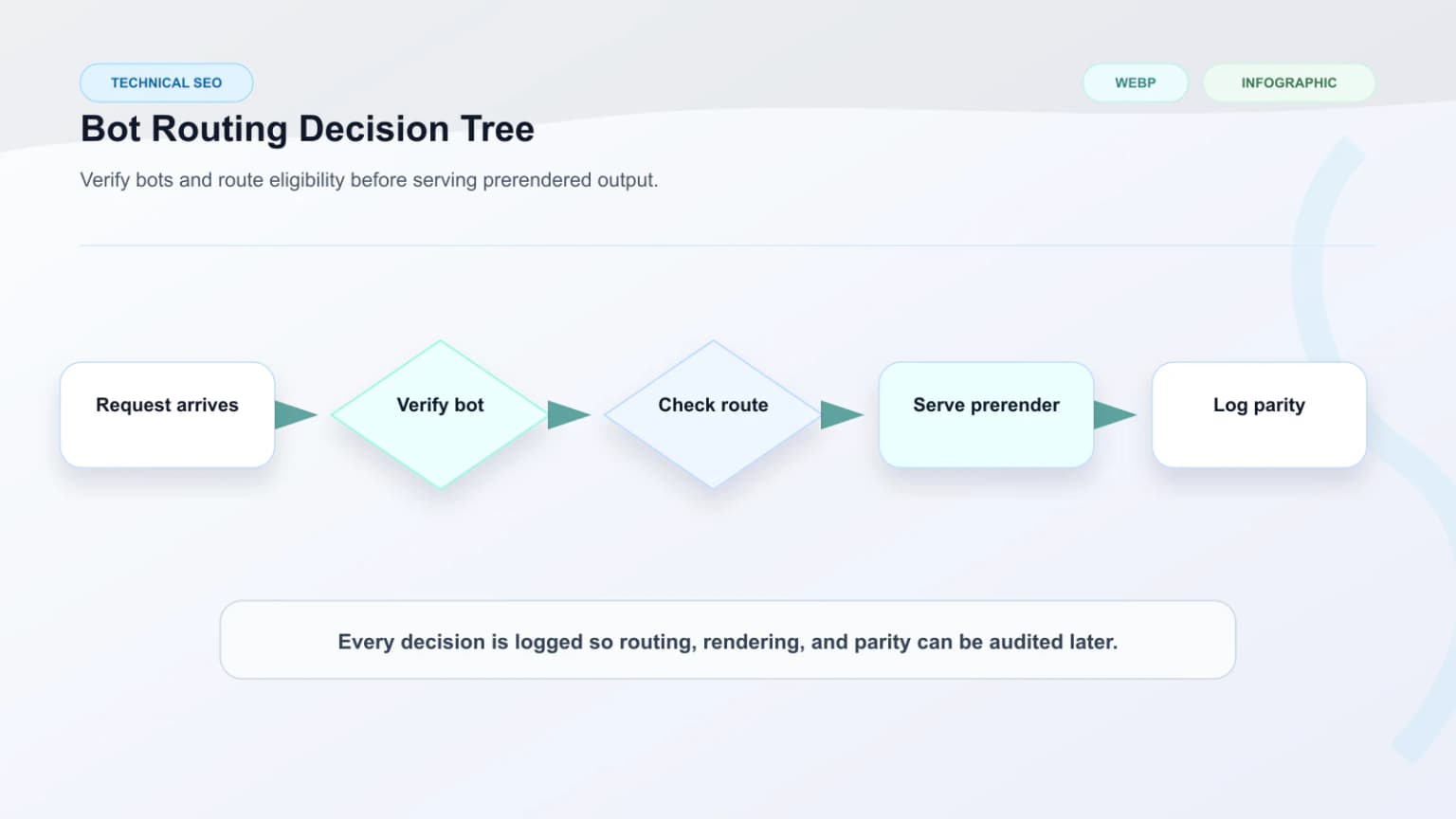
Most implementations put the routing decision in a reverse proxy, CDN worker, or edge function. The goal is to make the decision early, before the request reaches the expensive application path.
At a high level, the proxy should:
- inspect the request
- validate whether the client is a trusted bot
- check whether the route is eligible for prerendering
- forward the request to the rendering middleware
- return the machine-facing HTML without changing the public URL
This is why the redirect layer is really a controlled proxy handoff. The site is not changing destinations for SEO manipulation. It is changing execution paths to produce a reliable machine-facing response.
Fallback Behavior Matters More Than Teams Expect
Bot routing is not complete when the happy path works. Teams also need to decide what happens when prerendering fails, times out, or returns incomplete output.
Good fallback behavior usually includes:
- returning
503 Service Unavailablefor temporary rendering failures - avoiding silent empty responses
- preventing partial snapshots from being cached
- logging failed bot routes for audit and replay
- keeping timeout rules explicit and conservative
Signal failure honestly instead of serving broken HTML
The goal is to signal temporary failure honestly rather than serving broken machine-facing output. The external guide on HTTP status codes for bots is a useful reference for that layer.
Cache Strategy for Redirected Bot Traffic
Once bot traffic is routed to prerendering, caching becomes one of the most important operational controls. Rendering every bot request from scratch is expensive, but caching the wrong snapshot is risky.
Teams usually need:
- route-level cache eligibility
- fast invalidation after content changes
- exclusions for authenticated or market-specific views
- controls that prevent stale bot-facing metadata
- visibility into what snapshot version was served
This is one reason bot routing and cache design should be reviewed together. If the cache layer is weak, the site can return outdated machine-facing content even when the redirect logic itself is correct.
How to Keep Bot Redirection Compliant
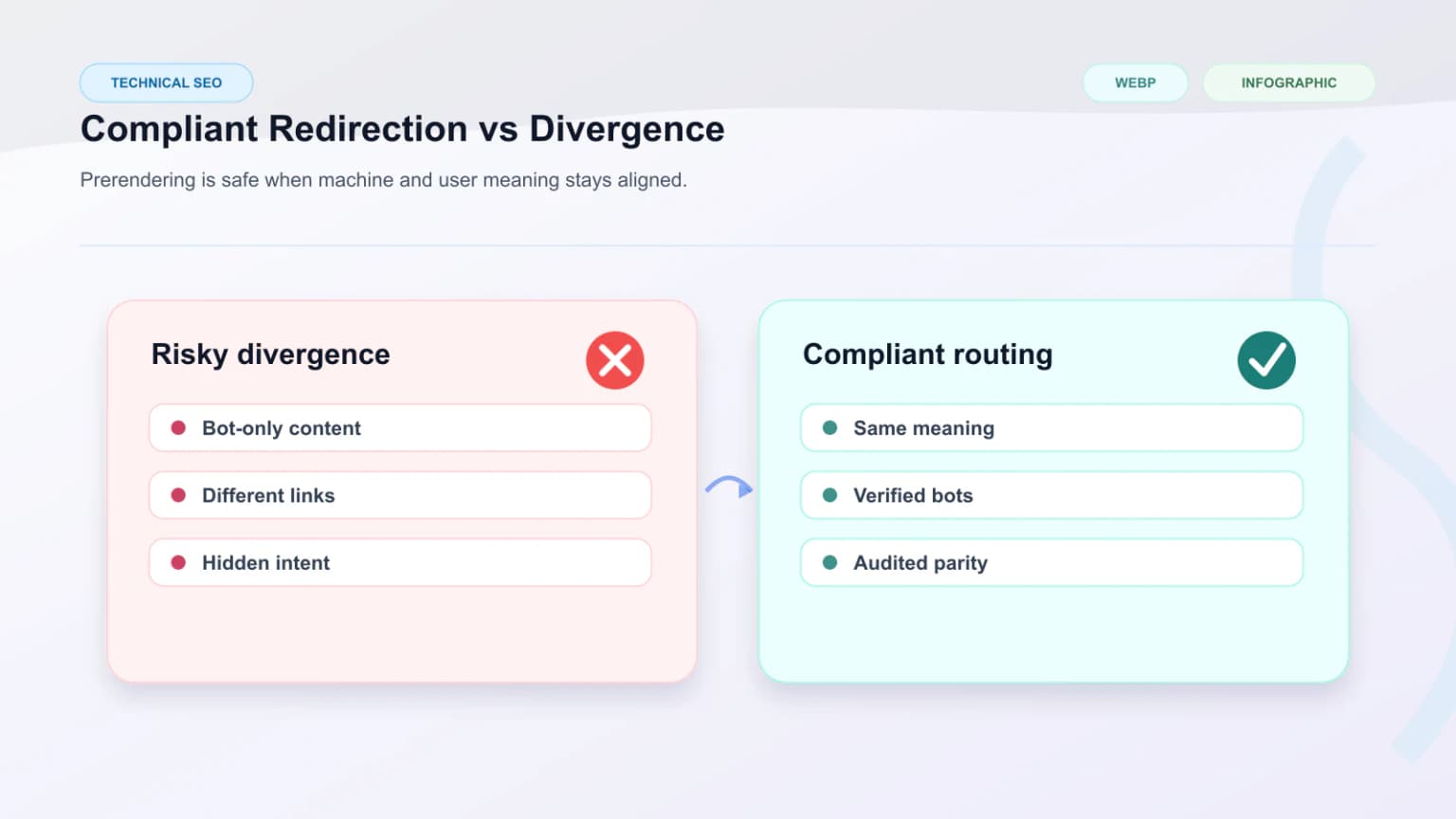
Bot-aware delivery becomes risky only when the redirected version stops matching what users actually get. The safe implementation changes delivery format and infrastructure path, not page intent.
To stay compliant:
- keep headings, body content, and entities aligned
- keep canonicals and metadata consistent
- exclude private and personalized routes
- validate prerendered output against the final user-visible route
- avoid crawler-only copy or destination changes
Where the cloaking line really sits
That is the same semantic parity rule covered in what is cloaking in SEO. Redirection is safe when it preserves meaning and unsafe when it changes it.
Cloudflare, Edge Workers, and Custom Proxy Rules
Cloudflare Bot Management and similar edge products can help with filtering and scoring, but they are not the same thing as route-level prerender delivery. Many teams use them for detection and then layer custom worker or proxy logic on top for the actual routing decision. The most common hosts for this layer are Cloudflare Workers, Vercel Edge Functions, and the Fastly edge cloud platform.
That hybrid model works well because:
- global edge filtering handles malicious traffic earlier
- custom rules keep crawler routing precise
- prerendering resources are reserved for verified bots
- the origin remains insulated from wasteful machine load
The main tradeoff is operational complexity. Teams need strong visibility into which requests were blocked, which were redirected, and which fell back.
A minimal Cloudflare Worker that classifies traffic and forwards verified bots to a prerender origin looks like this:
// Cloudflare Worker: route verified bot traffic to prerendering
const BOT_UA = /(googlebot|bingbot|gptbot|claudebot|perplexitybot)/i;
const PRERENDER_ORIGIN = "https://prerender.example.com";

export default {
  async fetch(request, env, ctx) {
    const ua = request.headers.get("user-agent") || "";
    const isBot = BOT_UA.test(ua);

    // Skip private and personalized routes
    const url = new URL(request.url);
    const ineligible = ["/account", "/checkout", "/dashboard"].some((p) =>
      url.pathname.startsWith(p),
    );

    if (isBot && !ineligible) {
      const proxied = new Request(
        PRERENDER_ORIGIN + url.pathname + url.search,
        request,
      );
      proxied.headers.set("X-Prerender-Token", env.PRERENDER_TOKEN);
      return fetch(proxied);
    }

    return fetch(request);
  },
};
The same pattern translates cleanly to a Vercel Edge Function or a Fastly Compute service, the routing decision lives at the edge, not inside the application.
How to Validate a Bot Redirection Setup
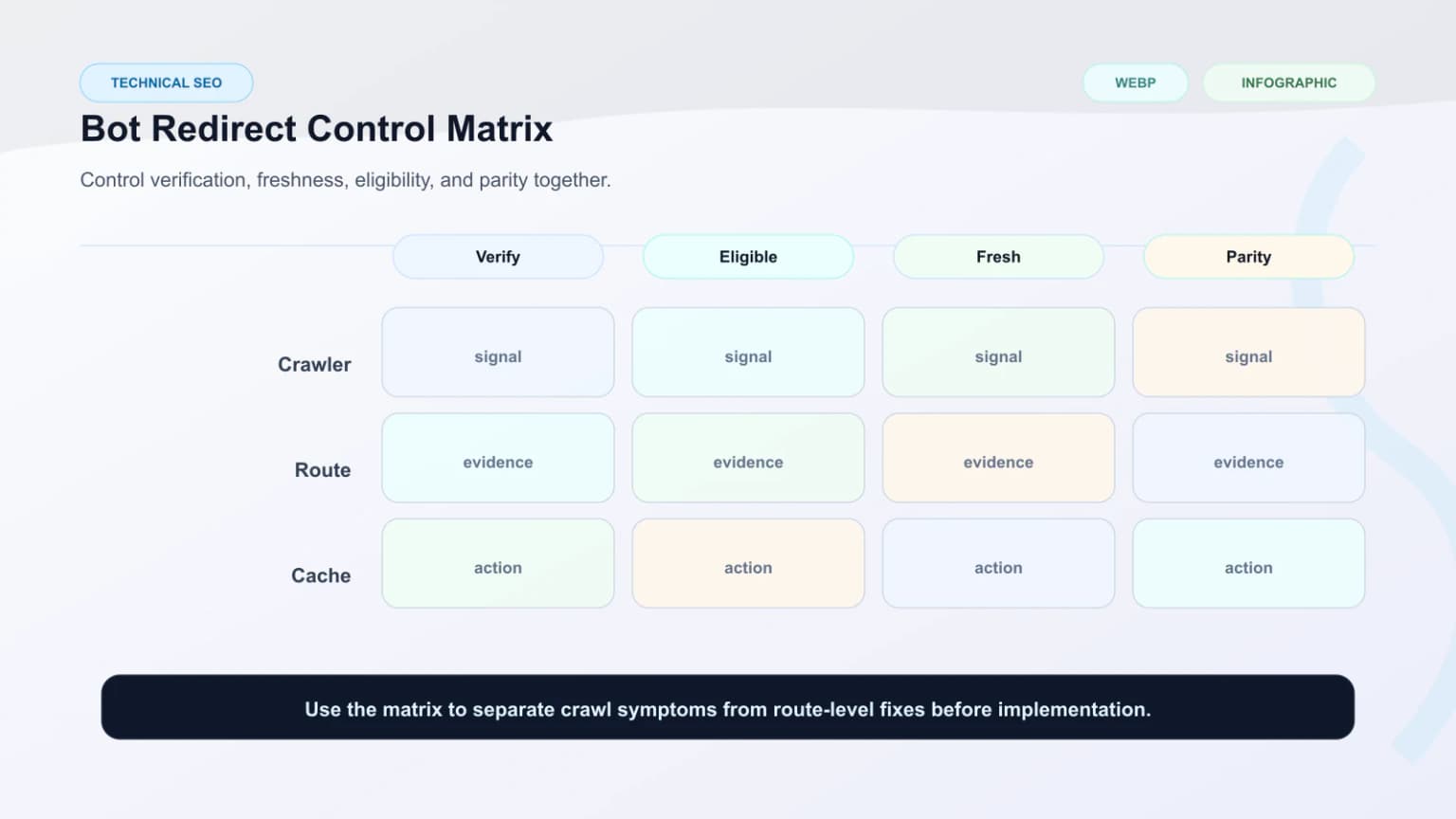
Validation should confirm both the routing decision and the resulting machine-facing output. It is not enough to know that the request hit the prerender path. The output still has to be complete, current, and aligned with the live route.
A strong validation checklist includes:
- whether trusted bots were routed correctly
- whether humans were kept out of the prerender path
- whether metadata and schema survived the handoff
- whether fallback logic returns the right status codes
- whether cache invalidation keeps snapshots fresh
- whether the machine-facing output matches the final route meaning
Confirming parity with the final route
Teams usually verify the last step with View as Bot vs Prerender before broader rollout.
| Strategy | Origin load protection | Crawler output quality | Operational risk |
|---|---|---|---|
| No bot routing | Low | Variable | Low |
Naive User-Agent redirect | Medium | Variable | High |
| Verified bot routing to prerendering | High | High | Moderate |
| Verified routing with cache and fallback controls | High | High | Low to moderate |
Conclusion
Redirecting bot traffic works best when it is treated as a controlled proxy decision rather than a blunt redirect trick. The system has to classify requests carefully, route only the right bots, and return the same page meaning through a more reliable machine-facing path.
On modern JavaScript-heavy websites, that combination can improve crawler delivery, protect origin capacity, and reduce rendering waste. But the benefits only hold when routing, cache behavior, fallback rules, and semantic parity are validated together.
Content Cocoon
Bot Redirection Editorial Cluster
This article should connect bot redirection logic back to detection quality, compliant prerendering, and the technical SEO work required to keep crawler-facing delivery stable and trustworthy.
Internal Pathways
Bot Detection and Offloading Bot Visits
The companion article for classifying machine traffic before any redirect or offload rule is applied.
Prerendering
The core service page for teams routing verified crawlers into deterministic machine-facing HTML.
What Is Cloaking in SEO?
Useful for validating that bot-aware redirection changes delivery mechanics without changing page intent.
Technical SEO Audit
Relevant when proxy rules, metadata parity, cache behavior, and indexation need to be reviewed together.
External Technical References
Prerendering Middleware Explained
A useful external reference for how reverse-proxy redirection works with prerendering infrastructure.
HTTP Status Codes for Bots
Helpful when defining fallback behavior and temporary failure responses for crawlers.
View as Bot vs Prerender
Useful for verifying that redirected bot traffic receives the intended machine-facing HTML.
Bridge CDN, edge delivery for crawlers
A pre-launch edge platform where bot routing and prerendered delivery sit in the CDN layer itself rather than in a worker placed in front of it.
Frequently Asked Questions
What does redirecting bot traffic usually mean?+
In most production setups it means internal reverse-proxy routing, not a visible browser redirect. The public URL stays the same while the request is fulfilled through a prerendering path for verified bots.
Should all bot traffic be redirected to prerendering?+
No. Only trusted bots hitting eligible public routes should usually be routed to prerendering. Private, personalized, or unstable routes should stay out of that path.
What happens if prerendering fails during bot routing?+
A good setup returns explicit temporary-failure responses such as 503, avoids caching broken snapshots, and logs the failure so teams can inspect and replay the route safely.
How do teams keep bot redirection compliant?+
They preserve semantic parity, keep metadata aligned, exclude private routes, and verify that the bot-facing output matches the final user-visible meaning of the page.