Category pages are often the most important organic landing pages on large ecommerce websites. They sit at the point where product discovery, taxonomy, filters, pagination, internal linking, and crawl behavior all meet. That makes them powerful, but it also makes them one of the easiest templates to weaken through uncontrolled URL states and thin listing architecture.
Strong category-page SEO is not mainly about adding a paragraph of copy above the products. It is about deciding which listing pages deserve indexation, how filters and pagination should behave, and how the template helps crawlers understand the category as a distinct search entity rather than as one more parameterized state. Updated for April 2026, this guide reflects the current Google ecommerce SEO documentation and the more focused best practices for ecommerce in Search, with crawl-budget context drawn from Google's large-site crawl management guidance and the broader technical SEO audit checklist.
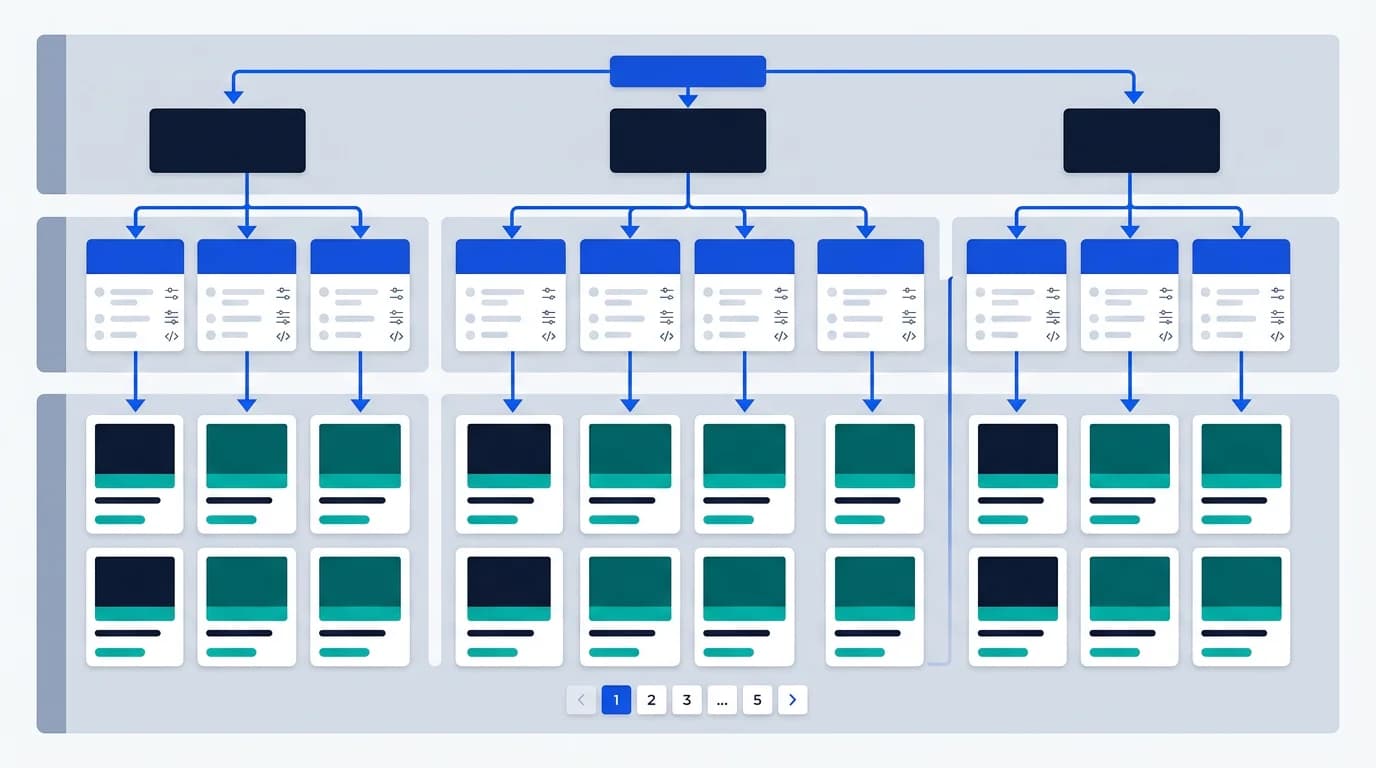
This guide explains how category pages should work on large ecommerce websites, which template decisions usually create the biggest SEO problems, and how teams can keep listing pages useful for both shoppers and crawlers.
Category pages are not just product containers
A weak category page behaves like a bucket of products. A strong category page behaves like a meaningful landing page for a distinct commercial intent.
That usually means the page should make it clear:
- what product group the route represents
- how it differs from adjacent categories
- how products within the set are related
- how the user can move deeper without losing meaning
When the category page fails to define the category clearly, the route becomes more replaceable by filtered states, product pages, or internal search results.
The main category page should usually be the strongest landing target
On most ecommerce sites, the main category route is the broadest and clearest version of the intent. It is usually the page that deserves the strongest internal-link support, the cleanest canonical logic, and the most stable place in the sitemap.
That is why the main category page often becomes the reference point for:
- self-canonical behavior
- filter consolidation
- pagination policy
- internal-link emphasis
- supporting category copy
If the main category route is weak, the whole listing system becomes easier to fragment.
Listing-page value matters more than teams expect
Search engines do not only evaluate the products on the page. They evaluate whether the listing itself adds value as a route.
Strong category pages often include:
- a clear category definition
- meaningful product grouping
- concise supporting copy or buying context
- navigable subcategory or refinement pathways
- metadata that reflects the real category scope
The goal is not to stuff the template with generic copy. The goal is to help the route stand on its own as a useful entity inside the site architecture.
Faceted navigation should support category SEO, not replace it
Filters can help users narrow a category, but the base category page should still remain the strongest broad-intent route unless there is a deliberate case for an indexable filtered page.
That usually means:
- the base category owns the broadest intent
- selected facet pages are elevated intentionally
- most filter combinations stay out of the indexable core
- canonicals and links reinforce the preferred category route
Why facet policy decides category-template strength
This is why ecommerce category SEO overlaps directly with faceted navigation SEO for large websites. On commerce stacks, category templates are often where facet policy becomes either powerful or dangerous.
Pagination policy should be part of the category strategy
Large product inventories usually require pagination, but not every page in the sequence deserves the same search role.
Healthy category-page strategy usually defines:
- which page in the sequence is the main landing route
- whether deeper pages are crawlable but not primary targets
- how pagination links support discovery without creating thin-value inventory
- how pagination interacts with filters and sorting
Why filters and pagination need one combined policy
This is why category pages connect naturally with pagination and infinite scroll for SEO. Listing templates need one policy for filters and pagination together, not separate rules that collide in production.
Category taxonomy should be visible in the template
A category page becomes stronger when the route clearly reflects where it sits inside the broader product taxonomy.
That often means:
- visible subcategory paths
- meaningful breadcrumb structure
- internal links to related collections
- clear distinction between parent and child categories
Why a clear route hierarchy outperforms improvised taxonomy
This is also where category SEO overlaps with site taxonomy and URL architecture for large websites. Category pages perform better when the route hierarchy is understandable rather than improvised.
Category copy should clarify, not pad
Many ecommerce teams add boilerplate copy to listing pages because they know the route needs some textual context. That instinct is understandable, but weak copy often makes the template worse.
Useful category copy usually:
- defines the category clearly
- explains differentiators or buying considerations
- introduces key subtypes or product attributes
- supports the primary commercial intent of the route
Signs the category copy is hurting the template
Weak category copy usually:
- repeats phrases with little informational value
- says the same thing across many categories
- pushes meaningful product signals too far down the page
- creates near-duplicate blocks across sibling templates
On large sites, repetitive category copy can quietly turn into a duplication problem.
Category pages need machine-readable stability
Category templates often rely on client-side filtering, sorting, lazy loading, and interactive grid behavior. That makes machine-facing stability especially important.
Teams should validate whether category pages expose:
- stable titles and canonicals
- useful product and category context in raw HTML
- breadcrumbs and structured data where appropriate
- category meaning before heavy interaction
Why JS-heavy listings often need prerendering
This overlaps with Next.js rendering decisions for SEO and AI visibility and prerendering when JS-heavy listing templates otherwise ship thin or unstable first responses.
Internal links should reinforce the most valuable listing routes
Category templates become stronger when internal links help crawlers understand which listing routes matter most.
Healthy internal-link patterns often include:
- strong links from navigation and hubs to top categories
- contextual links between adjacent high-value categories
- subcategory links that reflect real buyer journeys
- limited crawl promotion for low-value filtered combinations
Without this discipline, the site may expose many listing states with no clear prioritization.
A practical framework for category-page SEO at scale
For large ecommerce sites, a workable framework is:
- Define the main category route for each broad intent.
- Decide which filtered states, if any, deserve search visibility.
- Set pagination policy for discovery versus landing-page role.
- Add only category copy that strengthens route meaning.
- Keep canonicals, breadcrumbs, and sitemap logic aligned with the preferred routes.
- Validate raw HTML on representative listing templates and states.
This turns category pages into governed landing-page systems instead of uncontrolled product containers.
Common category-page SEO mistakes
The most common mistakes are:
- letting filtered pages compete with the main category route
- creating pagination and filter combinations without policy
- using repetitive copy across many category pages
- relying on thin client-rendered listing shells
- leaking non-canonical category states into sitemaps
- treating category pages as utility routes instead of landing pages
These mistakes usually come from weak template governance rather than from one missing tag.
Conclusion
Ecommerce category-page SEO works best when category templates are treated as strategic landing pages with clear route ownership, controlled filter policy, crawl-aware pagination, and machine-readable stability.
The strongest teams do not try to make every listing state rank. They strengthen the main category routes, elevate only the filtered pages that deserve it, and keep the rest from diluting crawl and indexation systems.
Content Cocoon
Ecommerce Category Page SEO Cluster
This article should connect ecommerce category-page strategy back to faceted navigation, pagination policy, taxonomy, and the broader technical SEO systems that determine whether listing templates become strong landing pages or noisy crawl sinks.
Internal Pathways
Faceted Navigation SEO for Large Websites
A companion article for understanding which filter states should strengthen category SEO and which should stay out of the search-facing architecture.
Pagination and Infinite Scroll for SEO
Useful when category templates span multiple listing pages and need a clear policy for crawlability and indexation.
Site Taxonomy and URL Architecture for Large Websites
Relevant when category paths, collection hierarchies, and route ownership need to stay stable across a large ecommerce inventory.
Technical SEO Audit
The parent service for teams diagnosing listing-page architecture, category templates, crawl efficiency, and indexation quality together.
External Technical References
Crawler Checker
Helpful for checking whether category pages and representative filtered states return strong machine-facing HTML.
Extract Sitemap Tool
Useful for validating whether only canonical category URLs are exposed in the ecommerce sitemap inventory.
SEO Audit Tool
Helpful for reviewing category metadata, status codes, and crawl-facing template issues together.
Frequently Asked Questions
What makes an ecommerce category page strong for SEO?+
A strong category page clearly defines the product group, acts as a stable landing page for broad intent, and keeps filters, pagination, canonicals, and internal links aligned around that role.
Should every filtered category page be indexable?+
Usually no. Most filter combinations are temporary browsing states, while only selected high-value facet pages deserve independent search visibility.
How important is category copy?+
It matters when it clarifies the route and supports buying intent, but repetitive boilerplate across many listing pages can create duplication and weaken the template.
Why do category pages often break at scale?+
Because filters, pagination, sorting, and JS-heavy grids create many route states without a clear policy for which pages are primary, which are supporting, and which should stay out of the search-facing architecture.