Large websites rarely struggle because one URL is ugly. They struggle because the site keeps adding new sections, route families, filters, locales, and content types without a stable taxonomy underneath them. Once that happens, URL architecture stops being a naming detail and becomes a crawl, duplication, and indexation problem.
That is why site taxonomy matters so much. A clear taxonomy helps search engines understand how routes relate, which pages are parents, which are children, and which paths represent distinct concepts rather than accidental route states. On large websites, that clarity affects crawl prioritization, canonical stability, internal linking, and the overall trustworthiness of the information architecture.
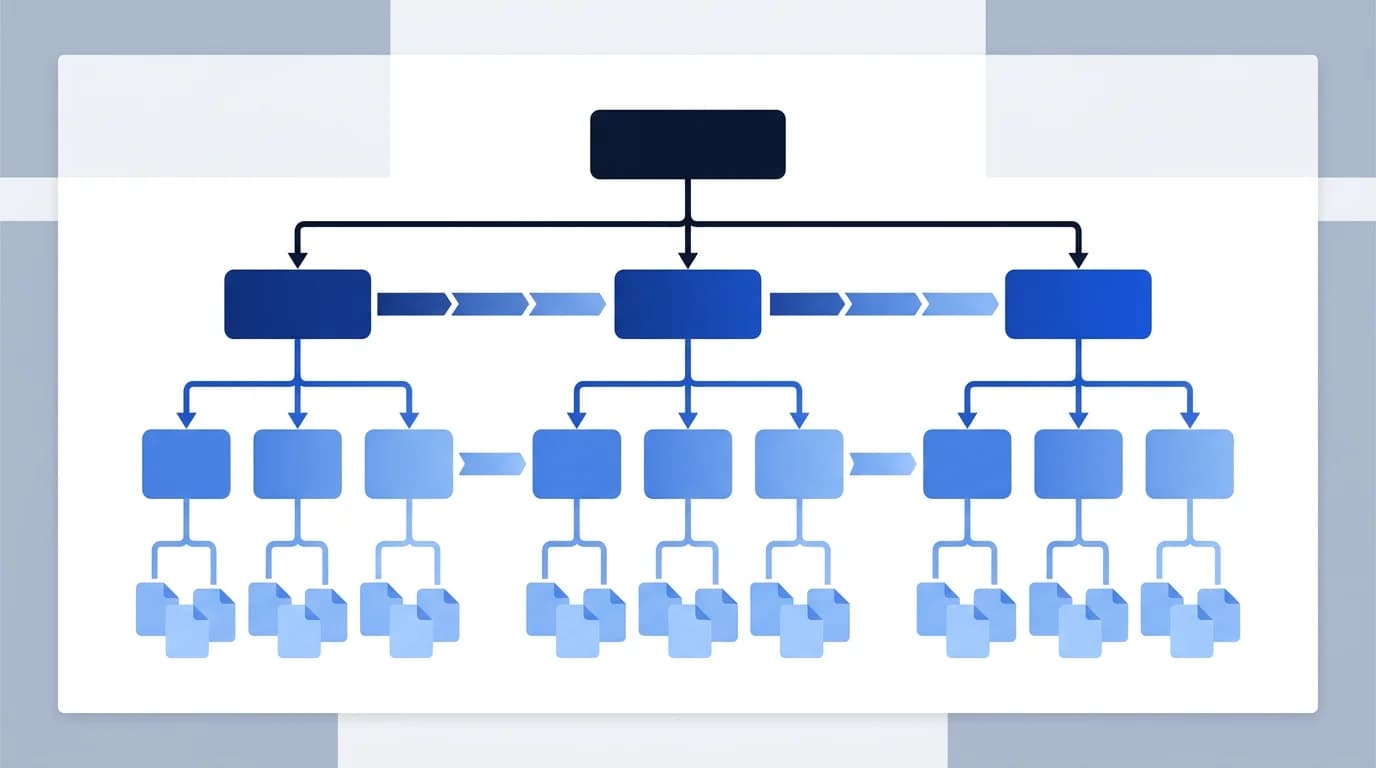
This guide explains how to design taxonomy and URL architecture for large websites, which patterns usually create structural SEO problems, and how technical teams can keep route hierarchy stable as the site grows. As of April 2026, this guide reflects the architectural patterns we still see causing crawl and indexation regressions on large multi-template sites.
Taxonomy is the system behind the URLs
A taxonomy is not just a set of categories in the CMS. It is the logic that decides how topics, products, services, locations, guides, and supporting pages are grouped.
Strong taxonomy usually defines, echoing what Google describes in its structure of an ecommerce site reference:
- what the main entities of the site are
- which sections belong under which parent paths
- how route families differ from one another
- how users and crawlers move between related areas
- which pages should behave as hubs versus leaf pages
Why a CMS category list is not a taxonomy
If the taxonomy is weak, the URLs may still work technically, but the site becomes harder to understand as a system.
URL architecture should make route roles legible
A good URL does not need to describe every nuance of the page. It does need to make the route role understandable.
For large websites, healthy URL architecture usually means, in line with Google's URL structure guidance:
- stable parent paths
- predictable naming rules
- consistent path depth within route families
- one primary path for each concept
- minimal reliance on parameters for core content states
This helps crawlers interpret the difference between hub pages, child pages, category routes, and temporary interaction states.
Route hierarchy affects crawl prioritization
Search engines often infer importance from how routes sit inside the site structure. Pages that live closer to strong parent routes and are easier to reach through the internal-link graph tend to be discovered and prioritized more efficiently.
That means taxonomy and crawl behavior are directly connected. Weak hierarchy often leads to:
- important pages buried too deep
- inconsistent parent-child paths
- orphaned clusters
- crawl effort spread across low-value branches
How weak hierarchy hides valuable routes
This is why taxonomy design overlaps with why pages are discovered but not crawled and the broader technical SEO audit checklist. A route can be valuable in theory and still be weak in practice if the architecture hides it.
Stable taxonomy reduces duplicate route growth
Many duplicate-content problems begin with weak taxonomy. If the site has no clear rules for which concept owns which path, multiple sections start publishing overlapping pages that look different in the URL but not different enough in meaning.
Common structural causes include:
- multiple parent paths for the same topic
- category and guide pages covering the same intent
- location and service branches colliding
- route families that can be generated from several entry points
How clean taxonomy prevents overlapping ownership
This is where taxonomy connects directly to duplicate content at scale. The cleaner the taxonomy, the easier it is to avoid overlapping route ownership.
Path depth matters less than path clarity
Teams often obsess over making every URL as short as possible. For large websites, clarity is usually more important than extreme brevity.
Deep paths are not automatically bad if they:
- reflect real hierarchy
- stay consistent across the section
- help distinguish route roles
- avoid creating ambiguous siblings
The real problem is not depth alone. The real problem is messy depth, where similar route families use different structures for no clear reason.
Naming systems should scale before the content does
Large sites often begin with intuitive naming and then drift into inconsistency as new sections appear. Over time that creates route confusion across teams and across crawlers.
Healthy naming systems usually:
- use one term for one concept
- avoid multiple synonyms for the same section
- keep pluralization and slug style consistent
- separate informational, commercial, and utility paths clearly
This matters because taxonomy weakens when naming decisions are made ad hoc by whichever team launches the next section.
Parameters should not replace core architecture
Parameters can be useful for tracking, sorting, filtering, and temporary user state. They are usually a poor substitute for core URL architecture.
Problems start when parameters are used to represent:
- important category states
- locale or market intent
- permanent content variations
- core listing logic that should have stable paths
Why parameter-driven core architecture grows duplicate risk
Once that happens, canonical control becomes harder, duplicate-risk grows, and the site starts treating temporary states like first-class routes. This connects directly to faceted navigation SEO and canonical issues on JavaScript websites.
Taxonomy should support both hubs and route families
A strong architecture distinguishes between:
- hub pages that organize a topic or section
- child pages that go deeper
- operational route families such as categories, products, or locations
- utility states that should not behave like primary search entities
How taxonomy reinforces hub-and-cluster architecture
This is where taxonomy overlaps with knowledge hub and topical authority architecture. Hubs become stronger when the surrounding route system is orderly, and route families become safer when the taxonomy makes their jobs explicit.
Canonicals work better when taxonomy is stable
Canonical tags are much easier to manage when the site already has one clear path for each concept. If taxonomy is unstable, canonicals end up compensating for structural ambiguity instead of simply reinforcing a strong route model.
Stable taxonomy usually improves:
- preferred URL consistency
- internal-link alignment
- sitemap cleanliness
- route-family ownership
How stable taxonomy prevents canonical problems
That is why taxonomy design often prevents canonical problems before they appear.
A practical framework for large-site URL architecture
For most teams, a useful framework is:
- List the core entity types and section types on the site.
- Decide which of them deserve stable parent paths.
- Assign one clear route role to each major family.
- Separate primary search entities from utility or temporary states.
- Review whether any concepts are being published under multiple path systems.
- Align internal links, canonicals, and sitemaps with that structure.
This turns URL architecture into a governed system instead of a patchwork of section-level decisions.
Signs the site taxonomy is getting weak
Common signals include:
- the same concept appearing under several sections
- frequent debates about where a new page "belongs"
- similar route families using different path conventions
- important pages sitting far from obvious parent routes
- canonicals compensating for structural overlap
- sitemap inventories that do not reflect a clean hierarchy
These signs usually appear before the traffic loss becomes obvious.
Conclusion
Site taxonomy and URL architecture are foundational technical SEO systems on large websites. They shape crawl paths, route ownership, duplicate risk, canonical clarity, and topic hierarchy long before any one metadata tag gets involved.
The strongest large sites decide their taxonomy deliberately, keep URL roles predictable, and make route hierarchy easy to understand for both users and crawlers. That is what turns a growing site into a scalable information architecture instead of a collection of expanding route problems.
Content Cocoon
Site Taxonomy and URL Architecture Cluster
This article should connect taxonomy and URL architecture back to crawl prioritization, duplicate prevention, knowledge-hub structure, and the broader technical SEO systems that determine whether a large site feels orderly or noisy to crawlers.
Internal Pathways
Knowledge Hub and Topical Authority Architecture
A companion article for understanding how topic clusters depend on stable route hierarchy and predictable parent-child structure.
Duplicate Content at Scale for Large Websites
Useful when weak taxonomy produces overlapping route families and near-duplicate URL states.
Why Pages Are Discovered but Not Crawled
Relevant when important pages sit too deep or too far from strong parent routes in the crawl graph.
Technical SEO Audit
The parent service for teams reviewing taxonomy, route structure, crawl paths, and canonical policy together.
External Technical References
Extract Sitemap Tool
Helpful for validating whether sitemap inventories reflect the intended taxonomy and only canonical route families.
Crawler Checker
Useful for checking whether important route families are easy for crawlers to fetch and interpret.
SEO Audit Tool
Helpful when route hierarchy, metadata, and canonical issues need to be reviewed together across large site sections.
Frequently Asked Questions
What is site taxonomy in SEO terms?+
It is the structural logic that decides how topics, sections, route families, and page roles are grouped so the site stays understandable to users and crawlers.
Does URL depth matter as much as people think?+
Usually not as much as path clarity and consistency. Deep URLs can work well when they reflect real hierarchy instead of random complexity.
Why do large websites get taxonomy problems?+
Because new sections, content types, filters, and route families are often added without one governing model for path ownership and section logic.
How does taxonomy affect SEO directly?+
It affects crawl prioritization, duplicate risk, canonical stability, internal linking, sitemap clarity, and how easily search engines can interpret route hierarchy.