Next.js gives teams several rendering options, but that flexibility can become a source of SEO and AI visibility problems when no one is explicitly deciding which mode should serve which template. A route that looks acceptable in the browser may still be weak for crawlers if the first response is too thin, the cache is stale, or the machine-facing output changes across rendering paths.
As of April 2026, this guide reflects the current Next.js App Router rendering model and how its server-first defaults interact with crawler and answer-engine expectations.
That is why rendering in Next.js should be treated as a visibility decision, not only as a frontend implementation detail. For search engines and answer engines, the important question is not whether the app eventually becomes correct. The important question is what the route communicates in the first response and how consistently that meaning survives caching, regeneration, hydration, and deployment.
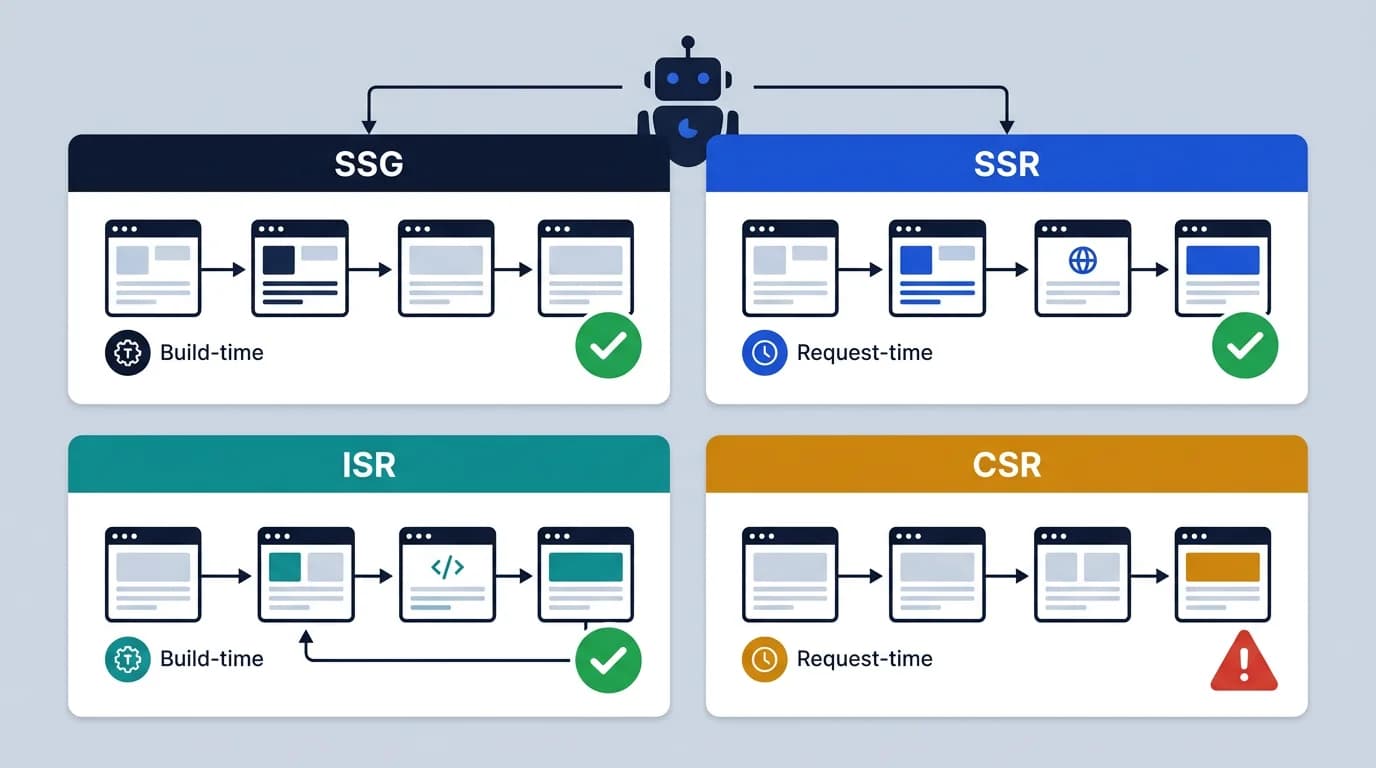
This article explains how to think about SSG, ISR, SSR, dynamic rendering patterns, and prerendering as practical delivery choices, building on the broader prerendering vs SSR vs SSG decision guide. The goal is not to pick one global rendering religion. The goal is to match each page type to the rendering path that produces the best machine-readable result with the least operational risk.
Why rendering choices affect SEO and AI visibility directly
Search crawlers and answer engines evaluate the route they receive, not the architecture diagram in the repo. If the chosen rendering path delays the meaningful content, strips entity signals, or creates unstable metadata, the page becomes harder to index, cite, or trust, which is a recurring theme in Google's JavaScript SEO basics guidance.
What rendering choices actually affect
Rendering choices affect:
- how much meaning is available in raw HTML
- whether schema and metadata appear before hydration
- how quickly updated content becomes visible to machines
- whether canonical and Open Graph values remain stable
- how expensive the route is to generate for bots at scale
These trade-offs map closely to the rendering taxonomy outlined on web.dev's rendering on the web overview, which is useful when comparing SSG, ISR, and SSR behavior in machine contexts.
That is why rendering strategy sits so close to JavaScript SEO, AI search visibility, and structured data for AI visibility. It is not just about performance. It is about whether the page can be extracted cleanly by machines.
Start with the first-response test, not the framework feature list
Teams often choose a rendering mode because it sounds modern or because it matches internal developer preference. That usually leads to overusing one pattern everywhere. For visibility work, a better starting point is the first-response test:
- Does the raw HTML explain the page clearly?
- Are title, headings, canonicals, and schema already present?
- Would a crawler understand the route without waiting for browser behavior?
- Does the response stay trustworthy under cache and regeneration rules?
If the answer is yes, the route may already be on a good rendering path. If the answer is no, the technical question becomes which mode improves that route with the least complexity.
When static generation is the best SEO choice
Static generation is usually the safest choice for pages whose content changes infrequently and whose meaning can be determined at build time. It tends to produce strong machine-facing HTML because the route is already complete before the request arrives.
Best-fit page types for static generation
This makes static generation a strong fit for:
- evergreen landing pages
- stable documentation
- foundational editorial pages
- company and policy routes
- high-value pages with low update frequency
For SEO and AI visibility, the benefit is straightforward. Static routes usually expose the cleanest first response and the fewest runtime surprises. Bots do not have to wait for personalization, streaming, or late data assembly before the page becomes understandable.
The main weakness is freshness. If content changes frequently, static output can become outdated unless the team has a predictable rebuild workflow. That is where teams often shift toward incremental regeneration instead of full static output.
When ISR is the practical middle path
Incremental static regeneration is often the most pragmatic choice when routes need strong first-response HTML but also need content to refresh without a full rebuild. For many marketing, editorial, and large-template systems built on a headless CMS, this is the most useful compromise between machine-readable stability and update cadence.
When ISR fits the route
ISR usually works well when:
- the page is public and important for discovery
- content updates regularly but not every second
- the first response still needs to be complete for bots
- the team can tolerate short windows of cached content
For visibility, the advantage is that machines still receive a prebuilt HTML document rather than a thin shell. The risk is operational rather than conceptual. If regeneration rules are unclear, stale content can remain live longer than intended. That can affect product details, pricing, inventories, timestamps, or claim accuracy.
This matters for AI visibility because answer engines may extract and reuse stale facts. A route with strong HTML but weak freshness rules can still become a poor source.
When SSR is justified and when it becomes risky
Server-side rendering is useful when the page needs runtime composition that cannot reasonably be generated ahead of time. It can be a good choice for public templates that require frequently changing data, region-aware routing, or live server-controlled output.
When SSR is the right call
SSR is justified when:
- the route must reflect fresh server data at request time
- public content changes too quickly for build-based approaches
- personalization is limited enough to preserve a stable public version
- the team can sustain origin compute and caching discipline
Why SSR alone does not guarantee SEO
The problem is that SSR is often treated as automatically better for SEO just because HTML is produced on the server. That is not always true. SSR can still fail visibility if:
- the server response is incomplete before client hydration
- metadata and schema differ between server and client states
- cache layers serve inconsistent versions
- route logic changes entity meaning by geography, cookie state, or headers
These risks connect directly to SSR cloaking risks and semantic parity. Server rendering is only as good as the stability of the output it produces.
Dynamic rendering patterns are not the same as stable machine-facing delivery
Some teams try to patch visibility issues by treating bots differently inside the app itself. That can drift into fragile territory quickly. If crawler-facing delivery becomes inconsistent, hard to debug, or semantically different from the user-facing route, the team may introduce parity and compliance risks instead of solving the underlying rendering problem.
The safest rule is to separate two concerns:
- application rendering mode for users
- delivery stabilization for machines
When those concerns are mixed carelessly, routes become harder to reason about. Teams start debugging one output in the browser, another in the crawler response, and a third after hydration. That is exactly why a dedicated delivery-layer approach sometimes becomes cleaner than trying to make every route perfect through app-level branching alone.
When prerendering is the right fallback in a Next.js stack
Prerendering becomes useful when the native rendering path still does not give bots a strong first response. That can happen even on a modern Next.js app if important routes remain hydration-heavy, if runtime output is unstable, or if the operational cost of full SSR is too high.
Conditions that point to prerendering
Prerendering is often the right fallback when:
- key public routes still ship weak HTML before hydration
- SSR is too expensive or too risky to scale across many templates
- the team needs cleaner machine-facing delivery without a full rewrite
- only some route families need stronger output for bots
- AI visibility depends on deterministic HTML and visible schema
This is where prerendering differs from an architectural ideology. It is a practical delivery layer. It lets teams keep the human-facing application while improving what verified machine traffic receives. That same logic appears in which pages should use prerendering and what websites benefit from a prerendering service.
A decision framework for common Next.js page types
The most effective rendering strategies are usually template-based, not app-wide. Different routes have different freshness, crawl, and interaction needs.
| Page type | Best default candidate | Why it usually works | Main risk to watch |
|---|---|---|---|
| Editorial articles | SSG or ISR | Strong first-response HTML with limited runtime complexity | Stale content if updates are frequent |
| Core landing pages | SSG | Stable, high-value, machine-readable pages | Rebuild dependency for changes |
| Large content hubs | ISR | Good HTML plus manageable freshness | Regeneration lag or cache confusion |
| Public catalogs with frequent updates | ISR or SSR | Needs balance between freshness and machine-readable output | Inconsistent cache or origin load |
| Complex app-like acquisition pages | SSR or prerendering fallback | Needs runtime control but still must be readable to bots | Thin server output or hydration drift |
| Highly interactive/private routes | Client rendering for users, no crawler focus | These are not primary search targets | Wasting effort trying to optimize the wrong templates |
The key idea is simple: choose the mode that gives the strongest public HTML for the route without introducing unnecessary operational burden.
AI visibility adds a second layer to the rendering decision
Traditional SEO already cares about crawlability and indexation. AI visibility raises the standard further because answer engines also benefit from clarity, semantic completeness, and stable extraction.
For AI retrieval, teams should ask:
- does the route expose the main topic immediately?
- are entities and schema visible before hydration?
- does the cached HTML stay fresh enough to be trustworthy?
- can the page be cited without the model guessing what the route means?
That is why some routes that are merely acceptable for classical indexing still underperform for AI inclusion. A page can be indexable yet still be too ambiguous, stale, or runtime-dependent to become a strong citation source.
What teams should validate before standardizing on a rendering path
Before locking a template into one rendering mode, validate the route like a machine would see it.
The best review process usually includes:
- Inspect raw HTML on the live route.
- Check whether metadata, canonicals, and JSON-LD exist before hydration.
- Compare stale and fresh states under cache or regeneration rules.
- Review whether server and client output preserve the same page meaning.
- Test high-value pages with a prerender checker or a view as bot vs prerender tool.
This validation step is where teams often realize the decision should be more granular. One template may work perfectly with ISR, while another should stay static, and a third may need prerendering support for bots even though the main app keeps its interactive runtime model.
Common rendering mistakes on Next.js sites
Most visibility regressions are not caused by the framework itself. They come from applying one rendering mode too broadly or from ignoring machine-facing QA.
Frequent rendering mistakes
Common mistakes include:
- defaulting everything to one mode for developer convenience
- assuming SSR automatically means crawler-safe output
- shipping schema only after hydration
- treating revalidation as a substitute for freshness strategy
- letting canonical logic drift across server, client, and cache states
- optimizing private or low-value routes instead of public discovery pages
These are strategy failures more than code failures. The fix is usually a clearer decision model tied to route purpose.
A practical way to choose
If a route is stable and strategic, prefer static output. If it changes regularly but still needs strong HTML, prefer ISR. If it truly needs request-time freshness, consider SSR but validate parity carefully. If the native output is still weak for machines, use prerendering as a targeted delivery-layer fix rather than forcing a full architectural rewrite everywhere.
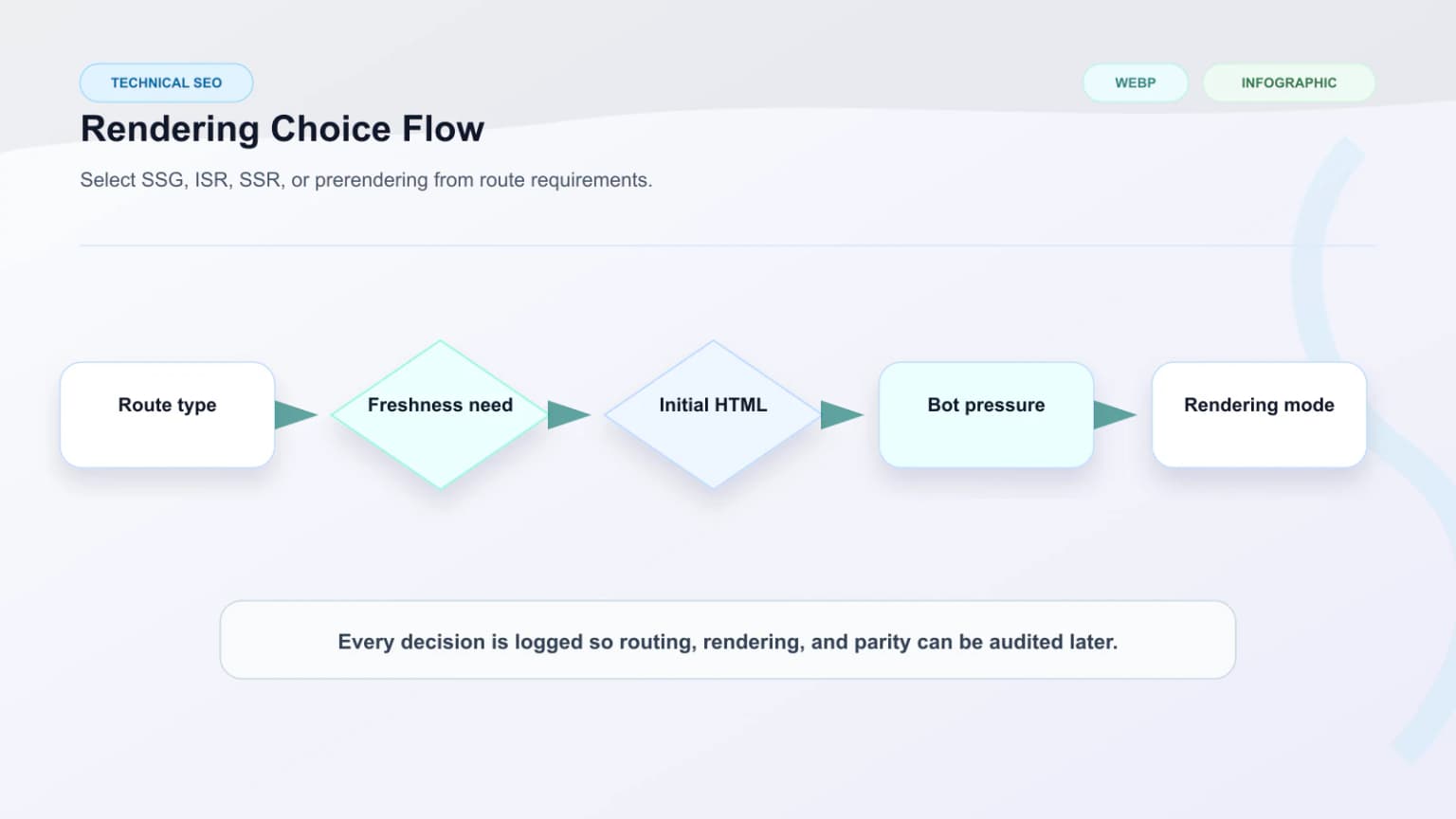
That approach keeps rendering decisions aligned with visibility outcomes, not just framework defaults.
Conclusion
Next.js does not make SEO and AI visibility decisions for you. It gives you several rendering tools, each with different strengths and risks. The right choice depends on what the route needs to communicate in the first response, how fresh that information must be, and how reliably the page stays semantically stable across rendering states.
For most teams, the best solution is not one universal mode. It is a route-level system: static where possible, regenerative where practical, server-rendered where justified, and prerendered where machine-facing delivery still needs help.
Content Cocoon
Next.js Rendering Decisions Cluster
This article should connect Next.js rendering choices back to machine-facing HTML quality, semantic parity, freshness control, and the service pages that support technical SEO and AI visibility implementation.
Internal Pathways
JavaScript SEO
The parent service for rendering reliability, crawler-facing HTML, and route-level visibility on modern frontend stacks.
Prerendering
Relevant when native rendering modes still do not produce stable machine-facing output for bots and answer engines.
Which Pages Should Use Prerendering?
A companion article for deciding which route families deserve stronger machine-facing delivery first.
Structured Data for AI Visibility
Useful when rendering decisions need to preserve JSON-LD visibility and entity clarity in the first response.
External Technical References
Prerender Checker
Helpful for verifying whether a chosen rendering path actually exposes complete machine-facing HTML.
View as Bot vs Prerender
Useful when comparing raw crawler-facing responses with the intended stabilized output.
Prerendering Middleware Explained
A useful reference when teams need a delivery-layer fallback outside native framework rendering modes.
Bridge CDN, the layer beneath the framework
Useful once framework rendering modes are exhausted and the remaining variable is delivery. Pre-launch.
Frequently Asked Questions
Which Next.js rendering mode is usually best for SEO?+
There is no single best mode for every route. Static generation is often strongest for stable public pages, ISR works well for frequently updated public content, SSR fits request-time freshness, and prerendering helps when machine-facing delivery is still weak.
Is SSR automatically better than SSG for AI visibility?+
No. SSR can still produce weak or unstable output. What matters is whether the first response is complete, semantically clear, and consistent across cache and hydration states.
When should a Next.js site use prerendering?+
Use prerendering when key public routes remain too weak for bots even after native rendering choices, or when you need deterministic machine-facing HTML without rewriting the full application architecture.
What should teams validate before choosing a rendering mode?+
They should validate raw HTML quality, metadata and schema timing, freshness behavior, semantic parity across rendering states, and whether bots receive a clear route meaning in the first response.