HTTP status codes are one of the clearest technical signals a website can send, but they still cause major SEO problems because teams often think of them as infrastructure details instead of search-facing behavior. The semantics defined in RFC 9110 and summarized by MDN's HTTP status reference are exactly what crawlers expect routes to honor. Crawlers do not guess what your route means. They rely on what the server actually returns.
As of April 2026, this guide reflects current crawler handling for redirects, soft errors, and rendering-aware delivery used by Google and other major bots.
That means a route with the wrong status code can send crawlers down the wrong path even if the visible page looks fine. A soft 404 can waste crawl attention. A temporary failure handled as 200 can look like thin content. A deleted route left behind as 302 or redirected to the homepage can weaken trust instead of clarifying intent.
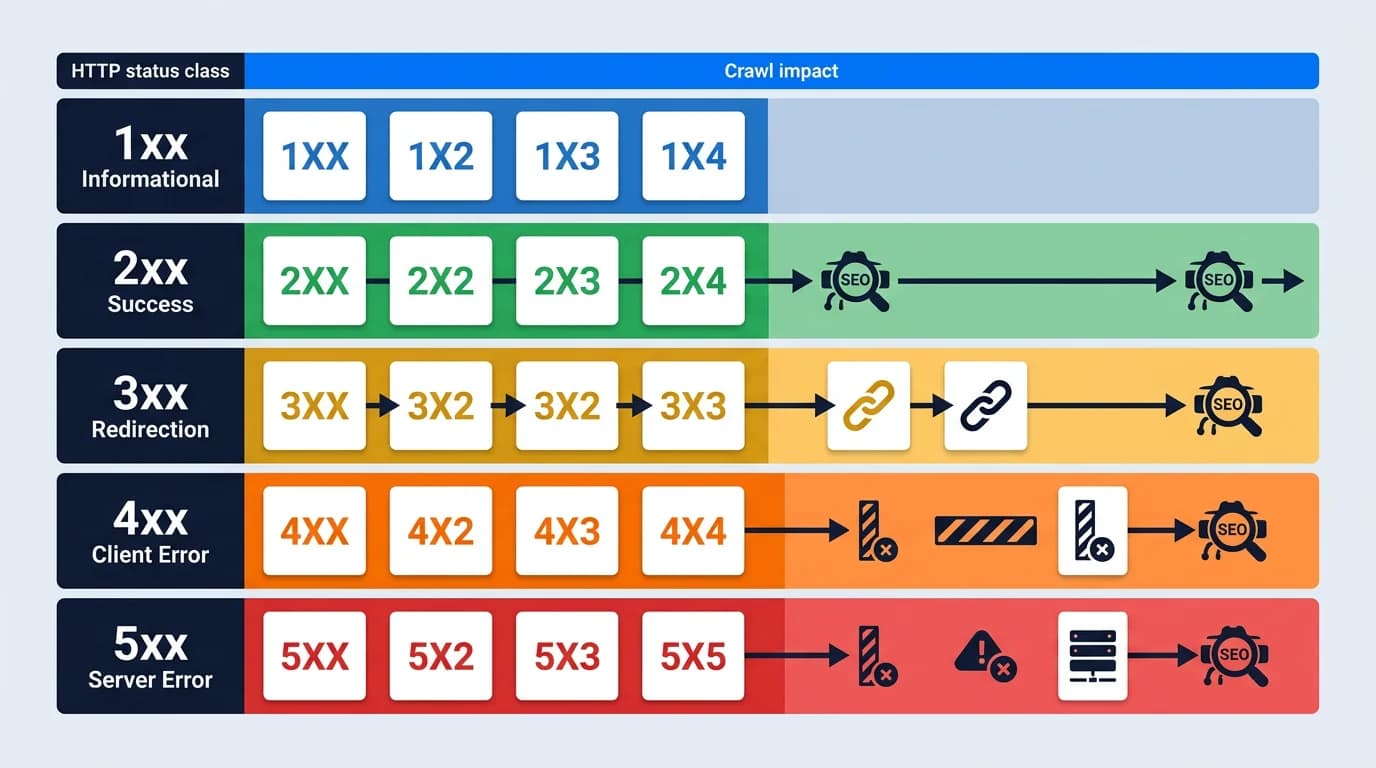
This guide explains how the most important status codes affect crawlability, indexation, redirects, and bot handling, and how technical teams should choose the right response behavior on modern websites.
Why status codes matter for SEO
Status codes tell crawlers what happened when they requested a URL. That response influences whether the crawler should keep the URL, revisit it, treat it as moved, or stop expecting useful content from it, and Google's notes on HTTP and network errors describe exactly how Googlebot reacts to each class of response.
How status codes shape SEO outcomes
For SEO, this affects:
- whether a URL is considered alive and indexable
- how redirects transfer crawlers toward a preferred destination
- how deleted content is retired from the crawl graph
- how temporary outages are interpreted
- whether the site's routing logic feels trustworthy
This is why status-code policy belongs inside a wider technical SEO audit and the related technical SEO audit checklist rather than being treated as backend trivia.
The full registry of codes maintained by IANA is broader than what most crawlers actually care about, so it helps to look at the SEO-relevant subset directly:
| Status code | What it means to the crawler | Indexation impact | When to use |
|---|---|---|---|
| 200 | Route is valid and returned the intended content | Eligible for indexation | Real, intentional pages |
| 301 | Permanent move to a new URL | Signal consolidation toward target | Stable host, route, or migration changes |
| 302 | Temporary move; original URL is still primary | Original URL retained | Short-lived experiments or promo routing |
| 304 | Content unchanged since last fetch | Reuses prior indexed version | Conditional requests with If-Modified-Since |
| 307 | Temporary redirect that preserves the HTTP method | Same as 302 with method semantics | API or method-sensitive temporary moves |
| 308 | Permanent redirect that preserves the HTTP method | Same as 301 with method semantics | Method-sensitive permanent moves |
| 404 | Page is missing | Eventually dropped from the index | Routes with no replacement |
| 410 | Page is gone deliberately | Faster removal than 404 | Intentionally retired URLs |
| 451 | Unavailable for legal reasons | Removed from index | Legally restricted content |
| 500 | Server error | Repeated 500s erode trust and crawl rate | Never intentionally; investigate |
| 503 | Service temporarily unavailable | Crawler retries without dropping | Maintenance windows, brief outages |
200 OK should mean the page is real and useful
A 200 response tells the crawler the requested URL is valid and returned the page it was supposed to return. That sounds obvious, but 200 is often misused for placeholder content, missing pages, thin error states, or client-side fallback shells.
The safest rule is:
- return
200only for real, intentional content - do not return
200for missing routes disguised as valid pages - do not use
200to mask temporary infrastructure failures
If a route is dead, temporary, or redirected, the status code should say so clearly. Otherwise, the crawler wastes time evaluating pages that do not actually deserve to remain part of the searchable inventory.
301 is for stable permanent moves
301 Moved Permanently is the right choice when a route has a durable replacement and the site wants crawlers to transfer their attention to the new destination.
When to use a 301 redirect
Typical valid uses include:
httptohttps- preferred host normalization
- route restructures after migrations
- permanent consolidation of outdated content into a better canonical target
The important word is permanent. If the move is not stable, a 301 can create confusion. This is also why chains should be avoided. Every extra hop adds friction and weakens clarity for crawlers.
302 should stay temporary
302 Found signals a temporary move. It can be useful, but only when the site genuinely expects the original URL to return as the primary destination later.
Valid temporary cases might include:
- short-lived promotional routing
- staged maintenance rerouting
- controlled experiments that should not redefine the long-term canonical destination
The problem appears when teams use 302 as a default redirect out of convenience. If the move is really permanent, keep it permanent. Otherwise, the site sends weak intent signals to crawlers and may delay consolidation.
404 is the honest answer for missing pages
If a page is gone and there is no meaningful replacement, 404 Not Found is usually the correct response. It tells crawlers that the route no longer has valid content at the requested URL.
Why a real 404 beats workarounds
This is healthier than:
- returning
200with a generic "not found" template - redirecting every dead page to the homepage
- keeping outdated routes alive with thin placeholder content
The crawler does not need the route to pretend it still exists. It needs a clear answer. That is why real 404 behavior is often better than weak attempts to preserve every old URL artificially.
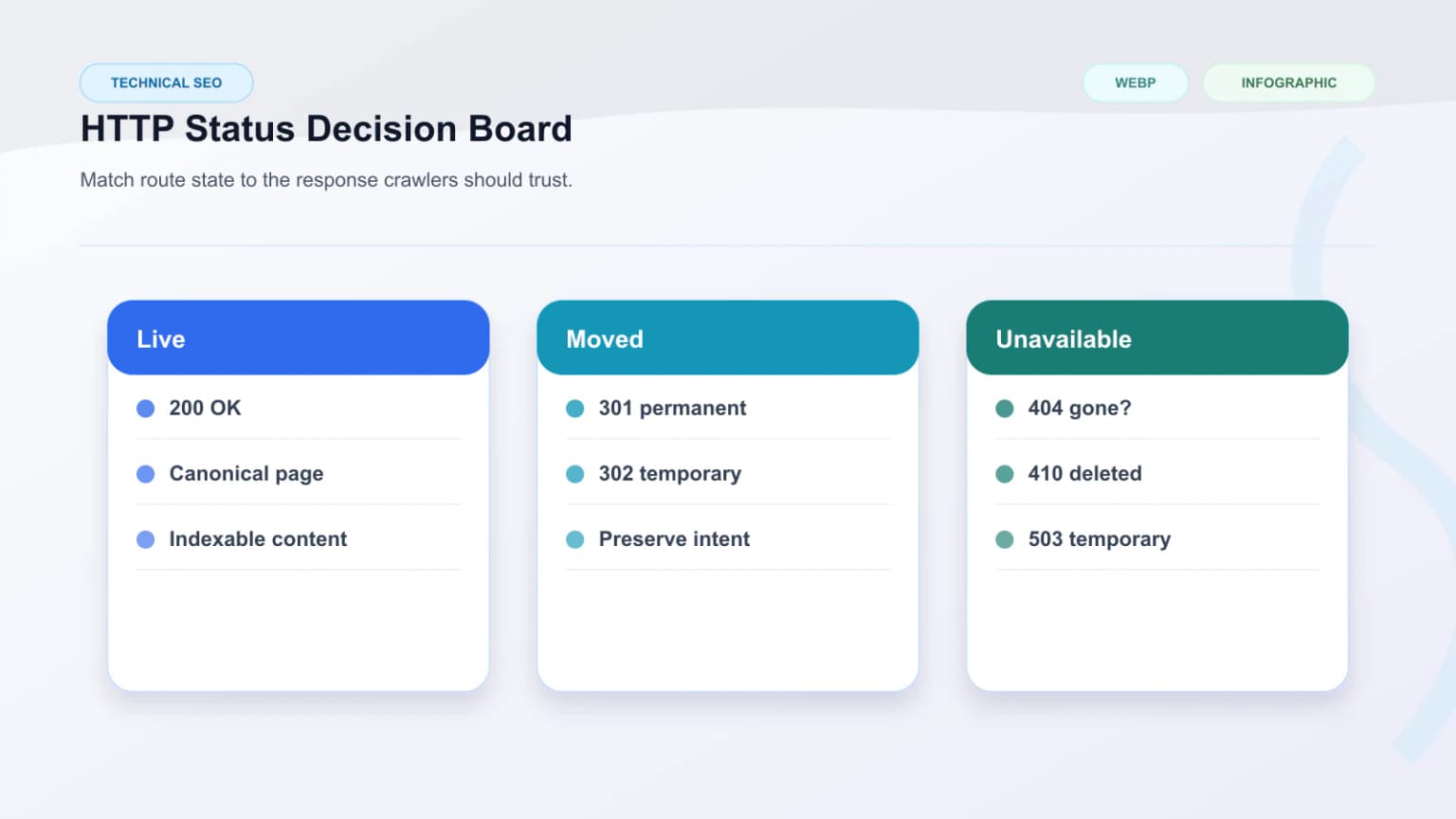
410 Gone is stronger when deletion is intentional
410 Gone is appropriate when the team knows the page has been intentionally removed and should not be expected to return. It is a stronger retirement signal than 404.
This can be useful for:
- expired content with no relevant replacement
- retired programmatic pages
- legacy inventory intentionally removed from the site
- routes that should leave the crawl graph faster
The key is intent. If the deletion is deliberate and durable, 410 can be a clearer signal than 404.
503 Service Unavailable should protect temporary failure states
Temporary outages, rendering failures, or maintenance windows should not be disguised as healthy content. If a route is unavailable for a short period, 503 Service Unavailable is often the correct response.
This matters because returning 200 on a broken shell or fallback message can cause crawlers to evaluate incomplete content as if it were the real page. That can weaken indexation quality and create low-value snapshots in the crawl graph.
When 503 is the right response
503 is especially important in:
- controlled maintenance windows
- temporary prerendering failures
- overloaded rendering clusters
- brief backend outages affecting public routes
The goal is to tell crawlers the issue is temporary rather than publishing a broken page as if it were valid.
Soft 404 pages are one of the most common mistakes
A soft 404 happens when the visible content behaves like a missing page but the server still returns 200. This often happens on JavaScript-heavy websites where the route shell renders successfully, but the requested resource does not actually exist.
How soft 404s appear in production
Common patterns include:
- "no results" or "not found" templates with
200 - client-side catch-all pages that never return a real
404 - expired product URLs showing generic fallback content
- broken route resolution hidden behind a successful status code
Soft 404s waste crawler attention because they make dead or weak routes look alive. This is one reason status-code auditing belongs close to rendering QA on modern stacks.
Status codes should align with canonicals, sitemaps, and redirects
Status-code policy cannot be reviewed alone. It has to align with the rest of the site's discovery and preferred-URL systems.
For example:
- a sitemap should not list URLs that return
404,410, or useless redirect chains - a canonical should not point at a broken destination
- a
301target should usually reflect the preferred live route the site wants indexed - deleted routes should not linger as indexable-looking URLs in crawl paths
This is why status-code issues often overlap with XML sitemap quality, canonical issues, and crawl budget optimization.
Bot-facing systems need honest failure handling too
On sites that use prerendering or bot-aware routing, status codes become even more important. If the machine-facing rendering path fails, the system still needs to return the right response semantics.
Honest responses on the bot-facing path
Good bot-facing behavior usually means:
200only when the machine-facing route is complete and valid503for temporary rendering failures- real
404or410for dead routes even in the prerender path - no fake success pages just to keep the crawler response green
This is one area where the guide on redirecting bot traffic to prerendering connects directly. The proxy path may differ, but the route meaning still has to stay honest.
A practical response model for common scenarios
The easiest way to manage status codes is to define route behavior by scenario instead of improvising per incident.
| Scenario | Best default response | Why |
|---|---|---|
| Live public page | 200 | The route is valid and intentionally available |
| Permanent route move | 301 | Crawlers should consolidate to the new destination |
| Temporary move | 302 | The original URL may still return as primary later |
| Missing page with no replacement | 404 or 410 | The route should not pretend to remain valid |
| Intentionally retired page | 410 | Stronger removal signal when the deletion is durable |
| Temporary outage or rendering failure | 503 | Tells crawlers the issue is short-lived |
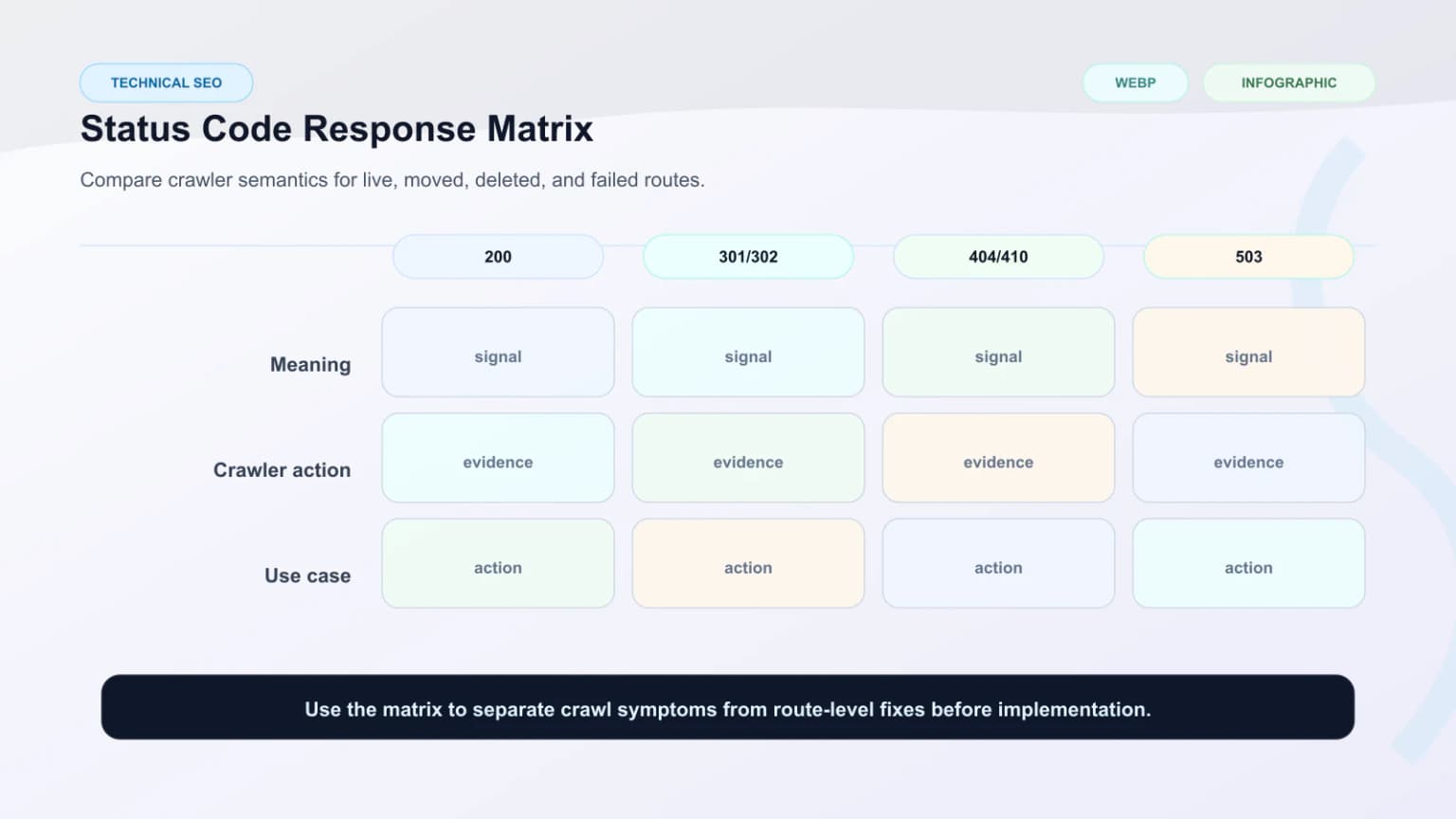
This matrix keeps response policy easier to reason about across engineering, platform, and SEO teams.
How to validate status-code behavior
The best validation workflow usually includes:
- Sample important URLs directly, not only in the browser UI.
- Check whether live responses match route intent.
- Follow redirect chains to their final destinations.
- Compare sitemap-listed URLs against actual response codes.
- Re-test bot-facing routes separately if prerendering or proxy logic is involved.
A fast way to verify status and chase redirect chains in one shot is curl with the -L follow flag and a custom write-out format:
# Show final status code and the next redirect target for a path
curl -sI -L -o /dev/null -w "%{http_code} %{redirect_url}\n" https://example.com/path

# Walk the full redirect chain step by step
curl -sIL https://example.com/path | grep -E "^(HTTP/|Location:)"
Useful supporting checks include a crawler checker, an SEO audit tool, and the external reference on HTTP status codes for bots. For deeper protocol semantics, the HTTP Working Group specifications and the WHATWG Fetch standard provide complementary perspectives to the core RFC.
Common mistakes to avoid
The most common status-code mistakes are:
- returning
200for missing or broken routes - redirecting every deleted page to the homepage
- using
302where the move is clearly permanent - chaining redirects unnecessarily
- leaving dead URLs in sitemaps or internal links
- returning broken machine-facing content instead of a temporary
503
These failures usually make the site feel less trustworthy to crawlers, even when the frontend experience hides the problem.
Conclusion
Status codes are not just transport metadata. They are part of the search-facing contract between the site and the crawler. A clean response model helps bots understand whether a page is live, moved, missing, or temporarily unavailable, and that clarity improves crawl efficiency and indexation quality.
For technical teams, the practical goal is simple: make sure every important route returns the status code that matches its real intent.
Content Cocoon
HTTP Status Codes Editorial Cluster
This article should connect route response behavior back to redirects, deleted content handling, crawler trust, and the wider technical SEO systems that shape discovery and indexation.
Internal Pathways
Technical SEO Audit Checklist and Implementation Guide
A companion article for fitting status-code validation into a broader implementation and QA workflow.
XML Sitemap Guide for Technical SEO
Useful when sitemap-listed routes need to be checked against live response codes and redirect behavior.
Redirect Bot Traffic to Prerendering
Relevant when temporary failures, proxy routing, and bot-specific fallback logic need the right status semantics.
Technical SEO Audit
The parent service for teams validating crawler-visible behavior across redirects, rendering, and indexation systems.
External Technical References
Crawler Checker
Helpful for confirming the real status code that crawlers receive on important routes.
SEO Audit Tool
Useful when status-code issues overlap with metadata, discovery, and rendering quality.
HTTP Status Codes for Bots
A supporting external reference for bot-facing response semantics and temporary failure handling.
Frequently Asked Questions
What status code should a deleted page return?+
Usually 404 when the page is missing with no replacement, or 410 when the deletion is intentional and durable and the team wants a stronger removal signal.
Is it bad to return 200 for a not-found page?+
Yes. That creates a soft 404 and can waste crawler attention because the route looks alive even though it does not contain real valid content.
When should a site use 302 instead of 301?+
Use 302 only for genuinely temporary moves where the original URL may return as the primary destination later. Stable moves should usually use 301.
Why does 503 matter for SEO?+
Because it tells crawlers a failure is temporary. That is better than returning a broken 200 page during maintenance or a rendering outage.