A technical SEO audit is most valuable when it goes beyond issue spotting and clarifies the engineering path required to remove crawl, rendering, indexation, and quality constraints. Most audits don't do this. Most audits produce a 60-page PDF with 200 findings, no prioritization, no implementation tasks, and no follow-up, and the engineering team treats it as background noise because they cannot tell which 5 fixes will move the needle.

The strongest audits are not just diagnostic reports. They are decision tools that connect symptoms to root causes, group findings by template, and end with implementation-ready tasks the engineering team can move into a sprint without translation. As of April 2026, this guide reflects how we currently scope audits against modern hybrid stacks and AI-driven crawl surfaces, and what differentiates an audit that actually ships fixes from one that becomes a shelf artifact. The framing pairs with the broader technical SEO audit service, the JavaScript SEO work, and any prerendering or AI search visibility program that depends on a clean baseline.
What a Technical SEO Audit Should Actually Cover
A real technical SEO audit should review the systems that shape search visibility, not only the final page output. That means crawlability, canonical logic, rendering behavior, internal linking, structured data, site templates, and the operational layer that governs how updates are shipped, mapped against the layered model in Google's crawling and indexing documentation. If you are evaluating a commercial engagement, the parent Technical SEO Audit service shows how this work is scoped in practice.
For engineering teams, the value of the audit comes from identifying root causes, not the surface signals listed in Google's SEO starter guide. A missing title tag is rarely the real problem. The real problem is usually a template pattern, routing decision, or rendering dependency that creates the issue repeatedly across the site. That is also why teams often pair an audit with a sample audit deliverable before planning implementation.
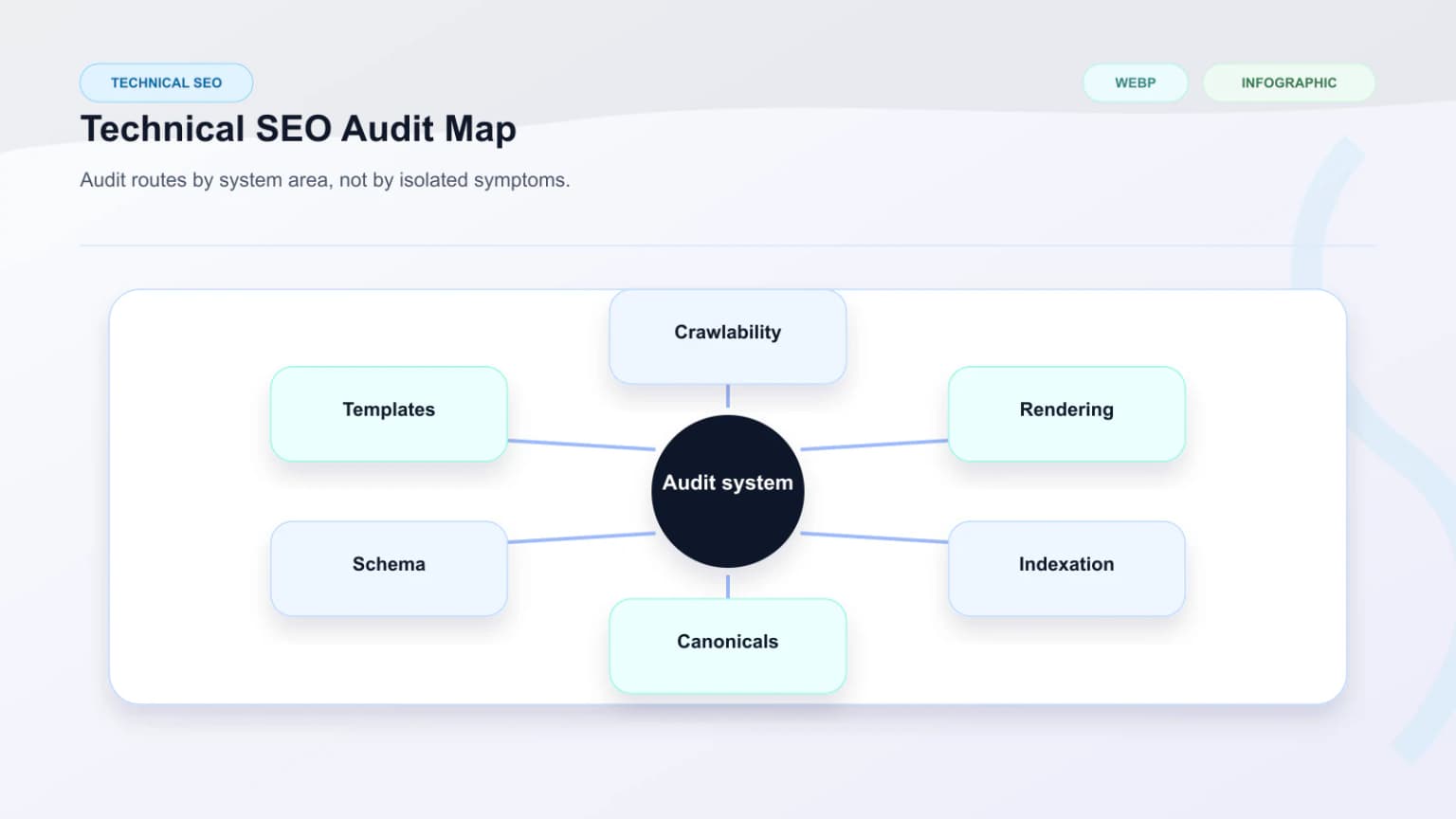
The seven layers a complete audit examines
A technical SEO audit that produces real implementation work covers seven layers in sequence. Each layer depends on the layer below being clean.
| Layer | What it checks | Why it matters |
|---|---|---|
| 1. Crawl control | robots.txt, sitemap reachability, host policy | If crawlers can't find the site, nothing else matters |
| 2. URL & redirect logic | canonical, redirects, 404 handling, parameter handling | Decides which URLs Google considers the same |
| 3. Rendering | first-response HTML, hydration boundaries, CSR vs SSR | Most JS-heavy SEO failures live here |
| 4. Indexation signals | meta robots, hreflang, sitemap inventory | Decides what makes it into the index |
| 5. Structured data | JSON-LD per template, schema.org compliance | Drives rich results and AI-engine extraction |
| 6. Internal linking | template-level link patterns, hub structure | Distributes equity, defines topical relevance |
| 7. Operational hygiene | release process, monitoring, incident handling | Determines whether fixes stick |
The mistake most audits make is jumping straight to layer 5 (structured data, the visible "rich result" wins) before validating layers 1–4. We covered the technical mechanics of the audit checklist in technical SEO audit checklist and implementation guide.
What a thin audit misses
A weak audit looks like:
- A list of URLs with missing meta descriptions
- A screenshot of a Lighthouse score
- A note that "Core Web Vitals could be improved"
- A 30-page section on keyword research
- No template-level grouping, no priority sequence, no implementation guidance
A strong audit looks like:
- "On the product detail template (~12,000 URLs), the canonical tag is set in
useEffectand is missing in the first response. This causes 23% of those URLs to be indexed under parameterized variants. Fix: move canonical generation to the server component. Estimated effort: 2 engineering days."
The difference is the second example tells the team exactly what to ship.
Why Audits Fail Without Prioritization
Many audits are too broad to be operationally useful. They list dozens or hundreds of findings but do not explain which issues suppress growth most, which teams own the work, and which changes should happen first. The team reads the audit, agrees something is wrong, and goes back to the existing roadmap because there is no clear next move.
Prioritization is the difference between a document and a decision tool. The audit must separate critical blockers from lower-impact cleanup and show where engineering effort produces meaningful search improvement.
A simple prioritization framework
We score every audit finding on three axes:
| Axis | Scale | Example |
|---|---|---|
| Impact | High / Medium / Low | High: blocks indexation on top 20 templates. Low: missing schema on a marketing detail page. |
| Effort | Days / Weeks / Months | Days: fix canonical in middleware. Weeks: rebuild faceted nav. Months: migrate from CSR to SSR. |
| Reversibility | Easy / Moderate / Hard | Easy: edit a template file. Hard: change URL structure across thousands of routes. |
The first wave of fixes should always be High impact + Days effort, the cheap wins. The second wave is High impact + Weeks effort, the strategic fixes. Anything Low impact + Months effort does not belong in the top of the backlog regardless of how interesting it is.
How to surface prioritization to engineering teams
The deliverable that works best for engineering teams is a prioritized backlog with one finding per row, in their issue tracker:
- One Jira / Linear / GitHub issue per finding
- Tagged by affected template family
- Linked to the audit section that explains the root cause
- Sized by the engineering team (not the SEO consultant)
When the audit ships as 47 issues in the team's actual tracker, fixes happen. When it ships as a PDF, fixes don't.
What Engineering Teams Need After the Audit
Implementation teams usually need more than observations. They need reproducible patterns, affected template groups, rollout guidance, and enough context to estimate effort without reverse engineering the recommendation.
That is why the strongest technical audits end with developer-ready tasks and a phased roadmap. The goal is to make the next sprint clearer, not create one more artifact that needs translation.
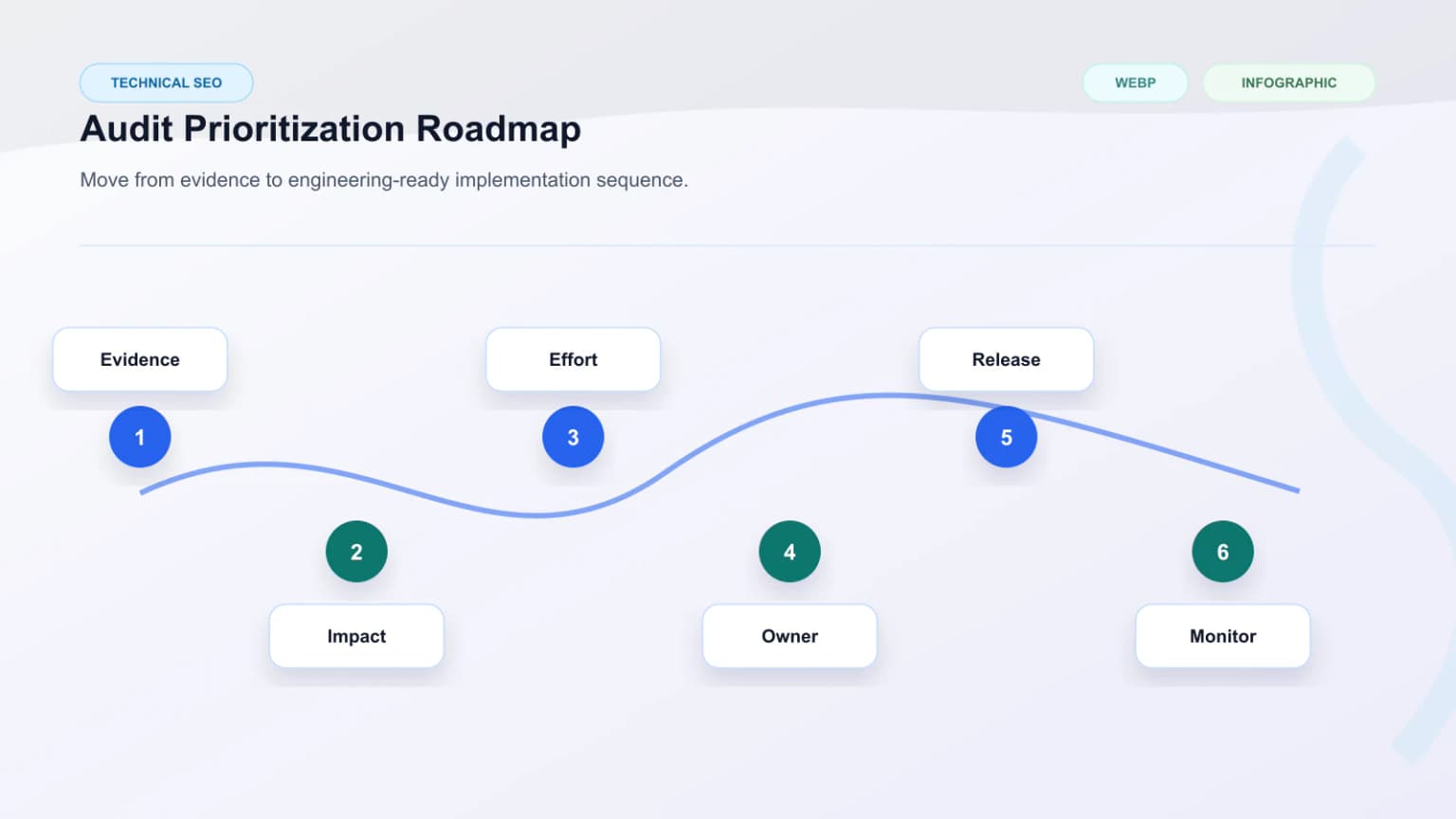
What "implementation-ready" actually looks like
For each finding, the audit should specify:
- Affected template family or route prefix,
/products/*,/blog/*, etc. - Reproducible test command, how to verify the issue exists today
- Expected behavior after fix, how to verify the issue is resolved
- Rollout suggestion, incremental, behind a flag, all-at-once
- Validation step, what to check 1 day, 7 days, 30 days after the fix
A concrete example for a canonical drift issue:
# Reproduce: confirm canonical is missing in first response
curl -s -A "Mozilla/5.0 (compatible; Googlebot/2.1; +http://www.google.com/bot.html)" \
  https://example.com/products/example-sku \
  | grep -c '<link rel="canonical"'
# Expected output: 1 (currently returns 0)
A finding with that level of specificity moves into engineering work in the same sprint. A finding that says "fix canonical issues" sits in the backlog for a quarter.
The engineering deliverables an audit should produce
| Deliverable | Format | Purpose |
|---|---|---|
| Findings backlog | Tickets in issue tracker | Direct execution input |
| Template-level summary | One-pager per template | Helps prioritize per-team workload |
| Implementation roadmap | Sequenced phases (4–8 weeks) | Sets expectations for stakeholders |
| Validation playbook | Per-finding test commands | Verifies fix shipped correctly |
| Monitor recommendations | Specific Datadog/Grafana monitors | Prevents regression |
The validation playbook overlaps with the rendering QA checklist for SEO releases. The monitor recommendations overlap with SEO monitoring and alerting for technical teams. The audit ties these surfaces together rather than treating them as separate disciplines.
How to Evaluate Audits for Modern Websites
Modern websites introduce additional complexity through JavaScript rendering, hybrid architectures, content APIs, edge delivery, and fragmented ownership across product teams. An audit must account for how those systems affect crawler behavior and machine-readable output. For JavaScript-heavy stacks, this naturally overlaps with the JavaScript SEO service.
If the website uses Next.js, a SPA shell, Webflow plus custom scripts, or a large content platform, the audit must test not only what the site looks like in the browser but what search engines can reliably fetch and index. In many cases, the answer depends on prerendering strategy or a stronger server-side rendering path.
Stack-specific evaluation areas
Different stacks produce different failure modes. A solid audit recognizes which patterns the team needs to test:
- Next.js App Router:
'use client'creep, hydration cost, ISR cache invalidation, edge-runtime API behavior - Next.js Pages Router:
getServerSidePropstiming,getStaticPropsrevalidation, custom 404 handling - Pure SPAs (Vite, Create React App, custom): first-response HTML completeness, hydration parity, route-level metadata
- Static site generators (Astro, Hugo, Eleventy): build pipeline, content collections, redirect handling
- Headless CMS-driven sites: webhook-triggered revalidation, slug history redirects, multi-language modeling, covered in technical SEO for headless CMS
- Hybrid sites with prerendering: cache invalidation, rendering parity, bot detection accuracy
The framework comparison sits in Next.js vs Remix vs Astro for SEO; the rendering-model comparison is in prerendering vs SSR vs SSG.
Signs the audit isn't built for modern complexity
A red flag during scoping: the auditor describes the work in terms of a generic checklist with no questions about the stack. Modern technical SEO audits require stack-specific questions before they can produce stack-specific findings. If the auditor does not ask about the rendering model, the deploy pipeline, or the CMS in the first conversation, the audit will be generic.
What a Good Technical SEO Audit Delivers
A strong technical SEO audit gives the business a visibility risk map, gives the product team clear sequencing, and gives engineers implementation-ready direction.
That is why the best audits are not generic. They are custom to the architecture, the scale of the site, and the way the organization ships change.
The five outputs we deliver on every engagement
- Findings inventory, a structured list, scored by impact/effort/reversibility, grouped by template family
- Implementation roadmap, sequenced phases with stakeholder ownership
- Per-finding validation guide, curl tests, Search Console queries, Lighthouse assertions
- Monitoring recommendations, specific synthetic checks and alerting thresholds, oriented around the SEO monitoring and alerting framework
- Pre/post benchmark, before-state captured at audit start, ready to compare against after-state at 30/60/90 days
The benchmark is the part most teams skip and most regret skipping. Without it, no one can prove the fixes worked.
Where this fits in a broader program
A technical SEO audit is the diagnostic step. The fixes are the implementation step. The release pipeline is the prevention step. Each one feeds the next:
- Audit finds the regressions → Engineering ships the fixes → Monitoring catches the next regression → Incident response handles it → Postmortem produces a new monitor → Cycle repeats
We covered the full feedback loop in SEO incident response playbook and the prevention layer in Lighthouse CI for technical SEO validation. The audit is not the end state; it is the starting point of an operational practice.
Common Engineering Mistakes
Patterns we see when audits don't translate into shipped work:
- Treating the audit PDF as the deliverable instead of tickets in the engineering tracker
- Prioritizing rich-result wins (schema, images) before fixing rendering and canonical
- Running the audit once and never re-running it, the site changes, the audit ages out
- Asking the SEO consultant to "just file the issues" without engineering context
- Skipping the pre/post benchmark, so the team can't prove the work moved metrics
- Buying a generic audit template and applying it to a JavaScript-heavy site
- Focusing on absolute best practices instead of which 5 fixes move this specific site
- Treating the audit as a one-time project instead of the diagnostic phase of a recurring program
The teams that ship audit findings consistently treat the audit as engineering input, not as a marketing document.
Conclusion
A technical SEO audit pays off when it stops being a list of findings and starts being a sequenced engineering plan. Treat it as the bridge between diagnostic and delivery, not an end-state document. The strongest audits ship as backlog tickets, not PDFs; they ground every finding in a reproducible test; they sequence work by impact and effort; and they connect to the monitoring and release pipelines that prevent the same regressions from shipping again.
Pick the audit shape that produces engineering work, not the one that produces the most findings. The team that closes 30 findings in a quarter outperforms the team that has 200 findings in a backlog and ships none of them.
Content Cocoon
Technical SEO Audit Editorial Cluster
This article is a child page under the core audit service. It should link upward to the commercial parent, sideways to related technical services, and outward to only a few relevant external references.
Internal Pathways
External Technical References
Frequently Asked Questions
How technical should the audit be?+
It should be technical enough that engineering teams can use it directly, while still being organized in a way product and SEO stakeholders can prioritize.
Is a technical SEO audit only for large sites?+
No. It is useful whenever architecture, rendering, indexation, or template complexity creates search visibility risk.