Server-side rendering is often introduced to make JavaScript-heavy websites easier for crawlers to process. But SSR does not automatically guarantee safe SEO delivery. When the bot-facing render and the user-facing experience drift apart, SSR can create the same trust problem that search engines associate with cloaking.
As of April 2026, this guide reflects the current Google spam policy on cloaking and the SSR drift patterns we now observe across edge-rendered React and Next.js applications.
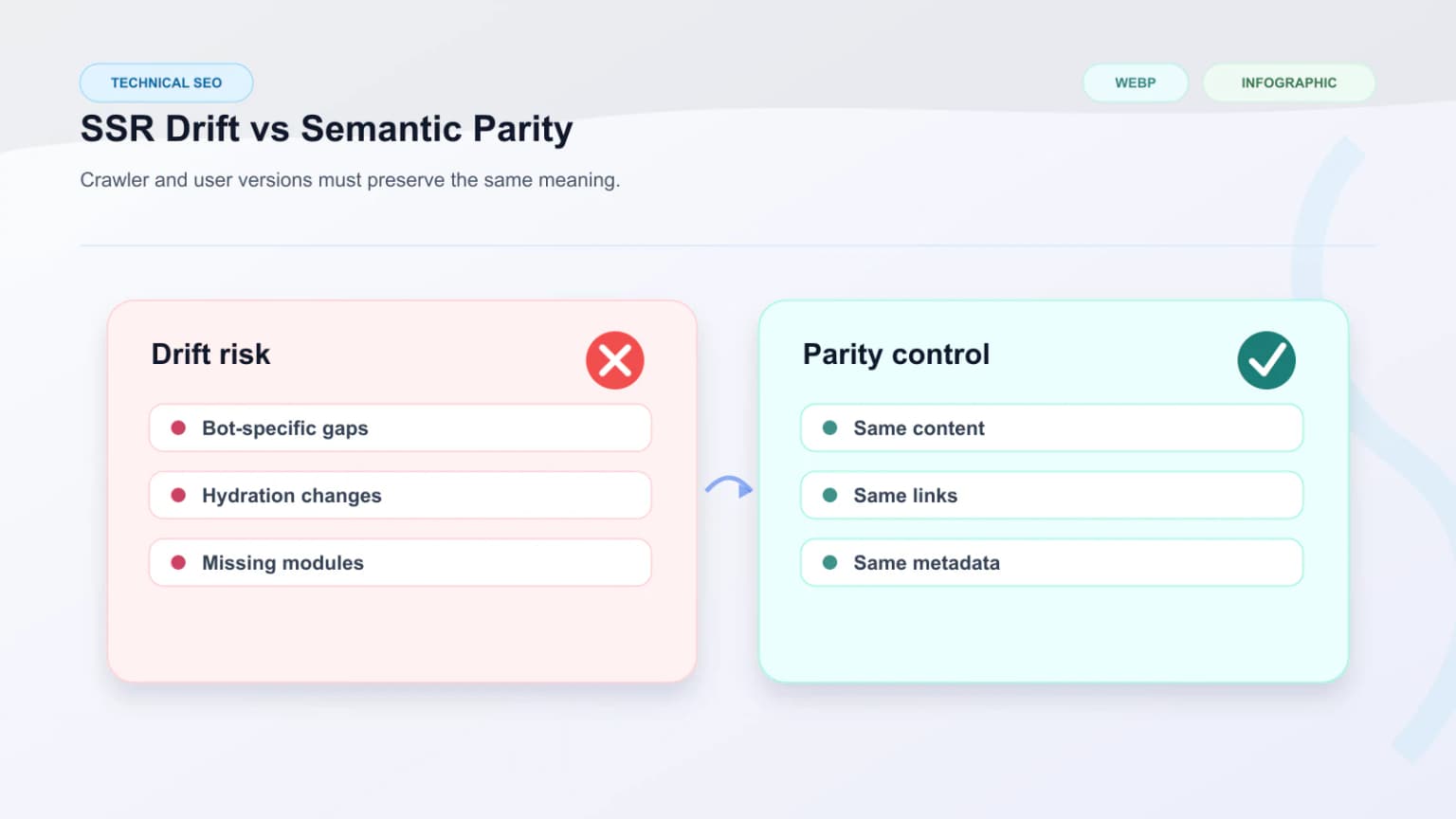
That does not mean SSR is inherently unsafe. It means SSR becomes risky when teams strip components for bots, hydrate into a meaningfully different page, or let cache and personalization logic create different semantic outputs. The real requirement is not "use SSR." The real requirement is semantic parity. This topic sits close to what cloaking is in SEO, prerendering, and crawl budget optimization for JavaScript sites, because the risk comes from delivery divergence, not from the rendering label itself.
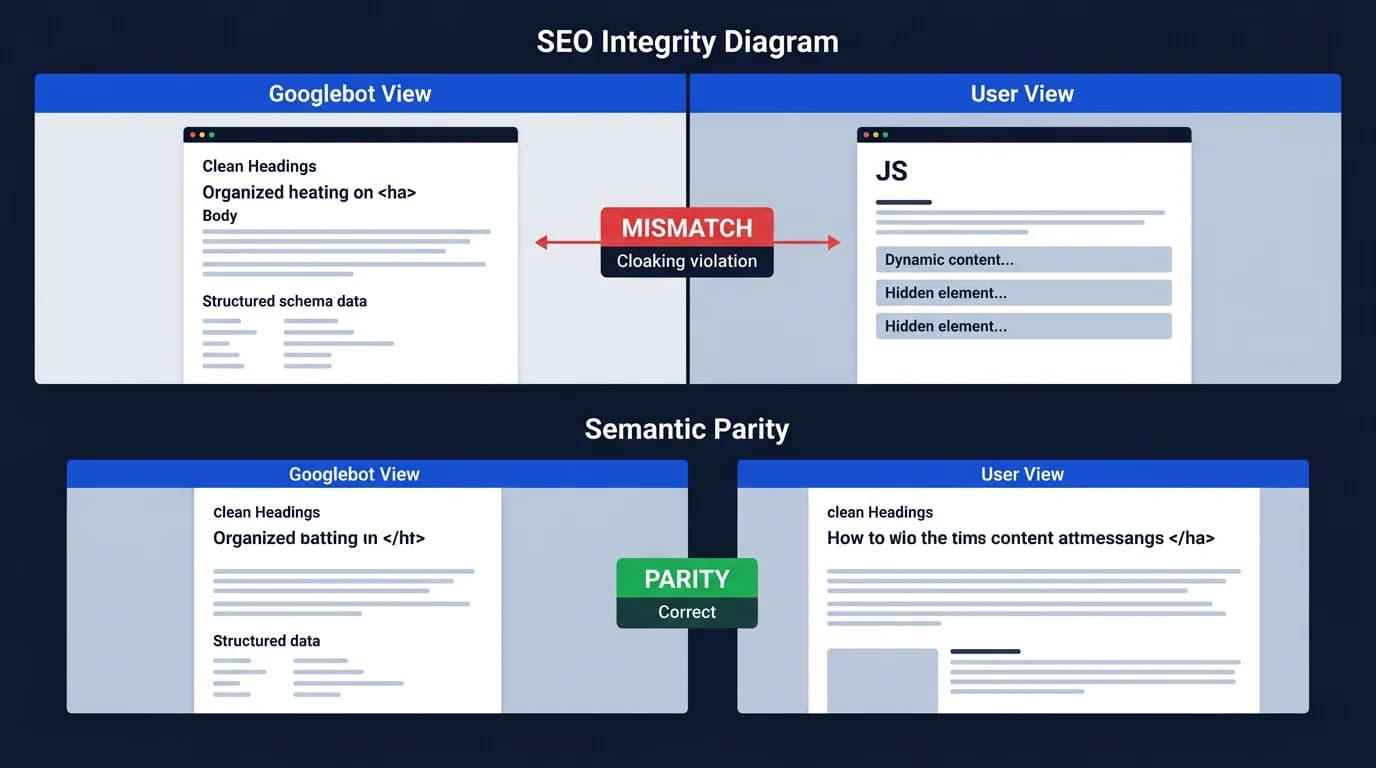
This article explains how flawed SSR creates cloaking-like conditions, why hydration and caching can widen the gap, how to audit parity, and why prerendering is often the safer alternative when teams need deterministic machine-facing HTML.
Why SSR Can Still Create Cloaking Risk
SSR is supposed to produce useful HTML early, which is good for crawlability, an outcome described in web.dev's rendering on the web overview. The problem starts when the server render is not actually the same page that the user ends up experiencing after client-side code takes over.
That can happen when:
- the server omits components for crawler or performance reasons
- personalization rewrites key content after hydration
- geo or cookie logic changes the page intent
- bot-specific branches strip commercial or interactive sections
- metadata or schema differs between server and client output
When SSR shifts from optimization to deception
Once the indexed meaning no longer matches the final user-visible route, SSR stops being a clean technical fix and starts looking like deceptive delivery.
The Difference Between Faster HTML and Different Meaning
Search engines do not require the response format for bots and humans to be identical at the byte level. They do require the meaning and destination of the page to stay aligned, which is why Google's dynamic rendering documentation emphasizes equivalent content rather than identical bytes.
That means:
- serialized bot-friendly HTML can be acceptable
- cleaner machine-facing output can be acceptable
- removed or rewritten meaning is not acceptable
What separates compliant delivery from cloaking
This is the core distinction behind compliant delivery. If the server render is just a faster, more accessible representation of the same route, that is one thing. If it becomes a simplified or altered page whose claims, links, or commercial intent no longer match the user version, the system drifts toward cloaking territory.
How Flawed SSR Introduces Semantic Drift
Many SSR problems are not malicious. They are engineering shortcuts that create unexpected semantic deltas.
Common examples include:
- rendering a lighter product page to bots while humans get reviews, pricing logic, and availability states
- serving default-market content on the server, then replacing it with a different offer after hydration
- outputting headings and body copy on the server that disappear in the client-rendered state
- returning one set of canonicals or schema in SSR and another after route hydration
These are often treated as application bugs, but they also create SEO trust risks. In practice, they get uncovered during the same kind of technical SEO audit used to compare crawler-facing HTML with the final stabilized route.
Hydration Mismatches Are Not Just UX Bugs
Teams often think of hydration mismatches as frontend quality issues, but they can also create search-facing parity problems. If the server render says one thing and the hydrated app says another, crawlers and users are no longer guaranteed to consume the same page meaning.
That matters especially when the mismatch affects:
- main headings and descriptive copy
- product details, pricing, or availability
- structured data entities
- canonical URLs and meta tags
- internal linking paths
How a forked page becomes two versions of the truth
If the server snapshot becomes the machine-readable truth while the hydrated route becomes the human truth, the system effectively forks the page into two versions.
Bot-Specific SSR Shortcuts That Look Like Cloaking
Some teams deliberately simplify SSR for bots to save server resources or improve crawl behavior. The intention may be practical, but the implementation can still be risky.
The most common shortcut patterns are:
- disabling heavy components only for known bots
- removing widgets, reviews, or faceted sections from bot renders
- swapping to crawler-only text blocks
- changing internal link structures for machine-facing routes
Safe delivery shortcuts vs unsafe content branches
This is where SSR starts to resemble the same conditional logic discussed in bot detection and offloading bot visits. The safe version changes delivery mechanics while preserving meaning. The unsafe version changes the content itself.
Why Prerendering Is Often Safer Than Custom SSR Logic
Prerendering is often safer because it captures the fully rendered route rather than asking teams to maintain separate semantic logic for the server and the client. Instead of hand-authoring bot-specific SSR exceptions, the system renders the same application state in a controlled environment and returns that stabilized output to the crawler.
That reduces risk because:
- the bot-facing HTML reflects the route after full render
- teams do not need custom content branches for crawlers
- parity is easier to validate against the live route
- the origin can avoid expensive SSR work for every automated request
Why fewer custom branches mean less drift
This is one reason the guide on what websites benefit from a prerendering service matters. For many teams, prerendering solves the same crawler-readability problem with fewer opportunities for semantic drift.
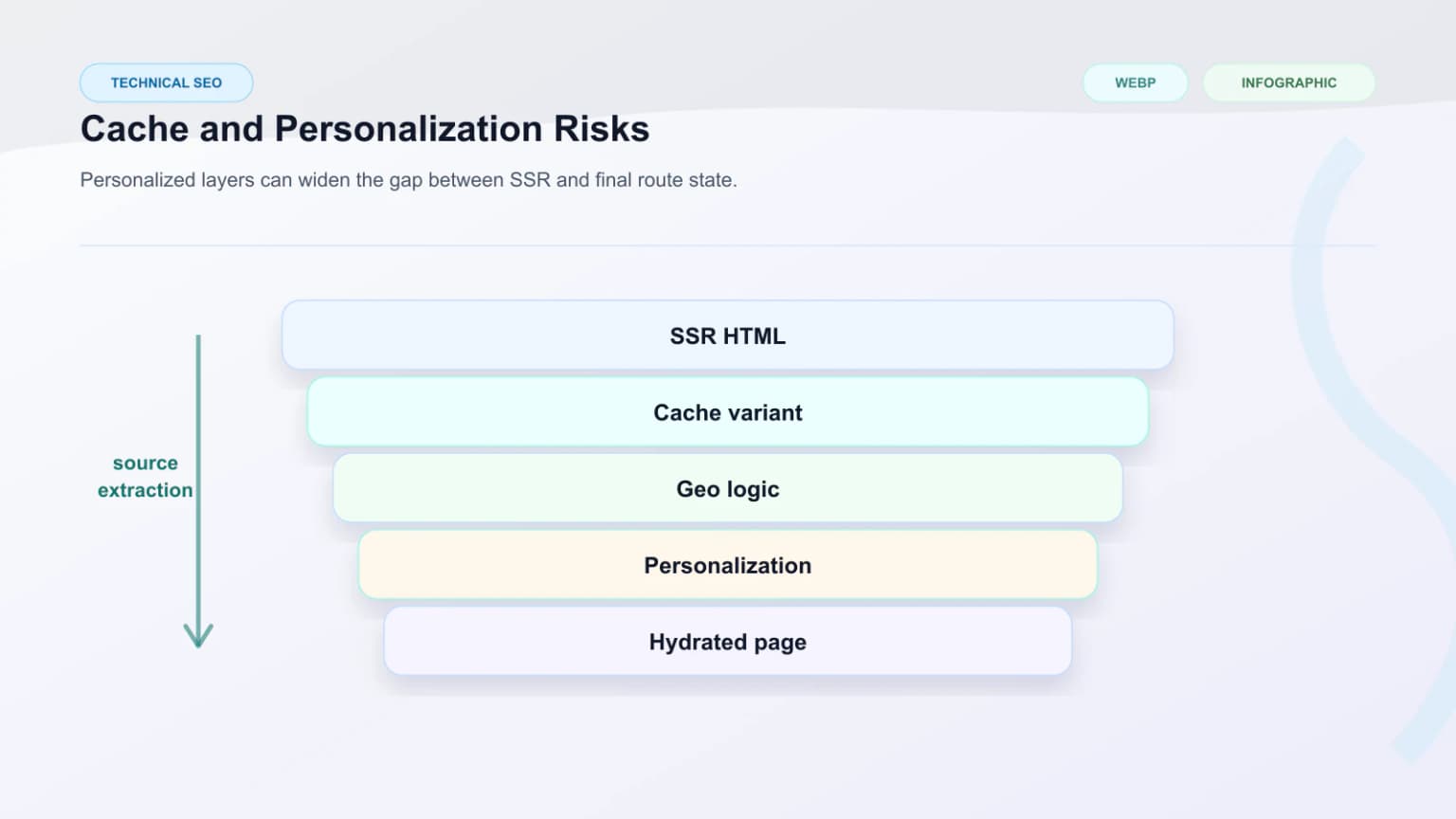
Caching and Personalization Make SSR Parity Harder
Even well-intentioned SSR setups can become risky when caching and personalization layers are added on top. A page that looks correct in a staging fetch may become inconsistent in production if the cached server variant no longer reflects the route that users actually receive.
Typical failure modes include:
- stale cached HTML after CMS or pricing updates
- market-specific content rendered from the wrong locale defaults
- authenticated states bleeding into cacheable server output
- bot-facing cache rules differing from user-facing cache rules
How unintentional drift still becomes a compliance risk
These issues overlap strongly with the compliance concerns in what is cloaking in SEO, because they create page variants that can diverge without anyone explicitly planning to deceive.
How to Audit SSR for Cloaking-Like Conditions
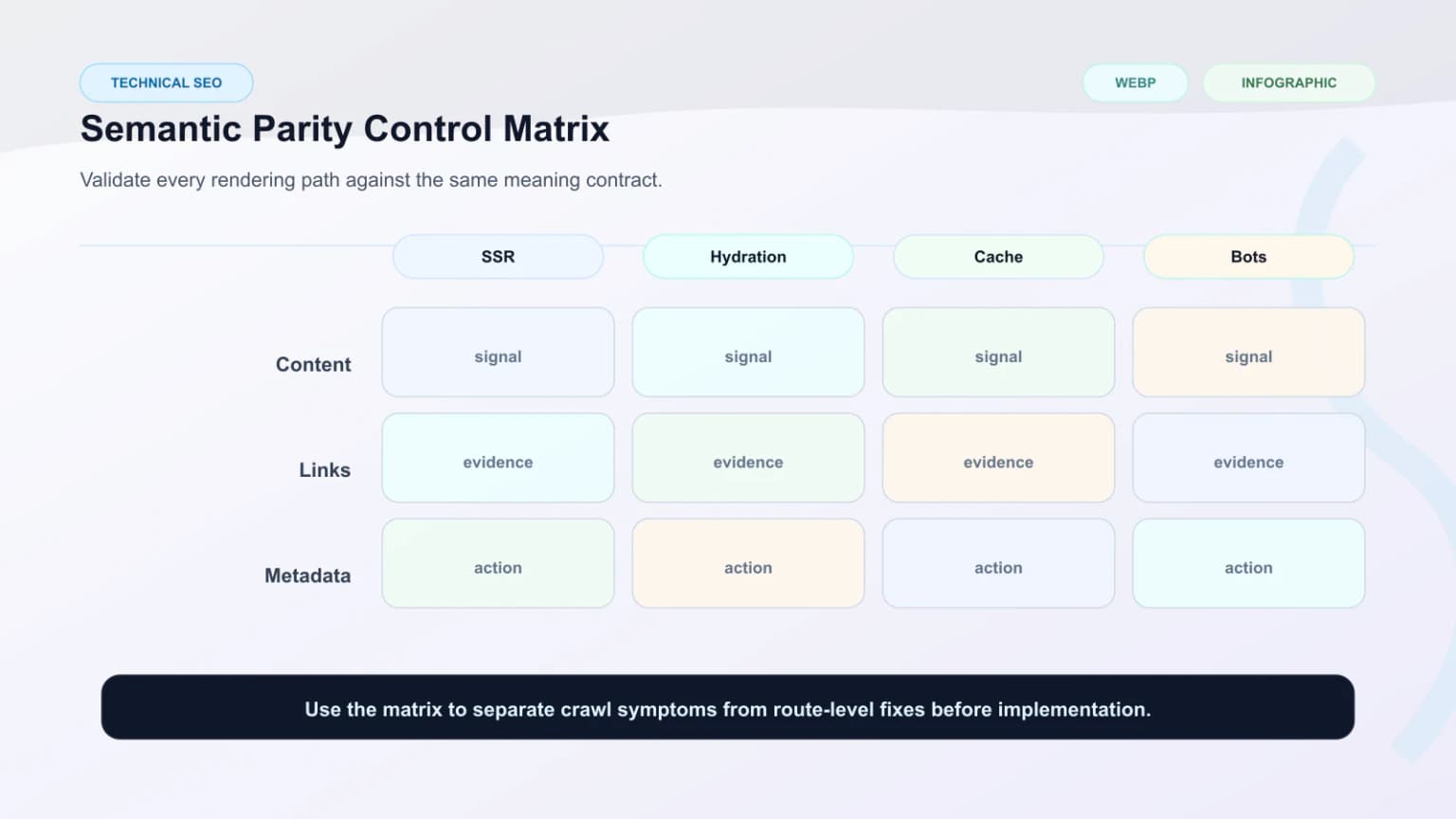
The fastest way to audit SSR safety is to compare what a crawler receives with what a user receives after the route fully stabilizes. The audit should focus on parity of meaning, not just visual similarity.
A strong review checks:
- server-rendered HTML before hydration
- final DOM after client-side execution
- metadata, canonicals, and schema across both states
- internal links and navigational intent
- bot-only branches in middleware or proxy logic
- cache invalidation behavior after content changes
Useful validation support includes a Prerender Checker for machine-facing HTML and a JSON-LD validator to confirm schema parity.
| Rendering pattern | Bot-facing consistency | User-facing consistency | Cloaking risk |
|---|---|---|---|
| Raw CSR only | Low | High | Low compliance risk, higher visibility risk |
| Custom SSR with bot-specific shortcuts | Variable | Variable | High |
| Stable SSR with strict parity controls | High | High | Moderate if maintained carefully |
| Prerendering with semantic parity checks | High | High | Low |
Best Practices to Preserve Semantic Parity
Teams that keep SSR should treat semantic parity as a release requirement, not a nice-to-have. Good practice usually includes:
- avoid bot-only content branches
- keep headings, links, and primary copy aligned across server and client
- validate schema and canonicals before and after hydration
- exclude authenticated and personalized routes from machine-facing caching
- monitor stale cache risk after content deployments
- use prerendering when SSR maintenance becomes too fragile
This is also where JavaScript SEO and rendering architecture start to overlap with compliance. A route can be technically fast and still be semantically unsafe if the output diverges by audience.
Conclusion
SSR is not automatically cloaking, but flawed SSR can absolutely create cloaking-like conditions when the machine-facing page and the human-facing page stop meaning the same thing. That is why semantic parity matters more than the rendering acronym.
For teams trying to improve crawlability on JavaScript-heavy websites, the safest path is usually the one that minimizes custom bot-specific logic and makes parity easier to inspect. In many cases, that means prerendering the real stabilized route instead of maintaining brittle SSR shortcuts that can drift into trust and compliance problems.
Content Cocoon
SSR Parity Editorial Cluster
This article should connect SSR-specific rendering risk back to semantic parity, compliant prerendering, and technical SEO audit work for teams that are seeing mismatches between bot-facing and user-facing output.
Internal Pathways
What Is Cloaking in SEO?
The parent explainer for the compliance distinction between deceptive delivery and safe machine-facing rendering.
JavaScript SEO
Relevant when SSR exists because the team is already trying to solve rendering reliability and crawler-facing HTML quality.
Prerendering
A safer path when teams need deterministic HTML without introducing bot-specific semantic drift.
Technical SEO Audit
Useful when parity, metadata, caching, and indexation issues need to be audited together.
External Technical References
Prerendering Middleware Explained
Useful for understanding how machine-facing delivery can stay compliant while avoiding SSR drift.
Prerender Checker
Helpful for validating that bot-facing HTML matches the intended stabilized route output.
JSON-LD Validator
Useful when checking whether structured data remains aligned across rendering paths.
Bridge CDN, parity at the delivery layer
Relevant when parity has to hold across an edge cache that serves bots and humans on different paths. In development.
Frequently Asked Questions
Can SSR cause cloaking issues?+
Yes. SSR can create cloaking-like risk when the server-rendered version diverges materially from the user-facing route after hydration, personalization, or bot-specific rendering shortcuts.
Is semantic parity more important than using SSR?+
Yes. Search systems care more about whether bots and users receive the same page meaning than about which rendering acronym the team uses.
Why is prerendering often safer than custom bot-specific SSR?+
Because prerendering can capture the stabilized application state and return deterministic HTML without forcing teams to maintain separate semantic branches for crawlers.
How should teams validate SSR parity?+
They should compare server HTML, hydrated DOM, metadata, schema, and route behavior across bot-like and normal requests, while also checking cache freshness and personalization rules.