Topical authority is often described as if it were mainly a content-volume game. In practice, large websites usually gain stronger topical authority when they improve architecture, not just output. The site needs to behave like a coherent knowledge system where hub pages, supporting routes, definitions, comparisons, and service explainers reinforce each other instead of competing in isolation.
That matters for both classic SEO and AI visibility. Search systems and answer engines are better at trusting sites that expose clear topic relationships, predictable route roles, and strong internal-link pathways. A collection of good pages is not the same thing as a good knowledge hub. The architecture between those pages determines whether the topic cluster feels coherent or fragmented. As of April 2026, this guide reflects current expectations for helpful, people-first content and the evolving E-E-A-T criteria that quality raters apply to topical clusters.
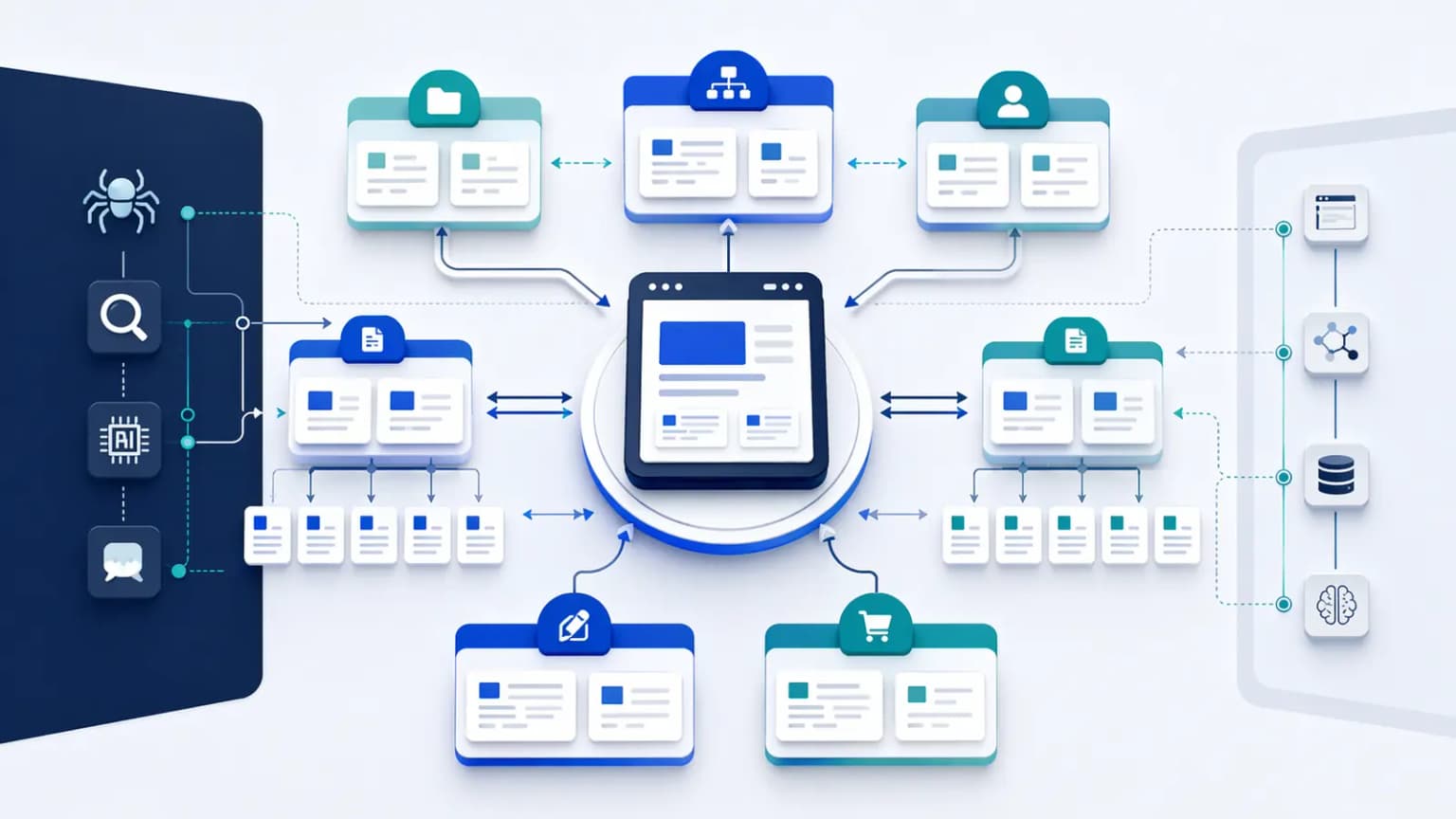
This guide explains how to structure knowledge hubs, how hub pages should differ from child pages, and how technical teams can turn content clusters into clearer source architecture for both search and answer-engine retrieval.
Topical authority is really a route-relationship problem
The strongest topic clusters do not come from publishing many related pages with similar keywords. They come from defining clear roles across routes.
That usually means the site has:
- one or more parent hub pages
- child pages with distinct subtopic jobs
- clear relationship signals between those routes
- internal links that match topic structure
- machine-readable output that keeps the hierarchy understandable
Why route relationships outweigh content volume
Without these relationships, the site may publish many pages on one topic while still failing to look authoritative as a system, which is also why hub pages benefit from the entity-level signals covered in structured data for AI visibility.
A knowledge hub should not be just a list of links
Many teams call a page a hub when it is really just an archive or index. A real knowledge hub usually does more. It gives topic scope, defines the parent concept, explains how subtopics relate, and helps both users and crawlers understand where to go next.
A strong hub page often includes:
- a clear topic definition
- the main subthemes within that topic
- links to supporting pages grouped by meaning
- concise framing for why each child route exists
- enough source value to stand on its own
Why a hub must hold standalone source value
That last point matters because a hub page should not exist only to pass PageRank around. It should also be a real source route in its own right.
Child pages need distinct jobs inside the cluster
Topical authority gets weaker when child routes overlap too much. If multiple pages answer the same question with slightly different wording, the cluster becomes noisy instead of strong.
Child pages usually work best when each one owns a distinct job, such as:
- definition page
- implementation guide
- comparison page
- troubleshooting page
- category or use-case explainer
How distinct child jobs prevent cluster cannibalization
This is where hub architecture connects directly to duplicate content at scale. A topic cluster should expand coverage, not create near-duplicate siblings that compete for the same meaning.
Internal linking should reflect topic logic, not publishing order
The best knowledge hubs use internal links to express topic structure. That usually means:
- hub pages link downward to the most important child routes
- child pages link back upward to the hub
- sibling pages connect when the relationship is meaningful
- commercial and editorial pages support each other without collapsing into one intent
Weak clusters often link according to recency or convenience instead of topic design. That makes the site harder to understand as a source graph.
Hub architecture affects crawl prioritization
Knowledge hubs are not only for users. They also affect discovery and crawl efficiency.
Important routes are easier to discover and prioritize when:
- they sit close to strong hubs
- the hub exposes them clearly in the crawl path
- the route hierarchy reduces orphaning
- topic clusters are not diluted by unnecessary overlap
How hubs improve discovery for deep routes
This is why hub design overlaps with why pages are discovered but not crawled. If important pages are too deep, weakly linked, or disconnected from strong parent routes, they become harder to prioritize.
Good topic clusters reduce ambiguity for AI systems
Answer engines do not only look at one page. They often compare nearby routes to understand whether a site has stable expertise on a topic.
A strong knowledge hub helps because it:
- clarifies the parent concept
- separates subtopics cleanly
- reinforces consistent terminology
- gives supporting pages stronger context
- makes the site easier to compare against competing source graphs
Why coherent clusters become better answer material
This is one reason hub architecture belongs close to AI Overviews and zero-click visibility. If the site feels like one coherent knowledge system, it becomes easier to use as answer material.
Hub pages and child pages should not share the same intent
A common mistake is turning the hub page into a thin summary while child pages cover the real substance, or doing the opposite and stuffing the hub with every detail so child pages feel redundant.
The safer pattern is:
- hub page owns the parent topic
- child pages own the subtopic depth
- links connect them clearly
- metadata and schema reinforce those differences
This reduces cannibalization and helps the cluster feel ordered rather than repetitive.
Knowledge hubs need stable route taxonomy
Strong hub architecture usually depends on predictable URLs and route roles. If the taxonomy keeps changing, the topic system becomes harder to trust.
Healthy patterns often include:
- stable parent paths for topic hubs
- consistent naming across title, H1, and navigation
- child-route URLs that reflect topic hierarchy where useful
- canonical logic that preserves one preferred route per concept
Why unstable canonicals weaken topic architecture
That is why hub design also touches canonical issues on JavaScript websites. Topic architecture weakens quickly if the preferred route for a concept is unstable.
Editorial and commercial routes should support each other
Many sites split editorial content and service content so completely that the topic cluster becomes fragmented. The best systems let editorial explainers, comparison content, and commercial pages reinforce one another while keeping their intents distinct.
That often means:
- service pages link to supporting explainers
- explainers link to the relevant commercial route where appropriate
- hub pages contextualize both informational and commercial paths
- conversion paths exist without erasing source clarity
How to balance source trust with business pathways
This matters because modern visibility is rarely only informational or only commercial. Strong clusters support both source trust and business pathways.
A practical framework for building a knowledge hub
For most teams, a simple framework works better than an overcomplicated content model:
- Define the parent topic that deserves a hub.
- List the subtopics that genuinely differ in user job or search intent.
- Assign one clear role to each child route.
- Build internal links that reflect the hierarchy.
- Make sure each route has stable machine-readable output and metadata.
- Review the cluster for overlap, isolation, and missing relationships.
This turns the topic cluster into a navigable source system instead of a pile of adjacent pages.
Signs your topical architecture is weak
Common signs include:
- many pages on one topic but weak internal-link structure
- child pages that overlap heavily in meaning
- hub pages that add little standalone value
- important routes buried too deep from strong parent pages
- inconsistent terminology across adjacent routes
- editorial and commercial pages that never reinforce each other
These patterns usually mean the site has content inventory but not true topical architecture.
Conclusion
Knowledge hubs and topical authority are not mainly about publishing more. They are about building a topic system that helps search engines, answer engines, and users understand how important routes relate to one another.
The strongest sites create hub pages with real value, assign clear jobs to child routes, and use internal links, metadata, and route structure to behave like one coherent source graph. That is what turns many pages on a topic into real topical authority.
Content Cocoon
Knowledge Hub and Topical Authority Cluster
This article should connect topical-authority architecture back to source-route design, internal-link systems, crawl prioritization, and the broader technical SEO and AI visibility layers that help a site behave like one coherent knowledge graph.
Internal Pathways
AI Overviews and Zero-Click Visibility Architecture
A companion article for understanding why strong knowledge hubs improve answer-surface visibility before the click.
Entity SEO and Citation Readiness
Useful when hub pages and child routes need clearer entity boundaries and citation-ready source relationships.
Why Pages Are Discovered but Not Crawled
Relevant when weak hub architecture leaves important routes too deep or too isolated in the crawl graph.
AI Search Visibility Service
The parent service for teams improving source-layer architecture, internal linking, and answer-engine visibility together.
External Technical References
How AI Agents Crawl Websites
Helpful for understanding why connected source routes are easier for answer systems to discover and compare.
Crawler Checker
Useful for validating whether hub pages and supporting cluster routes are easily fetchable by crawlers.
Fix SEO Fundamentals for AI Overviews
A strong external reference for tying topic-cluster quality back to answer-surface inclusion fundamentals.
Frequently Asked Questions
What is a knowledge hub in SEO terms?+
It is a parent route that defines a topic, gives it structure, and connects the most important supporting pages in a way that helps users and crawlers understand the cluster clearly.
Is topical authority mainly about publishing more pages?+
No. It is more about whether the topic system is coherent, whether child routes have distinct jobs, and whether internal links and metadata express those relationships clearly.
How should hub pages differ from child pages?+
Hub pages should own the parent concept and cluster structure, while child pages should go deeper on a distinct subtopic, comparison, definition, or implementation job.
Why does hub architecture matter for AI visibility?+
Because answer engines can trust and compare a site more easily when related source routes behave like one coherent knowledge graph instead of isolated pages.