Programmatic SEO creates leverage because a strong template can scale across thousands of routes. It also creates risk because the same template can multiply weak content, duplicate intent, canonical mistakes, and crawl waste just as quickly. That is why the real question is not whether a site should do programmatic SEO. The real question is whether the team has a quality-control system strong enough to govern it.
Large websites usually fail with programmatic SEO for one of two reasons. Either they publish route families that are too thin to deserve search visibility, or they create so much template sprawl that crawlers stop trusting the inventory. The technical layer matters as much as the content layer because indexation decisions happen at the route-family level, not only at the single-page level. Updated for April 2026, this guide aligns its thresholds with Google's guidance on managing crawl budget for large sites and the helpful content fundamentals used to evaluate templated routes.
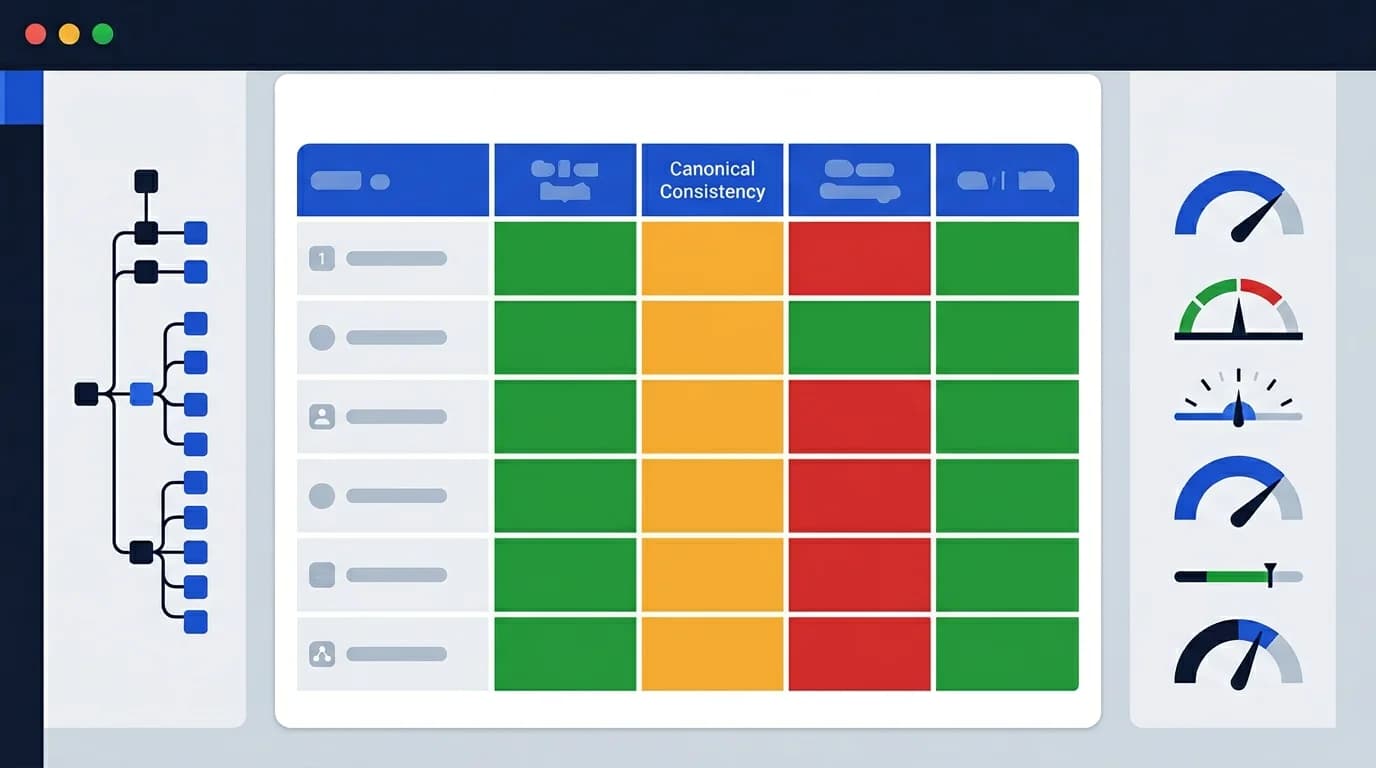
This guide explains how to build quality-control rules for programmatic SEO, how to decide which templates deserve indexation, and how engineering teams can keep large route inventories from collapsing under duplication, crawl inefficiency, and low-value page generation.
Programmatic SEO fails when template quality is judged too late
Many teams review quality after pages are already live. That is backwards. Programmatic SEO should be evaluated at the template and route-family level before the first large rollout.
That means checking:
- whether the page solves a distinct search intent
- whether the route has enough unique factual value
- whether the template can support stable canonical logic
- whether metadata, schema, and internal linking stay consistent across the family
- whether the first HTML response already exposes the core answer
If these questions are deferred until after launch, the site usually ends up publishing thousands of pages that later need to be pruned, canonicalized, or noindexed. Folding these checks into a broader technical SEO audit checklist keeps the governance consistent across template families.
Quality control should happen at the route-family level
The strongest teams do not approve pages one by one. They approve route families.
A route family is a set of URLs generated from the same content model and template logic, such as:
/services/{city}/compare/{tool-a}-vs-{tool-b}/category/{topic}/{subtopic}/locations/{city}/{service}
Why search systems evaluate route families as patterns
Search systems often evaluate these families as patterns. If one template produces many weak pages, that weakness tends to show up as a broad indexation problem. This is why programmatic work sits so close to why pages are crawled but not indexed and why pages are discovered but not crawled.
A page must earn indexation, not just exist
Programmatic systems are good at generating pages that technically exist but do not deserve to be indexed. A route should not be indexable simply because the CMS can assemble it.
What makes a programmatic page worth indexing
The better question is: what makes this page meaningfully different from its siblings?
A strong programmatic page usually includes:
- a distinct intent target
- unique supporting facts, entities, or comparisons
- a clear main answer visible before interaction
- route-specific internal links
- metadata and schema that describe the actual page, not a generic shell
If most of the content can be copied to another city, another tag, or another variant with almost no loss of meaning, the route probably has weak standalone value.
Canonical policy must be designed before scale
Canonical mistakes are one of the fastest ways to break programmatic SEO. Teams often create pages faster than they define preferred URL rules, which leads to collisions between:
- parameterized versions
- alternate path structures
- near-duplicate city or facet combinations
- paginated or sorted variants
- template states that share the same core intent
Why canonical logic belongs in template design
That is why canonical logic should be part of template design, not a cleanup step. If the family has weak canonical discipline, route growth turns into duplication growth. This is also where canonical issues on JavaScript websites becomes directly relevant, especially when the preferred URL is assembled dynamically.
Internal linking should confirm page importance
Programmatic pages should be linked according to importance, not just generated into existence.
Strong internal-linking policy usually means:
- important route families are reachable from indexable hubs
- sibling links reflect real user journeys rather than arbitrary cross-link stuffing
- deep pages have upward and lateral context
- weak or experimental routes are kept out of prominent crawl paths
If the site exposes every generated URL with the same linking weight, crawlers receive no meaningful prioritization signal. Large inventories like ecommerce category pages need editorial hierarchy even when the pages are programmatically assembled.
Sitemaps should include only routes that passed the threshold
One of the most common programmatic SEO mistakes is dumping every generated route into the XML sitemap. That tells crawlers the whole inventory is equally worthy, even when the family includes thin or uncertain pages.
A healthier approach is to treat sitemap inclusion as an approval state. Routes should usually be added only after they meet:
- quality requirements
- canonical stability
- content completeness
- render reliability
- internal-linking readiness
Why sitemap inclusion should be an approval state
This is why programmatic rollouts should stay aligned with the broader XML sitemap guide for technical SEO. Sitemap hygiene is part of quality control, not a separate operational task.
Rendering quality still matters in programmatic systems
Programmatic SEO often focuses on content templates, but rendering problems can quietly erase the value of the whole system. If critical copy, linked entities, or structured data appear only after hydration, crawlers may see a much weaker version of the route than the team expects.
That means launch review should include:
- raw HTML inspection
- prerender or SSR validation
- route-level schema checks
- metadata parity between templates and live output
- response testing across representative URL samples
Why rendering review belongs at template launch
For JavaScript-heavy stacks, this connects directly to Next.js rendering decisions for SEO and AI visibility and prerendering strategy.
Programmatic SEO needs kill criteria as much as launch criteria
Healthy template governance includes rules for stopping expansion. Teams often define when a route family should launch but forget to define when it should be paused, pruned, or noindexed.
Common kill criteria include:
- very low engagement across the family
- repeated crawled-but-not-indexed patterns
- canonical instability
- high duplication with nearby routes
- weak factual coverage that cannot be improved economically
Why kill criteria protect crawl attention
Without kill criteria, low-value families linger in the site architecture and keep consuming crawl attention long after the initial experiment has failed.
QA should sample the family, not only the best pages
Another common failure pattern is reviewing only the strongest examples. Programmatic QA should deliberately sample:
- high-volume routes
- low-volume routes
- long-tail combinations
- edge-case entity states
- pages with optional fields missing
This reveals whether the template stays coherent across messy real data. The goal is not to prove that the best page looks good. The goal is to prove that the family does not collapse under imperfect inputs.
A practical governance workflow for large sites
For most teams, a simple governance workflow works better than a giant theoretical framework:
- Define route families and their intended search jobs.
- Set minimum quality thresholds for uniqueness, answer depth, metadata, schema, and linking.
- Validate canonical and indexation rules before bulk publishing.
- Sample rendered output across the family, not only in staging demos.
- Launch only the routes that pass the threshold.
- Track crawl, indexation, and duplication outcomes by family.
- Pause or prune families that fail the economics or quality rules.
This kind of workflow turns programmatic SEO into a governed publishing system rather than a page factory.
Programmatic SEO works best when engineering and editorial review stay connected
The best programmatic systems are collaborative. Editorial strategy decides what deserves a page. Engineering makes sure the route can ship stable canonicals, machine-readable markup, and consistent rendered output. SEO operations decides which families belong in crawl paths and sitemaps.
When those functions split apart, quality drifts quickly. Pages may read acceptably in isolation while still failing as a technical template family.
Conclusion
Programmatic SEO is not mainly a scaling problem. It is a governance problem. Large websites win when they treat templates like products with launch criteria, kill criteria, and route-family QA.
The core principle is simple: do not index everything you can generate. Index only the families that repeatedly prove they are unique, technically stable, and worth crawler attention.
If your team is trying to scale programmatic routes without increasing duplication, crawl waste, or indexation loss, a technical SEO audit is often the fastest way to define thresholds before the inventory grows beyond control.
Content Cocoon
Programmatic SEO Quality Control Cluster
This article should connect programmatic template governance back to canonical policy, crawl efficiency, route-family quality thresholds, and the broader technical SEO systems that determine whether large-scale page generation creates visibility or noise.
Internal Pathways
Canonical Issues on JavaScript Websites
A companion article for understanding how template families often create duplicate preferred-URL problems at scale.
Why Pages Are Crawled but Not Indexed
Useful when programmatic routes are being fetched but still failing quality or uniqueness evaluation.
Faceted Navigation SEO for Large Websites
Relevant when filters, parameters, and route combinatorics overlap with programmatic template growth.
Technical SEO Audit
The parent service for teams reviewing large route inventories, rendering, indexation, and implementation quality together.
External Technical References
SEO Audit Tool
Helpful for reviewing route-level technical issues when large programmatic inventories need consistent validation.
Extract Sitemap Tool
Useful for checking whether only index-worthy programmatic routes are being exposed in sitemap inventories.
Crawler Checker
Helpful for validating whether template families expose stable crawler-visible HTML and response behavior.
Frequently Asked Questions
What is programmatic SEO quality control?+
It is the governance system that decides which template families deserve indexation, how they should handle canonicals and metadata, and when weak routes should be excluded, paused, or pruned.
Why do programmatic SEO pages often fail to index?+
They often fail because the route family is too thin, too duplicative, weakly linked, canonically unstable, or rendered poorly for crawlers across large samples of URLs.
Should every generated page go into the XML sitemap?+
No. Sitemap inclusion should usually be treated as an approval state for routes that already passed quality, canonical, and render-readiness thresholds.
What is the best level for QA: page or template?+
Both matter, but the highest leverage comes from route-family QA because search systems often evaluate large template patterns rather than isolated pages.