JavaScript SEO becomes critical when the content users see is not reliably available to crawlers in a deterministic HTML response. The promise of modern frontend frameworks, instant client-side navigation, dynamic content, slick interaction, collides with the simpler reality of how search and AI crawlers actually fetch pages. Most of them want HTML in the first response. Most JavaScript-heavy sites give them an empty <div id="root">.
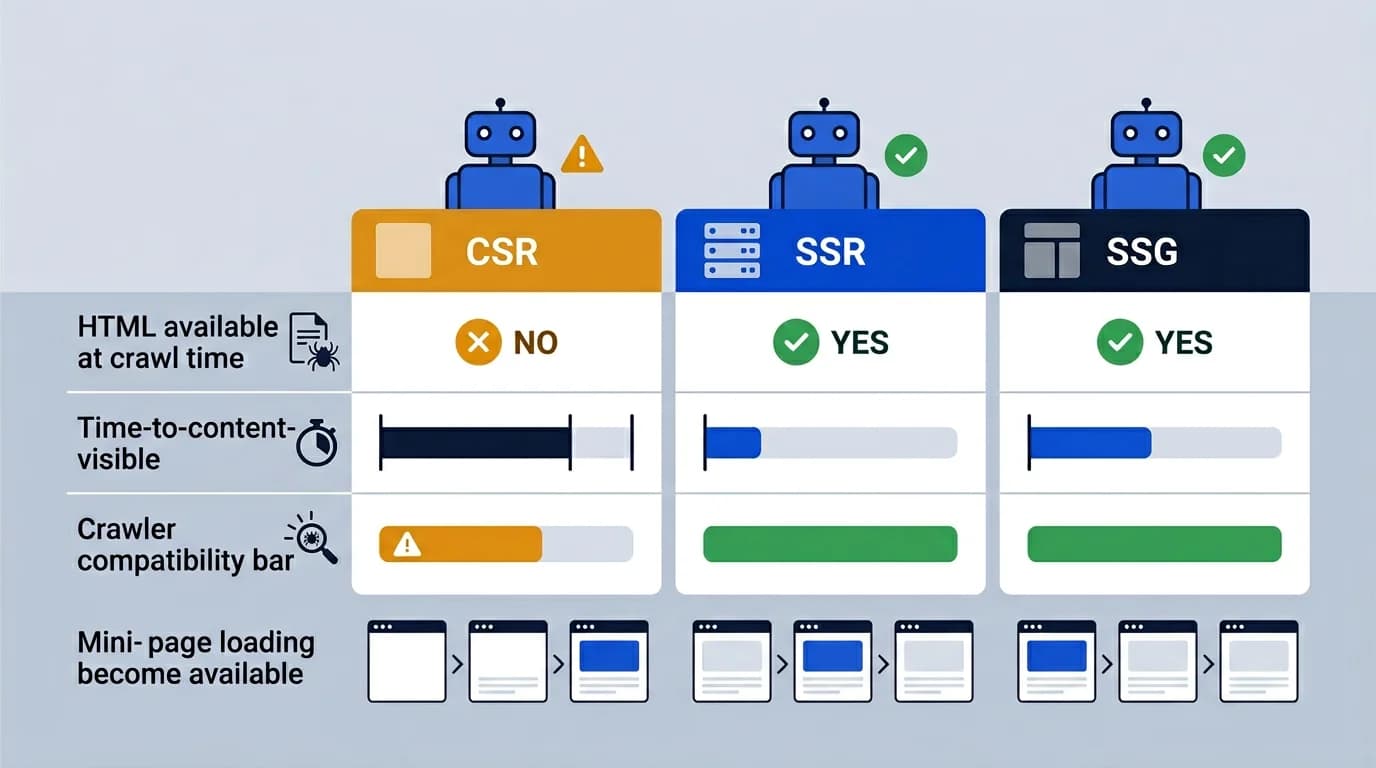
The reality of modern frontend stacks is that what looks complete in the browser is not always what the crawler receives. JavaScript SEO is the discipline of making sure rendering decisions, route discovery, and metadata stay reliable for search engines and answer engines under crawl conditions. As of April 2026, the guidance below reflects how Googlebot and the major AI crawlers are currently handling client-rendered routes in production, and it is increasingly less forgiving than the JS rendering era of 2020–2023. The framing pairs with the broader JavaScript SEO service, the technical SEO audit work, decisions about prerendering when the framework can't fully solve the problem, and the operational discipline covered in crawl budget optimization for JavaScript sites.
Where JavaScript SEO Usually Breaks
The most common failure mode is assuming that if a page looks complete in the browser, it is equally visible to search engines, an assumption Google explicitly warns against in its JavaScript SEO basics. That assumption breaks when essential content depends on hydration, delayed client-side requests, or route transitions that never produce a stable server response. Teams dealing with that pattern usually need a JavaScript SEO review before scaling more templates.
Single-page applications and hybrid frameworks often hide the real issue behind apparently healthy page loads. The problem only appears when crawlers fetch the route under stricter resource and timing constraints, and in 2026, that constraint is much tighter for AI crawlers than for Googlebot.
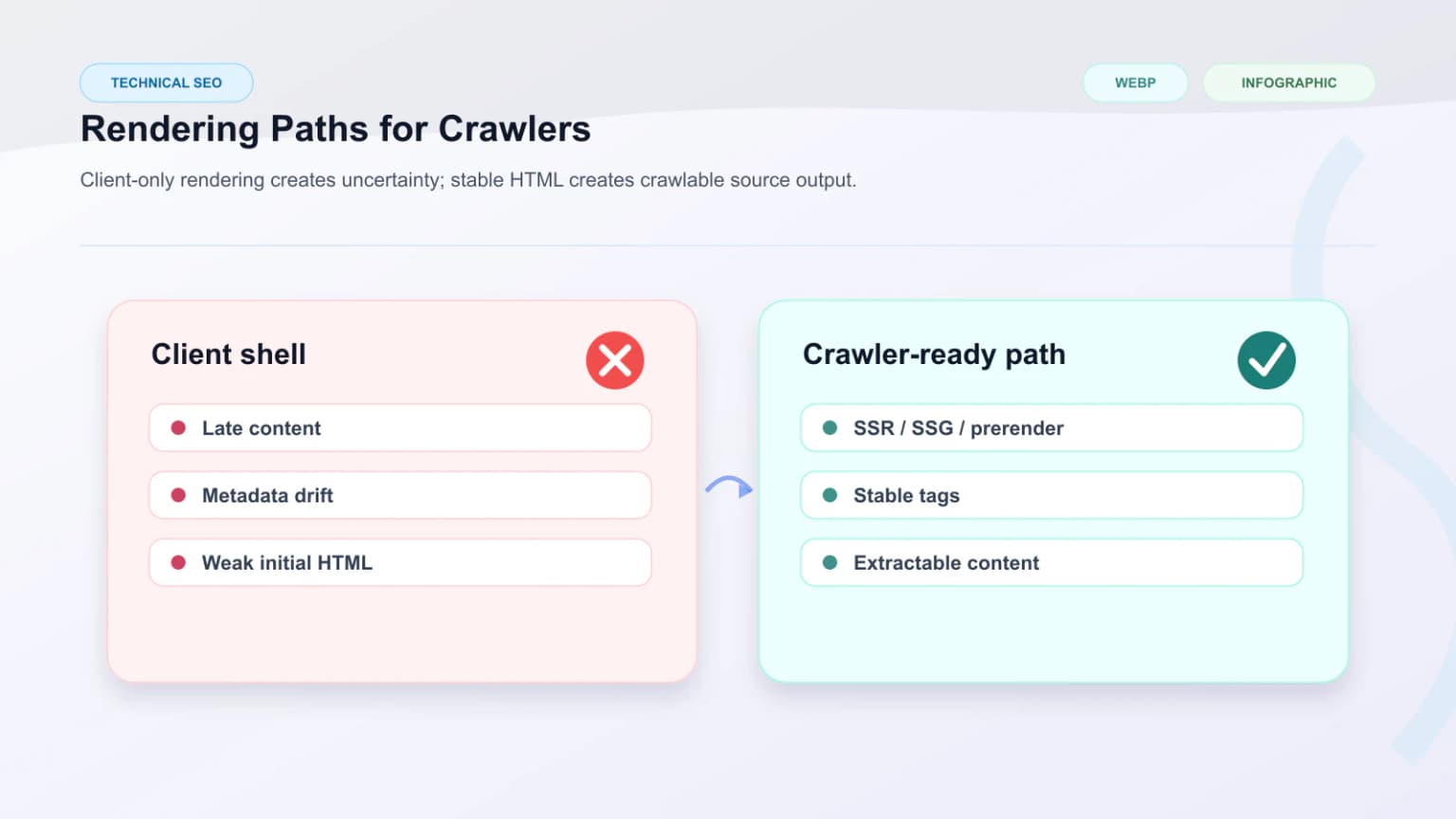
The five concrete failure modes we see most
Across recent audits, JavaScript SEO failures cluster into five patterns:
- Empty shell with client-side content,
<div id="root"></div>and the body fills via API calls inuseEffect. Visible to humans, invisible to most AI crawlers. - Hydration-dependent metadata, title, description, canonical, structured data set in
useEffector via client-side libraries. Bots that don't run JS see an empty<head>. - Route transitions that never re-render at the server, internal navigation works in the browser; direct fetches return the same skeletal HTML.
- Client-side data fetches that bypass the server, product detail pages where the title, price, and description come from a
fetchcall after first render. - Frameworks configured for SSR but shipping CSR by default, the framework supports SSR; the team's component patterns push every route into client mode.
The fifth pattern is the one teams rarely catch on their own. The framework's documentation describes SSR as "the default." The team's actual code uses 'use client' at the top of nearly every component. The result looks like SSR in name and behaves like CSR in production.
How to detect each failure quickly
The cheapest detection method is a curl-based first-response check:
curl -s -A "Mozilla/5.0 (compatible; Googlebot/2.1; +http://www.google.com/bot.html)" \
  https://example.com/your-product-page \
  | grep -E '<title>|description|canonical|application/ld\+json|<h1>'
If the response is missing the title, the canonical, the H1, or the structured data, even though the same fields appear in the browser DOM, the page is failing JavaScript SEO. The diagnostic flow is documented in how to test if your site needs prerendering.
Why Next.js Sites Still Have JavaScript SEO Risk
Framework choice does not remove technical SEO risk by itself. A Next.js site can still expose thin HTML, rely too heavily on client-side data fetching, or produce unstable metadata depending on how routes and templates are implemented. The transition from Pages Router to App Router introduced new defaults that are server-first, but the team's actual usage decides whether that default holds.
That is why JavaScript SEO audits must evaluate actual crawler-facing output, not framework branding. The question is whether the important content, metadata, and structure are visible at fetch time.
The 'use client' creep problem
The Next.js App Router defaults to Server Components. The path of least resistance for a feature dev under deadline is to add 'use client' at the top of a component to unblock interactivity, state, or a third-party library that doesn't work on the server. Each instance is a small decision; the cumulative effect over a year is a site that is server-rendered in name and client-rendered in practice.
We have audited Next.js sites where 70–90% of the rendered components were client components, meaning Server Components were a minority of the actual codebase despite the team being on the App Router. The Next.js rendering documentation explains the boundary clearly; the discipline of staying on the server side is something the team has to enforce in code review.
Pages Router specifics
Sites still on the Pages Router (getServerSideProps, getStaticProps) tend to ship complete HTML by default. Their failure modes are different:
getStaticPropswithrevalidate: 60running on a frequently-updated CMS with no on-demand revalidationgetServerSidePropsthat times out on slow upstream APIs_app.tsxwrappers that defer rendering to client-side providers- Custom 404 pages that hydrate from the client and confuse crawlers
The diagnostics are similar; the patterns vary by router. We covered the broader rendering picture in Next.js rendering decisions for SEO and AI visibility.
How to Decide Between SSR, Static, and Prerendering
The right rendering model depends on content freshness, route complexity, personalization boundaries, and the operational cost of maintaining the output, a tradeoff space mapped clearly in web.dev's rendering on the web overview and Next.js's own rendering documentation. Some sites need stronger SSR discipline. Others benefit more from prerendering selected routes for search-facing reliability.
The best decision usually comes from mapping which routes matter for discoverability and which rendering path gives crawlers the most stable result with the least operational drag. If your team needs help choosing, start with a technical SEO audit rather than guessing at architecture.
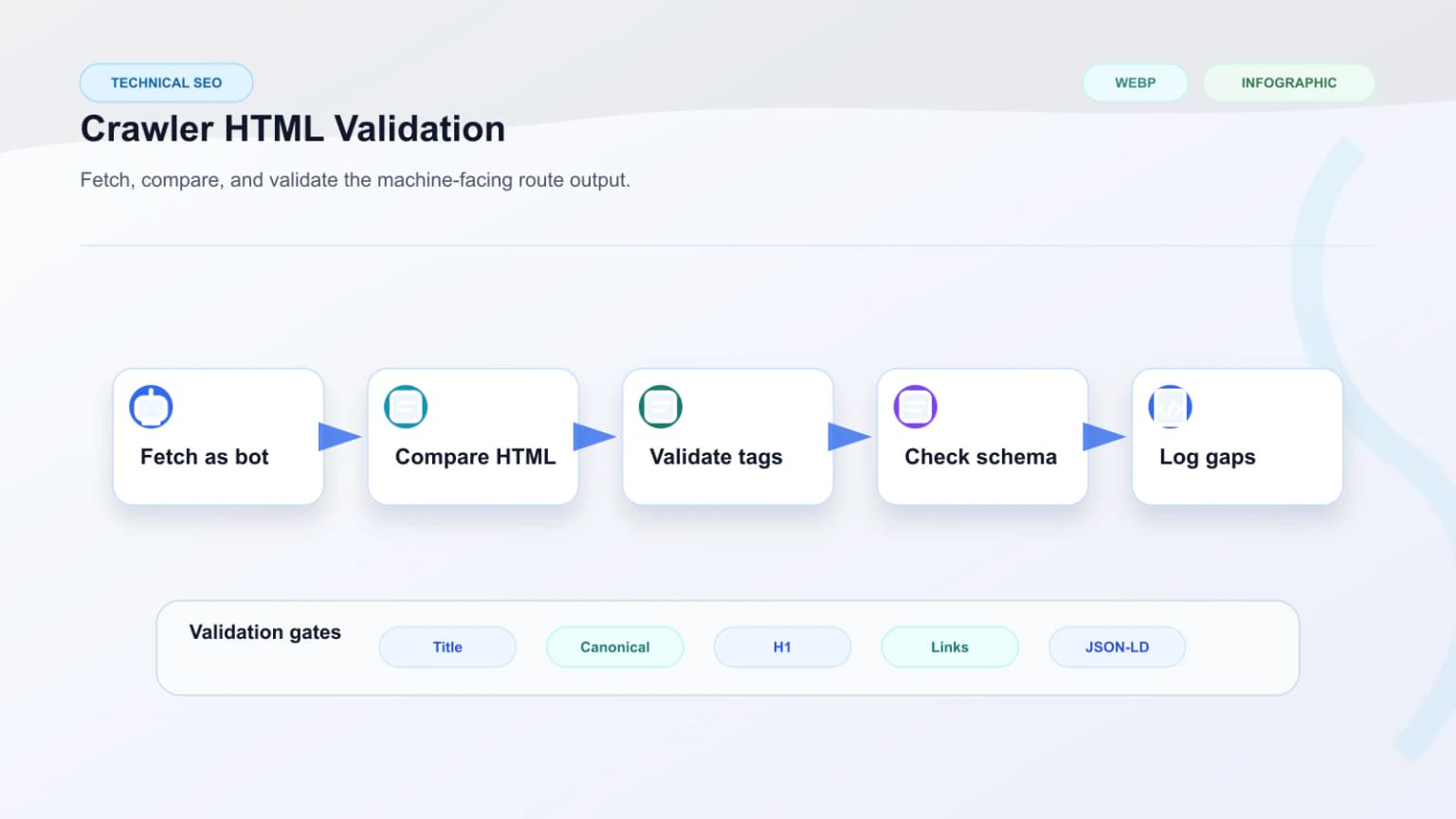
Decision matrix by route shape
| Route shape | Default model | Why |
|---|---|---|
| Marketing / landing pages | SSG or App Router Server Components | Pre-built HTML, fastest TTFB |
| Blog / docs / editorial | SSG or ISR | Cached static; ISR if frequent edits |
| Product detail pages (catalog) | ISR | Static cache + CMS-triggered revalidation |
| Listing / category pages with filters | SSR with edge cache | Per-request, parameterized |
| Authenticated dashboard | SSR or CSR | Out of crawl scope; SEO not relevant |
| Search results pages | SSR (no-index for most) | Dynamic; usually noindex anyway |
| Legacy SPA being incrementally migrated | Prerendering on top of SPA | Bridges crawler-facing HTML gap during migration |
The decision is not framework-locked. A Next.js site can ship SSG marketing, ISR catalog, SSR personalized routes, and prerendering for legacy sections, all in the same codebase. The framework comparison is in Next.js vs Remix vs Astro for SEO. The full rendering-model comparison is in prerendering vs SSR vs SSG.
When prerendering still earns its keep
Even on a well-configured Next.js site, prerendering can be the right answer for specific routes:
- The framework is doing its job, but a specific section uses a third-party widget that only renders client-side
- A migration from a legacy SPA is mid-flight and crawler-facing HTML for the old routes still needs to work
- The team needs deterministic output for AI crawlers (GPTBot, ClaudeBot, PerplexityBot) that don't execute JS
The prerendering for technical SEO article covers when to add the layer; the cost analysis is in build vs buy prerendering.
What to Fix First in JavaScript SEO
Start with routes that drive acquisition. Validate that essential content, metadata, canonicals, and structured data are present in the initial HTML response. Then review internal links, route discoverability, and crawl paths across the same templates.
Once the most valuable pages are stable, broader cleanup can focus on consistency across components, lower-value routes, and long-tail template patterns.
Priority order for fixes
We use this sequence on every JavaScript SEO engagement:
- First-response HTML completeness on top 20 templates, title, canonical, meta description, structured data, H1, body content, internal links visible to bots
- Canonical drift, covered in canonical issues on JavaScript websites. Hydration-driven canonical changes are silent rank killers.
- Structured data before hydration, JSON-LD must be in the first response, not added by client-side components. Patterns in structured data for AI visibility.
- Crawl paths visible without JS,
<a href="...">tags, not click handlers. Bots that don't run JS need real anchors. - Status codes correct for crawlers, 404s return 404 (not 200 with an error UI), redirects use 301, soft 404s eliminated. Covered in HTTP status codes for SEO and crawlers.
- Sitemap reflects actual indexable URL set, no orphans, no orphan-stale URLs, reflected via XML sitemap guide for technical SEO.
Items 1–3 fix the rendering layer. Items 4–6 fix the discovery layer. Both matter; the rendering fixes pay back faster.
What success looks like
A JavaScript SEO engagement is successful when:
- Curl-as-Googlebot returns complete HTML on the top 20 templates
- The same fetch returns identical title, canonical, and structured data as a human browser sees
- Search Console "Submitted and indexed" climbs above 85% over 4–8 weeks
- AI crawler reachability passes (GPTBot, ClaudeBot, PerplexityBot fetches show complete responses)
The diagnostic in how to test if your site needs prerendering is the same diagnostic you should run again after fixes ship.
Why JavaScript SEO Is an Engineering Problem First
JavaScript SEO is ultimately a delivery problem. Search visibility depends on whether systems expose reliable output under crawler conditions. That makes it a product and engineering concern as much as an SEO concern.
The sites that win are usually the ones where frontend, platform, and SEO stakeholders share the same model of what the crawler should receive. The model isn't complicated, "Googlebot, Bingbot, and the AI crawlers should receive HTML that contains our content, our canonical, and our structured data on the first request", but enforcing it requires code review discipline, not just SEO checklists.
Where SEO discipline lives in the engineering workflow
Three places where the team can keep JavaScript SEO from regressing:
- Pull request review, flag any new
'use client'on a route component; require justification - CI gates, a curl-as-Googlebot check on representative routes that fails the build if the title or canonical disappears, covered in Lighthouse CI for technical SEO validation
- Release QA, the route-family validation pattern in rendering QA checklist for SEO releases
The teams that bake these checks into the release pipeline catch JavaScript SEO regressions at PR review. The teams that rely on Search Console to surface them weeks later end up paying recovery costs that dwarf the prevention cost.
Common Engineering Mistakes
Patterns we see when JavaScript SEO regresses:
- Adding
'use client'to a marketing page component because a small interactive element needs state - Fetching the page title from an API in
useEffectand never setting it on the server - Treating Googlebot's JavaScript rendering as universal, it isn't, and AI crawlers don't render JS at all
- Setting canonical via
next/headinside a client component (it shows up only after hydration) - Configuring
next.config.jsfor SSR while every route file uses'use client' - Migrating to App Router and copying the old client-rendered patterns one-to-one
- Treating "the site renders fine in the browser" as evidence, bots see different output
- Skipping AI crawler testing entirely; assuming Google support equals AI engine support
The fix for most of these is the same: make rendering boundaries explicit, audit them at PR review, and validate them with curl in CI. The framework will not enforce this on its own.
Conclusion
For Next.js and SPA teams, JavaScript SEO is not about following a checklist of meta tags. It is about owning the rendering path end-to-end and proving the crawler-facing output is deterministic. The frameworks have improved every year, but the path of least resistance for product teams under deadline pressure still pushes toward client-side rendering, which is exactly where SEO and AI visibility break.
The teams that win treat JavaScript SEO as engineering discipline: explicit rendering decisions per route, code review that catches the drift, CI gates that fail on regressions, and audit cycles that verify what bots actually see. The framework is the chassis. The discipline is the team.
Content Cocoon
JavaScript SEO Editorial Cluster
This article belongs under the JavaScript SEO and rendering branch of the site. The best links here point readers toward service pages that solve the problem and deeper references that explain framework-specific rendering tradeoffs.
Internal Pathways
JavaScript SEO Service
The main service page for teams dealing with crawler-visible HTML and rendering reliability.
Prerendering
A related service when selective prerendering is the cleanest path to stable crawler output.
Technical SEO Audit
The parent diagnostic path when JavaScript rendering issues are part of a larger technical problem set.
External Technical References
Frequently Asked Questions
Does Google render JavaScript well enough now?+
Sometimes, but reliable SEO should not depend on optimistic assumptions about rendering quality when business-critical routes are involved.
Is prerendering always necessary?+
No. It is one of several technical options and should be chosen based on how the routes behave and what level of stability is required.